The blacksmith was an indispensable person, and there used to be several smithies in North Troms. Today there is only one smithy left in the area. Hans Erik Olsen from Kåfjord forges knife blades, nails, tools, axes, hinges and more, the old-fashioned way.
Published: 23.11.2016
Text and photos: Torun Olsen
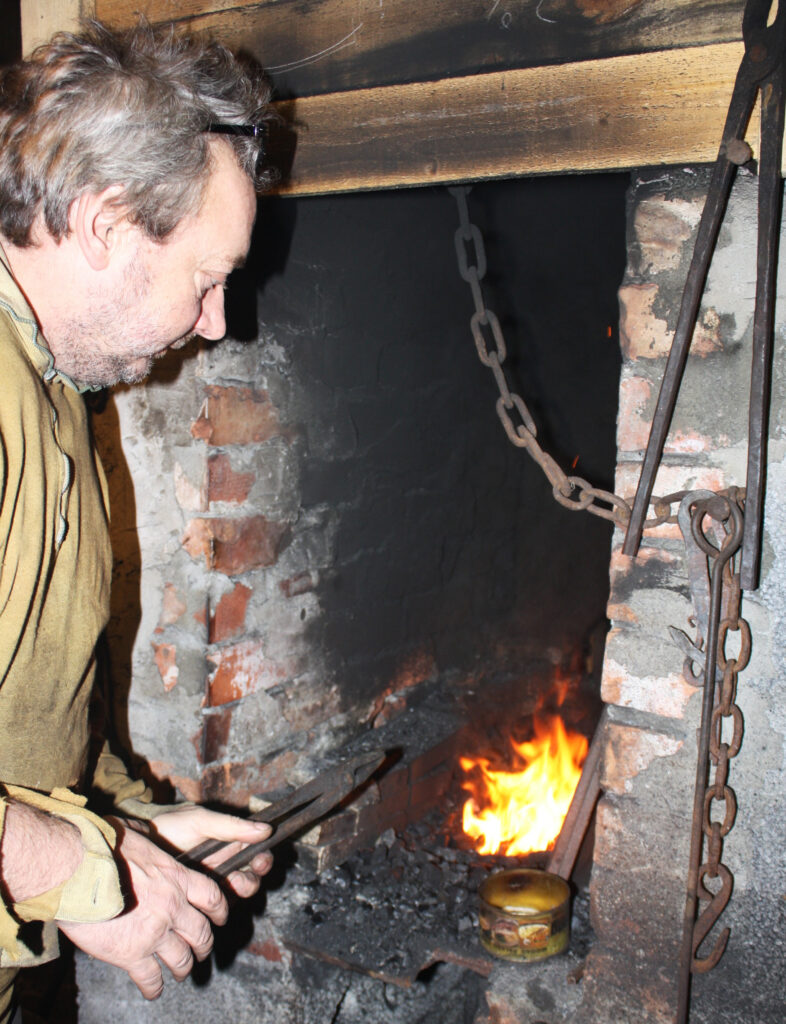
– This is not something you can live off, says Hans Erik Olsen from Birtavarre in Kåfjord, as he fires up the forge, or "avlen" as he prefers to call the hearth, which is the very heart of the smithy.
For twenty years, blacksmithing has been his passion, and in 2013, he built his own forge in his hometown of Birtavarre.
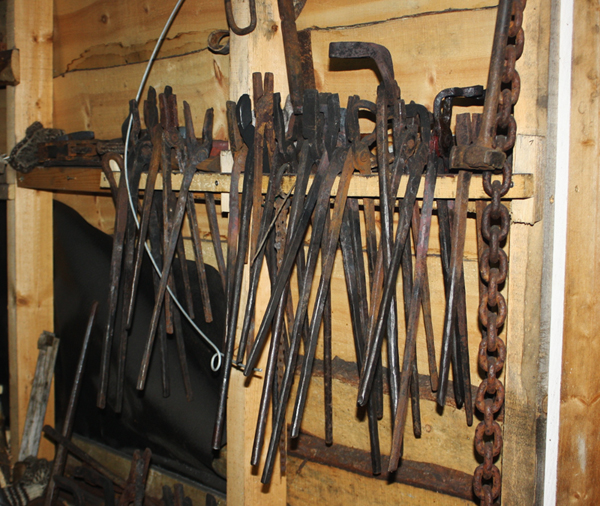
On the wall hangs a whole row of tools used in the forge, and scattered around are axes, knife blades, and nails. All produced in the forge by Hans himself.
– My interest in blacksmithing came about when I was a student at Fosen Folk High School about 20 years ago.
Since then, he has practised the blacksmithing trade, both as a hobby and as a side business. In addition, he works at the Nord-Troms Museum, where he both holds courses in blacksmithing and exhibits products made in the forge.
The craft of blacksmithing is very old. The art was seen as magical, and the blacksmith often held a high status in society. Beautiful objects were made in the smithies, not least tools and other items that were absolutely necessary in daily work.
Today there are few blacksmiths left, and even fewer who work with the old forging techniques, like Hans does.
Never stop learning
Although Hans holds courses for willing learners, he believes that art takes a long time to learn.
– I've been working for 20 years, but I don't feel like I'm nearly done learning. I'm still learning new things all the time, says Hans.
The forge is fired up with wood or coal. The iron or steel is heated here to the correct temperature before it can be worked. In the first part of the process, the steel is to be welded and worked well together. The steel is heated, hammered. This must be repeated until the weld is properly set.
After that, the knife blade can be forged. The anvil is used extensively here and must be forged until the blade is thin enough.
The steel is then hardened. This process ensures the steel achieves the correct hardness, making the knife sharp. In this process, oil or water is often used to rapidly cool the steel. Temperature is also very important here. The steel must be heated to the hardening temperature. The hot steel is then quickly dipped into the liquid. This will change the structure of the steel.
Secret
It is the hardening that is the very core of tool making, and which made blacksmiths proper craftsmen.
In the past, this is where the secret lay. All blacksmiths had their own secret recipe, which they didn't share with anyone other than their very closest, often father to son. No one was allowed into the forge when this work was taking place. The common man didn't understand this process, and the blacksmiths gained a reputation for being able to do most things, says Hans.
He himself has no secrets. That's not necessary these days.
– Today, the process can be explained with the help of natural science. Previously, people didn't understand what was happening inside the steel, that it was changing structure, says Hans.
Hans uses his finger to check the temperature of the oil. In his day, not just anyone could do this without incurring the blacksmith master's displeasure.
- A Japanese apprentice tried it once, and the poor chap had his finger chopped off, according to an urban legend.
The shade dampens Hans' light, so that it will be easier to see the temperature from the colour of the steel.
He demonstrates it all by heating the steel, then quickly dipping it into the bucket of oil. Finally, there are a few rounds of re-hardening and tempering, before the knife blade has the correct structure and hardness, and is ready for sharpening and use.