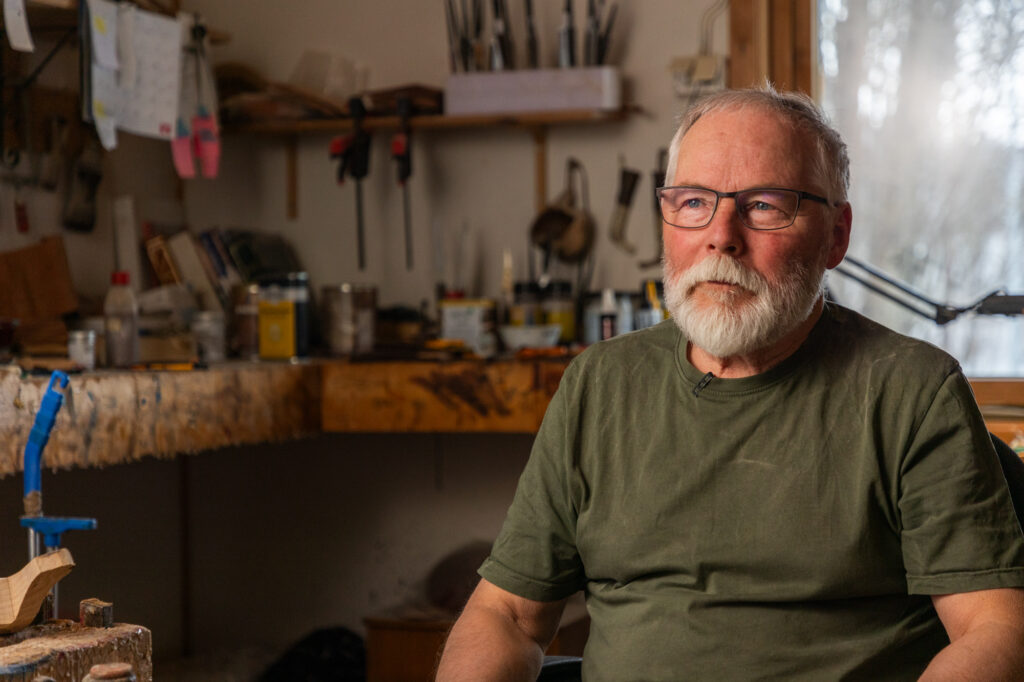
Håvard Larsen, was born in Kvænangen in 1955 and currently lives in Storsteinnes in Balsfjord. In January 2025, he turned 70 years old and has had an eventful career spanning four decades. This article is a brief biography of Larsen, scratching the surface of his 40 years as a duojár. The text is intended to provide insight into his work to become one of the most recognised duojárat on the Norwegian side of Sápmi. It must also be said that Håvard Larsen is still active as a performing duojár in Sápmi to this day.
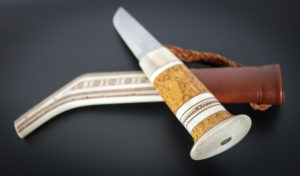
Larsen is best known for his knives forged in the Sami tradition. The knives are often highlighted for continuing the Sámi knife traditions, and are well-recognised having received a number of awards from several high-ranking award ceremonies. A distinctive skill in his work is that he can also forge his own knife blades. He is also well known for producing a wide range of duodji artefacts, such as náhppi, drums and guksi (etc.). Throughout his career, he has developed an understanding of materials and skills focussing on traditional materials such as wood, horn, leather and metal.
Håvard Larsen's childhood
Larsen's childhood is linked to the Sea Sámi area of Kvænangen in northern Troms. Like other Sea Sami areas, Kvænangen was also characterised by the Norwegianisation policy and there were major breaks in the continuation of Sami traditional knowledge. This had an impact, as Larsen himself describes it, where he had to look beyond his home area to acquire knowledge of garra duodji. He travelled to acquaintances and to duodji exhibitions in several places in Sápmi to learn more about duodji. Larsen explains that he has built up his expertise through trials and tribulations, both good and bad, and characterises himself as being mostly self-taught in his practice.
Duodji from the start
In 1985, Larsen began his craftsmanship as both a preparer and a duodji practitioner. By 1991, the demand for his duodji products was already in high demand. This meant that he could focus on his own production and thus no longer needed to work as a preparant. Since then, Larsen has been purchased by both private collectors and public purchasing schemes such as KORO and the Sami collections.
One example of this is a duodji competition organised in 2000 by the Varanger Sami Museum's duodji collection (VSM), where they purchased knife with sheath (inventory number: VSM.00620-1), and salt bottle (VSM.00620-2). Another duodji work worth noting is Náhppi, 1999 (KORO.004168). This work is part of the Sami Parliament's decoration, placed on a meeting room table in one of their meeting rooms. It should also be noted that King Olav himself received a horn knife during the opening of the Sami Parliament in 1989. A few years later, in 1994, Queen Sonja received a similar knife when she visited the Harstad Festival. No less important was the milestone when Larsen became the first person in the Nordic region to emboss postal stamps with the motif of one of his horn knives.
Artistic work in exhibitions
Furthermore, Larsen's artistic work extends beyond traditional duodji; he also applies his traditional knowledge to dáidda. Larsen has, among other things, explored expressions in sculptures and watercolours. Sculpture Melt (The Watcher), 1996, purchased by Troms County Council's art collection is one such example. In the exhibition Time for Sculpture #1 - Muoras - árdnan, 2019, the sculpture Sweetness (Lust), 1996, exhibited alongside some of the most recognised artists in Sápmi, such as Iver Jåks and Aage Gaup.
Both his traditional duodji and dáidda works have been exhibited at home and abroad throughout his career. For example, Larsen participated with the work Untitled, 1992- Sami drum, in the group exhibition House of Norway, shown at the prestigious Museum Angewandte Kunst in Frankfurt am Main, in connection with Norway being the guest country at the international book fair in 2019-2020.
Håvard Larsen is now part of the travelling exhibition RUOKTOT - Bringing back Sami drums (2024-2025), a project with cultural-political and symbolic weight. The exhibition is produced by RiddoDuottarMuseat (RDM) to mark the 50th anniversary of The Sami Collections, which was established in 1972. The drum shown in the House of Norway exhibition is the same one featured in RUOKTOT, now with the description/title Drum (Goavddis), 1992.
A life as a duojár
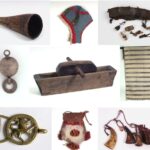
From Larsen's 40 years as a duojár, the Centre for Northern Peoples / Davvi álbmogiid guovddáš has acquired two private collections of his work. The collection currently housed at DÁG shows a significant part of Larsen's work and consists of 69 artefacts. At the same time, it is important to emphasise that the collection of Håvard Larsen as a whole is a modest number when you consider the 40 years of production that Larsen has had as his main work. Throughout Larsen's work, we see traditional values that preserve the characteristics and functionality of duodji, where utility and purpose are central.
Larsen's duodji is based on both traditional materials and a strong emphasis on traditional use and form. At the centre of Larsen's dáidda works is also the use of traditional materials. At the same time, both his duodji and dáidda works are set in contexts that explore Sea Sámi and Sámi perspectives, be it the knife motif on the stamp, sculptures made of wooden materials, or drums in exhibitions at home and abroad.
Seen in the light of Sami tradition, where functionality, choice of materials and form are the prerequisites for duodji, Larsen has in many ways helped to make Sea Sami garra-duodji visible. His work over 40 years and up to the present day helps to ensure that Sea Sami garra duodji remains a living cultural heritage. At his workshop in Balsfjord, he works continuously to further develop the duodji tradition, guksi by guksi and knife by knife, and is thus an important bearer of tradition in Sápmi and for Sea Sami cultural heritage. Something we are all grateful for.

Collectors
The role of collectors in the museum sector has always been central. They not only build up collections and institutions, but also provide museums with rare artefacts and invaluable professional insight - resources that can otherwise be difficult to find in a busy museum environment. Collectors also act as important links, bringing museums closer to both artists and other members of the collecting community.
Thanks to two committed and dedicated collectors, Kjell Erik Sørum and Per Gamborg-Nielsen, we had the opportunity to start this project documenting Håvard Larsen's life and work as a duojár. Håvard Larsen has lived from duodji production all his adult life. His knives, guksi, bowls and other artefacts have been sought after far beyond the local community for many decades.
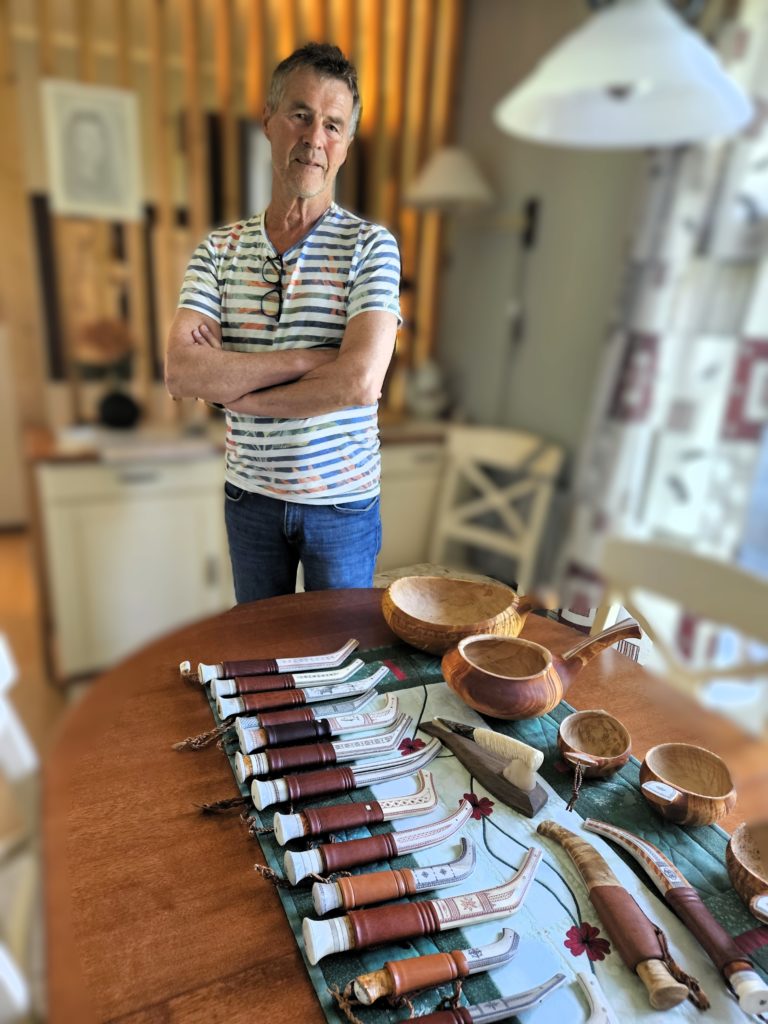
Gathering a representative selection of his work would have been almost impossible without Sørum and Gamborg-Nielsen's enthusiasm and efforts.
Kjell Erik Sørum, who lives in Storsteinnes, not far from Håvard Larsen, has visited the workshop countless times. He has seen Larsen at work, felt the materials, and realised which objects truly represent his artistry. Many of the artefacts in Sørum's collection have been carefully selected for both technique and aesthetics - and often with a story attached to the production process.
Per Gamborg-Nielsen, who lives in Roa, a few kilometres north of Oslo, has had a lifelong fascination with knives.
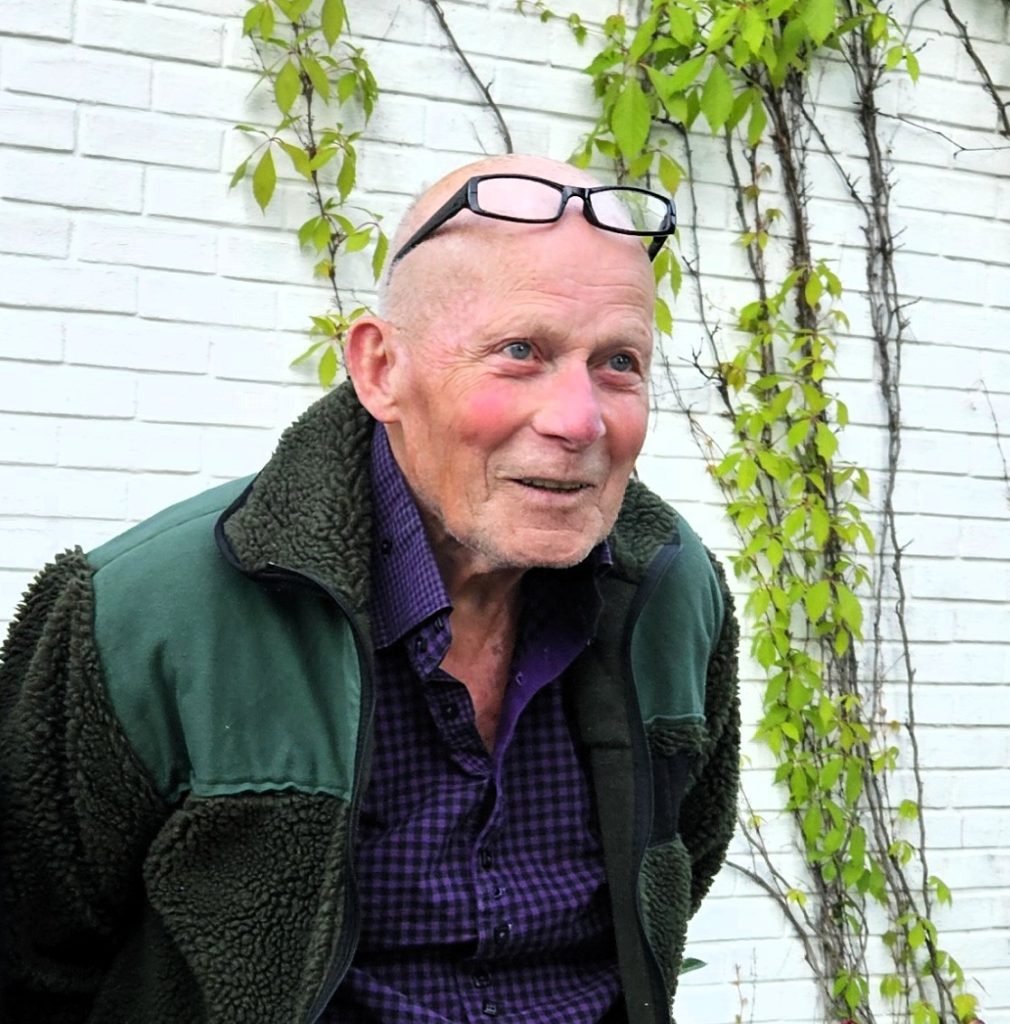
His interest goes far beyond collecting; he has followed the development of Larsen's knife production over the years, and with his keen eye he has made sure to preserve many examples of the artist's most characteristic work. Gamborg-Nielsen has also had a special interest in knife blades, an interest he has shared with Håvard Larsen.
Together, these two collectors have preserved artefacts from more than 40 years of Larsen's career - knives, guksi, bowls and other duodji products that together provide a broad and representative picture of his production. This is a rare opportunity: rarely do you get access to a collection of such high quality and scope, where each object carries with it both craftsmanship and history.
Thanks to Sørum and Gamborg-Nielsen, we can now present Håvard Larsen's duodji career in a way that can be explored, learnt from and enjoyed by researchers, art enthusiasts and the public alike. At the same time, it demonstrates the invaluable role collectors play in preserving cultural heritage and connecting people, stories and crafts across generations.
Articles about Håvard Larsen
The artist was in tears when he saw the collection Svein and Lisa got hold of - framtidinord.no
Badjel 1.3 miljovnna ruvnno sámi kulturdoaimmaide ja -prošeavttaide - Sametinget
Exhibiting Sami crafts - framtidinord.no
FACTS ABOUT HÅVARD LARSEN
- Duojár, photographer, artist
- Born in Kvænangen in 1955
- Lives in Storsteinnes, Balsfjord
- Working with Sami crafts for four decades
- Recognised duojár
Watch the film «A Year with the artist Håvard Larsen" here: