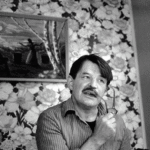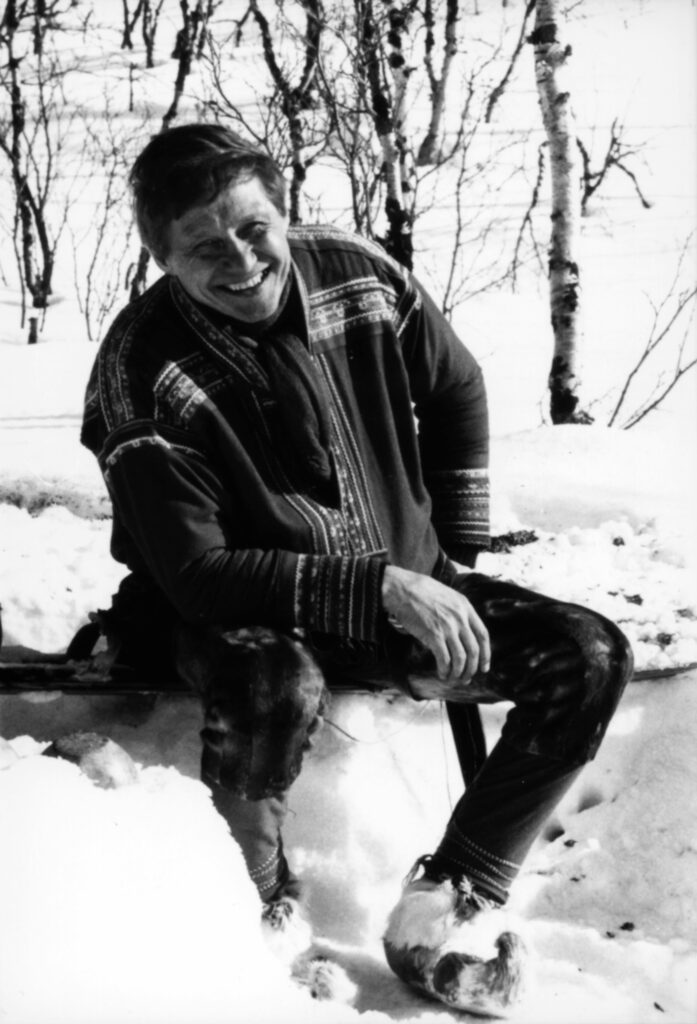
Nils-Aslak Valkeapää, also known as Áillohaš, is one of the foremost and most pioneering Sámi artists of all time. Valkeapää saw everything as a unity, and was keen for Sámi culture to be in constant development. He blurred the boundaries between genres and peoples, combining poetry, joik and visual art into a powerful whole.
Sámi multi-artist Nils-Aslak Valkeapää grew up in a reindeer-herding family in Beattet/Pättikä in Finland. The last years of his life he lived in Skibotn in North Troms.
Valkeapää's artistic career began in the 1960s with joik and music. He was concerned that joik should not become a museum artefact, but be further developed and brought to the public. At a time when joik could only be heard in close circles, and was seen by many as a sin, this did not happen without resistance. In 1968, Valkeapäa released his first album «Yikuja,» in which he combined the joik with instruments and sound effects, something that had never been done before. The release attracted attention and anger in many circles, but also gave him star status, especially among the younger generation in Sápmi.

"Joik is the folk music of the Sami. It's free, and you can do almost anything you want. It has no beginning and no end. It just is..
Nils-Aslak Valkeapää
By combining joik with modern instruments and popular music, Valkeapäa ensured that joik was brought out into the public sphere and became an art form both in concert and on disc. He continued to experiment, drawing inspiration from jazz, classical and music from other parts of the world. Together with Finland's foremost jazz musicians: Seppo Pakunainen and Esa Kotilainen, he released several albums, including “Sami eatnan duottariid” in 1978. The title track is often referred to as Sápmi's second national song.
Valkeapää's innovative music was seen and recognised far beyond the country's borders. The so-called bird symphony, Goase dušše, was awarded the jury's special prize in the international radio competition Prix Italia in 1993.
The author Valkeapää
Valkeapäa made his debut as an author with “Terveisiä Lapista” (Helsing från Sameland) in 1971. In the book, he confronts the West and the abuses and prejudices to which the Sami people are subjected.
The message of nature, indigenous thinking and worldview are recurring themes in Valkeapää's work. His greatest recognition as a poet came when he was awarded the Nordic Council Literature Prize in 1991 for his book Beaivi áhčážan / The sun, my father. A work that, through poetry and photographs, provides a unique insight into Sámi and indigenous culture, language and sense of nature. He caused a stir when he unfurled the Sami flag during the award ceremony and accused the Nordic states of not wanting to let the Sami into the Nordic Council.
Valkeapää published a number of poetry collections. The most recent Eanni eannážan / Earth my mother, was published in 2001. Here he speaks to all the world's indigenous peoples. He sees himself as a guest on earth, and visits his brothers and sisters in other parts of the world. In the book, the voice of the indigenous peoples is expressed in poems and images, shedding light on their place in the world.

when I was a child
I wonder
why I didn't have wings
like other birds
and if I am no longer a child
it still amazes me
Nils-Aslak Valkeapää, from Beaivi áhčážan / The sun, my father, 1990
In 1994, Valkeapää performed at the opening of the Olympic Games in Lillehammer. The joik he performed was created especially for the occasion, and was later released on disc.
Valkeapää dedicated his art primarily to the Sámi people, but also to indigenous peoples around the world. All his books of poetry have been published in Sámi, and several have been translated into a number of languages, including English, German, French, Japanese, Faroese, Norwegian and Swedish.
I believe that Sami is one of the finest languages in the world. It's made to express itself lyrically. Sami has many beautiful words. A single word can be a poem. As a poet, I feel that the language is a great help, because it is a poem in itself. Sami is also important in music. It sounds uninterrupted, it's like listening to music.
Nils-Aslak Valkeapää
The multi-artist
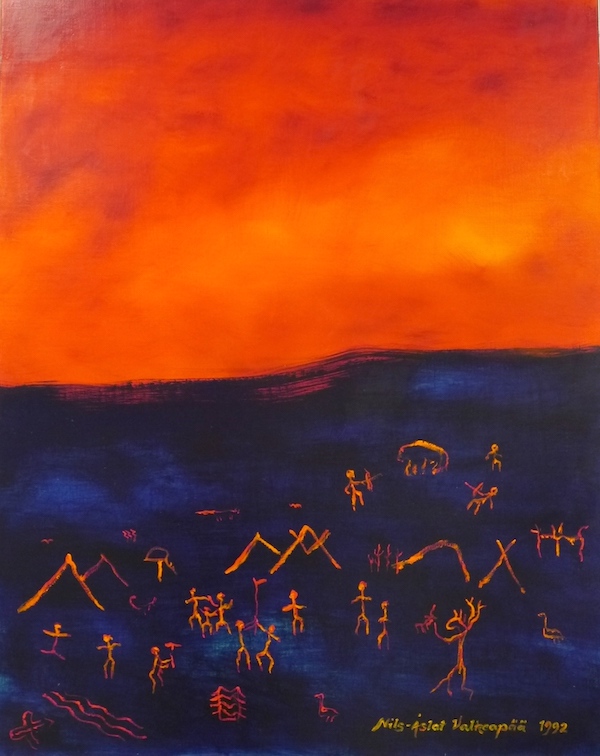
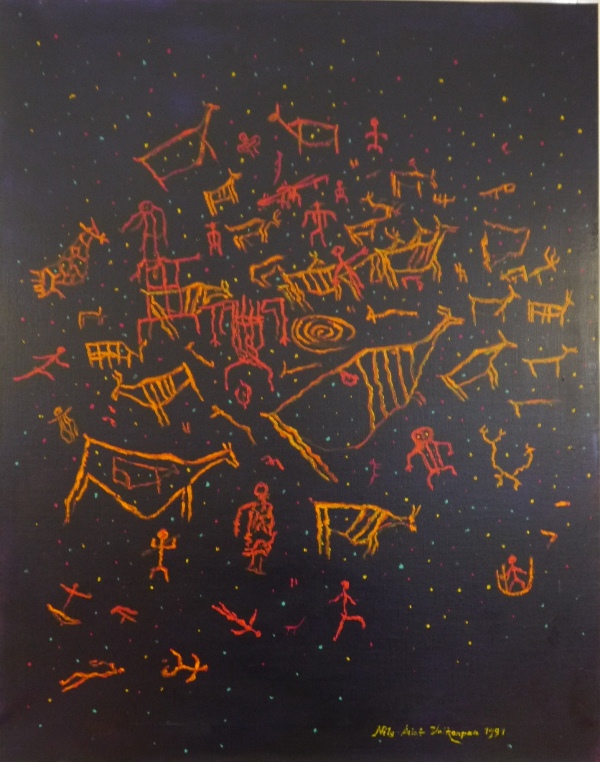
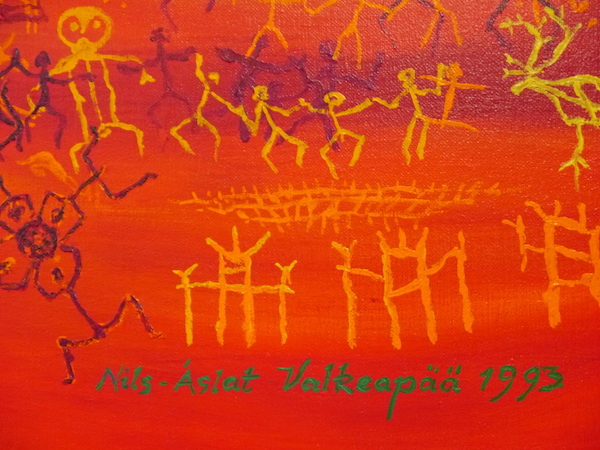
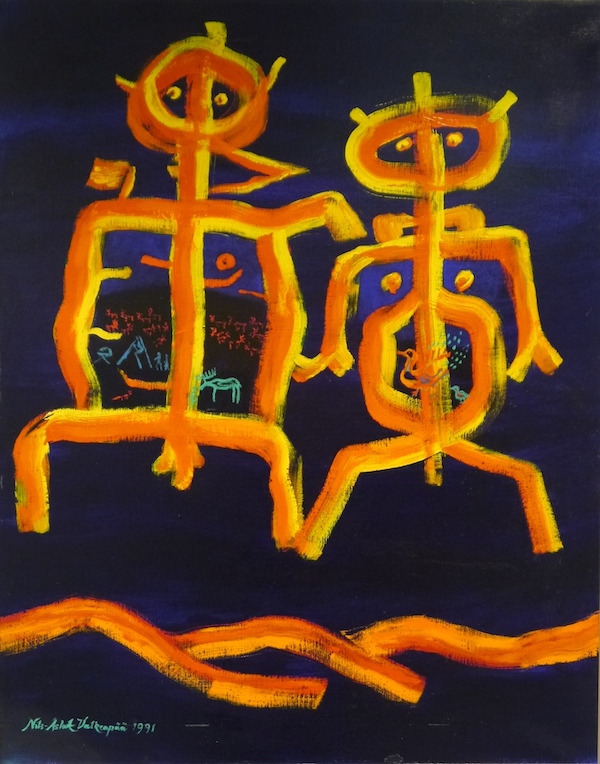
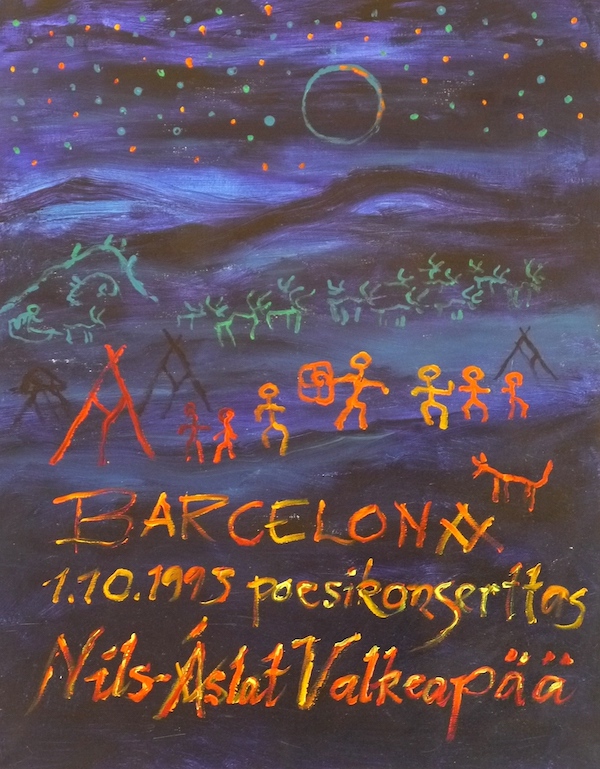
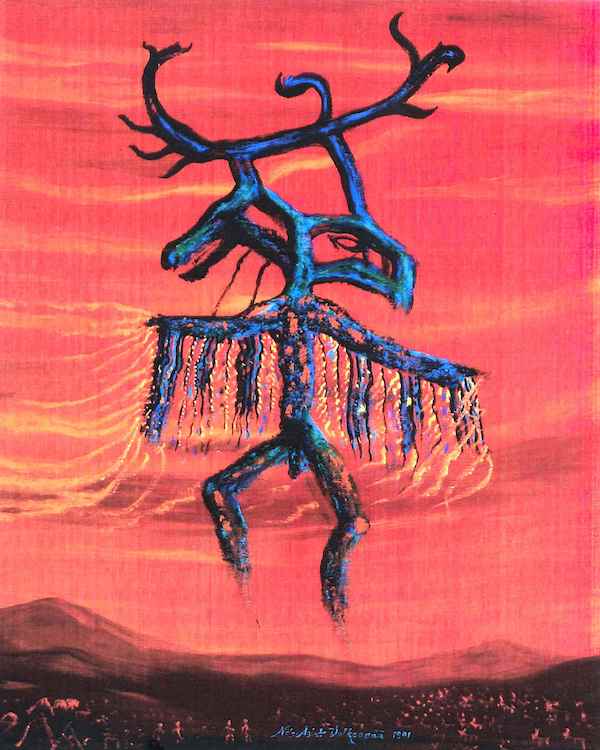
Valkeapää not only distinguished himself as a musician and poet. He is known for his paintings, whose motifs are often linked to ancient Sami traditions. He participated with drawings and paintings in exhibitions around the world.
He was also a sculptor, photographer, essayist, playwright and actor. In the Oscar-nominated film Ofelaš (The Wizard) from 1987, Valkeapää played the leader of the siida - Siiddaisit. He also composed the opening melody for the film.
Valkeapää's many talents and unique charisma made him a leading star not only in Sápmi, but also among indigenous peoples worldwide. He was the cultural coordinator of WCIP (World Council of Indigenous Peoples) 1978-81. He visited other indigenous peoples around the world and initiated the first festival of indigenous art and culture, Davvi Šuvva in 1979.
"I've deliberately chosen places that I feel harmonise with my ideas to a certain extent. That's why it doesn't matter much to me whether I'm in Paris or New York. It's still so different. And what I do is different for them.
I'd rather travel to the Indians in Peru, to Greenland, Siberia, or places where I don't have to explain why I do such stupid things.Nils-Aslak Valkeapää
Inspirers
For Valkeapää, it was important for Sami artists to organise themselves, and he played a key role in establishing the Sami Writers' Association. He also initiated the foundation of the Sami Artists' Association, of which he was also an honorary member.
In 1996, Valkeapää was involved in a car accident not far from his home in Beattet/Pättikä. He fought his way back to his feet and realised his dream of settling down by the fjord when he built the house Lásságámmi / Svaberggammen in Skibotn. The land was given to him as a gift from Storfjord municipality when he turned 50.
Valkeapää died in November 2001 after a long journey in Japan. He is buried in Birtavarre in Kåfjord.
Valkeapää's groundbreaking approach to art has given him a very special status in Sami and Nordic cultural life. His strong voice can still be heard, and his philosophy and multimedia art productions operate in ever new contexts. His art is used as a reference and inspiration for Sámi artists, cultural workers, activists, researchers and others.




Nils-Aslak Valkeapää on Spotify
Nils-Aslak Valkeapää's books, National Car Library
Beaivi, áhčážan, Nils-Aslak Valkeapää, 1991
The sun, my father, Nils-Aslak Valkeapää, 1991
The sun, my fathter, Nils-Aslak Valkeapää
Helsing from Sameland, Nils-Aslak Valkeapää, 1979
Ruoktu váimmus, Nils-Aslak Valkeapää,1985
Girddán, seivvodan, Nils-Aslak Valkeapää, 1999
Jus gazzebiehtár bohkosivččii, Nils-Aslak Valkeapää, 1996
The Ways of the Wind, Nils-Aslak Valkeapää, 1990, translated by Laila Stien
Nu guhkkin dat mii lahka, Nils-Aslak Valkeapää
Current links
Áillohaš - The Sami guide (1943 -2001), NRK 2021
Nils Aslak Valkeapää: Indigenous voice and multimedia artist, Harald Gaski, pdf
Lásságámmi, the foundation that manages the legacy of Nils-Aslak Valkeapää
Nils-Aslak Valkeapää - a humble Sámi voice in the world, lassagammi.no
Nils-Aslak Valkeapää, Norwegian Biographical Encyclopaedia
Nils-Aslak Valkeapää, Troms County Council
Are we the same tomorrow, NRK 2011
Listen - the windpipe sings, Northern Lights 2013
- Such a great multi-artist must be remembered often, NRK Sápmi 2014
The sun's son is gone, Tromsø, Dagbladet 2001
An unknown Valkeapää, Nordlys 2018
A Sami mainstay has passed away, Nordlys 2001