Joik is the traditional song of the Sami people, and joiking is their traditional way of singing. The word joik comes from the Sami verb ”juoigat”, which means to joike. The joik tradition is an old one, and is considered one of the oldest vocal traditions in Europe.
Today, traditional joik is performed without the use of instruments. Usually the melody is the key element in joik, along with rhythm and beat, and thus the most important characteristic of a joik. But in some Sami areas, the joik text is essential to include. All joiks must contain the name of the object - the person being described in the joik melody. In some areas, it is also common to use more joik text than in other areas. The text adds extra meaning to the joke and is included in the description of the joke, in addition to the joke melody. It's common to say that you're joking about an object, such as a person, an animal or a landscape, instead of saying that you're joking about someone or something.
A joik melody is not divided into verses, as we know it from ordinary songs. The joik melody runs in a circle, which can be long or short. That's why you could say that a joik never ends!
Different types of joik
We have different types of joik, and today we distinguish between people, animals and nature.
Personjoik is a personalised joik melody, often with joik lyrics made for a special person.
Joik can be perceived as an extra name for the person being joked about. The nature (personality) and characteristics of the person are portrayed with the help of rhythm, beat, melody and text. Personal jokes usually only describe positive features of the person. Hearing your own joik is perceived as a compliment and makes you happy. When we say that we joik someone, this is the same as referring to the person by name. When we joik someone, we refer to them by a tone or melody name, which is a joik. We're not saying that we're telling the person's name, but we're saying what the person's name is. Therefore, it is not common to say that you joke about someone.
Personjoik
Getting your own joik is seen as an honour, and you can also give a joik as a gift, for example as a wedding present.
In earlier times, almost everyone had their own joik. Often you had your own children's joik, called ”dovdna” (North Sami). When you grew up, around confirmation age, you were given an adult joik. Either the children's joik was adapted to an adult joik, or you were given a completely new adult joik.
Joik can be used to describe emotions, and to commemorate something, or remember someone, or honour something or someone.
A animal yoke describes with the help of the melody the characteristics of an animal. Such as how an animal moves, whether it is big or small, and so on. Animal yodels are also used to encourage an animal, such as a shepherd dog that has done well, or a carriage that might run faster when it hears its own yodel.
A nature joik, or landscape joik, can describe a mountain, a reindeer grazing district, or a season such as a cold spring winter.
Joike variations
There are different ways of joking and different ways of using your voice. We could say that there are different dialects of joik, which can sound very different, for example, North Sami and South Sami joiks sound very different.
As a result of the Norwegianisation policy, joik has disappeared from some areas, including the Sea Sami area in Troms County.
Each person has their own personal way of joking, and two people can joi the same joik in different ways, even if they perform the same joik melody. You should still be able to hear that these people are performing the same joik in their own way, and the joik must not change so much that it is no longer the same joik.
The use of joik
Joik was more widespread in the past and was used in the daily lives of the Sami. As mentioned earlier, most people had their own joik, which was an important part of their identity. The same person could also have several joiks.
Joik was previously used in the pre-Christian Sámi nature religion, including the shaman's use of joik and rune boom during ceremonies. There were also long epic joiks or narrative joiks - which could tell an entire life story or the history of a ”siida” (Sámi settlement unit) through generations.
The missionaries who were to Christianise the Sami banned joik because they claimed that it was a ”sin” to joik. One reason was that joik was used in the old, pre-Christian religion, another reason was the suppression of the Sami culture by society at large and the desire to Norwegianise the Sami. This led to the disappearance of the joik from many areas.
In the past, children and young people learnt joik naturally in their local communities and grew up listening to adults and elders joik. Today, it is no longer the case that all children and young people have the opportunity to hear and learn joik at home, and it has become more common to teach joik in schools, at joik courses and workshops. In this way, young people who wouldn't otherwise have learnt about joik or learned to joik have the opportunity to do so. In this way, an important Sami cultural heritage is preserved for the future.
Fun aspects of using joik
In the past, joik was used for flirting. It was common for popular girls to receive a joik as a gift from boys who liked these girls, and for several boys to learn these joiks and perform them at markets and other events. It was important to teach the joik to a girl or boy that you liked or were in love with. Boys who were popular were also given joiks as gifts.
Elements of this ”the joike-flirt phenomenon” still exists.
A joke usually only describes the positive aspects of a person and can be compared to a compliment. For example, a typical joik text might describe how pretty the person is, or that she/he is kind, good at throwing a lasso, has beautiful daughters or talented sons. A person is often delighted to hear their own joik when others joik it. Joiking your own joik alone can be perceived as self-promotional.
Did you know that you can often be able to guess which animal is being yodeled just by hearing the yodel without the lyrics? By listening to how the joik melody describes the nature of an animal, and how the voice is sometimes used to imitate animal sounds, you can get an idea of which animal is being joiked. This is well worth a try!
Excerpt from the booklet “Joik” by Lena Susanne Gaup, published by Riddu Riđđu Centre for Northern Peoples/Riddu Riđđu Davvi Álbmogiid Guovddáš, 2009.
Personjoik
Bear yoke
Harejoik
Mosquito eggs
The story of Cujaju
Cujaju is all about:
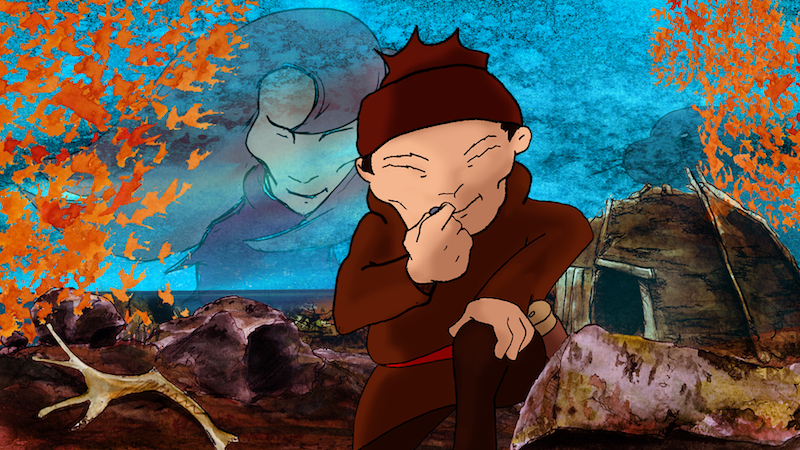
Garral is going hunting - and this time he's going seal hunting. He dreams of the jacket - which the woman is going to sew for him from the new black-speckled hide. He also dreams of the fire pit - where the meat is sizzling. The meat he will bring home to his family. He walks over the mountains in Varangerbotn, the soft mountains shaped as an extension of the plains where he also has his home. He leaves his hunting lodge - the muzzleloader has been cleaned the night before. At the hunting ground - he takes the rifle off his shoulder and fills the barrel with gunpowder - he draws the barrel and presses the leaden bullet into the barrel. Before he left the settlement - a mood had prompted him to turn round and return to retrieve the silver bullet. The bullet that can take down even the draug people in disguise. Now he is ready. Now he just has to wait. This is where the seals come in to sunbathe on the rocks after eating their fill - from the shoals of herring that the herd has chased into the narrow fjord.
Cassandra - is the sea woman who for thousands of years was condemned by the gods to see what will be seen, but what no one will believe. Her people, the dragons, are to gather today - the seafarers are to race today, the right time is here. From east and west they gather in the boats they have built themselves - to hide themselves they take up the shape of the seal. The Draug people, those who chose to remain in the sea.
Our forefathers and foremothers, those who gave themselves to wet eternity.
Garral's body has a stillness - which means that even the seals can't see anything but the black mountains and therefore can't sense the danger that threatens. Cassandra, who sits with her raven-black hair in the forepeak, cries out. Cujaju! Don't row any closer! We're in danger - turn around - row away - there's danger in the grey mountains!
The dragons raise their demonic ugly or angelic faces and look towards the mountain she is shouting at. But there's no one there Cassandra, they say in unison. Again, your warnings have no message. We can win this race and we can't turn back now!
Cassandra lowers her head. There is silence around her fear.
Garral sees the seal sliding towards the mountains and gropes for the bullet - today he can take down the draug people themselves. Every hunter's most precious prey. He pulls the silver bullet out of the leather pouch and reloads the rifle. They get closer and closer. The bullet goes off. As Cassandra's mournful voice is heard over the swell. I told you so! I told you so! You didn't want to hear!
The harness lies still in the water - and is washed up against the rock.
The clouds part and the mother of the draug people, the sun, casts her rays down towards her precious daughter. Cassandra's joik is strengthened by the sweetness of the sun's rays and the tones gently stroke the lifeless seal - quietly the joik wraps the lifeless seal in its embrace and closes the wounds made by the silver bullet.
The harness pulls for air. The heart begins to beat heavy heavy beats as the power returns to the lifeless body. The lips beat heavily against the waves - and the harness turns round - and the draug people can once again raise their faces to the sun. They plunge their oars into the sea and with a jerk the boat takes off. Row - row! Row for life, we can still win!
Current links
Joik - Audio recordings and videos
Joikesamlinga, Tromsø Museum, UiT