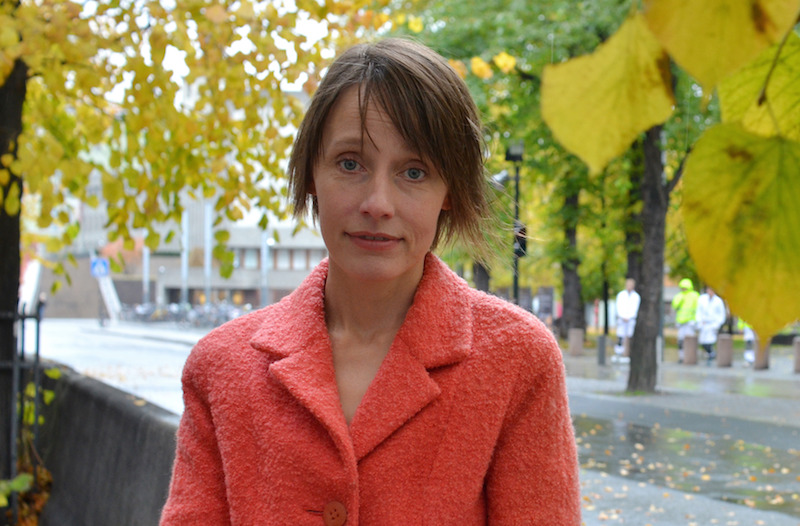
Ingeborg Arvola has published a number of novels for both children and adults. Arvola is known for her unique language and specialised themes, and her novel Neiden 1970 is regarded as an innovation in Kven literature.
By Kaisa Maliniemi
Ingeborg Arvola (born 1974) grew up in Varanger and Tromsø. Today she lives in Oslo. She made her debut in autumn 1999 with the novel Koralhuset. Since then, she has published a number of novels for both children and adults. She received the Cappelen Prize in 2004 and the Havmann Prize in 2008 for her writing. Neiden 1970 was released in autumn 2015. Neiden 1970 is, however, her first novel that can be defined as Kven literature.
Neiden 1970
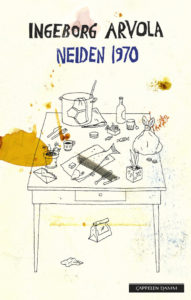
Neiden 1970 has garnered good reviews, especially because Arvola addresses painful themes from her childhood and life. She gives a face to a child growing up with an alcoholic father. This novel also has another dimension: It describes a minority in the north. Language, cultural affiliation and border identity are elements that play a fundamental role in the protagonist's childhood in a Kven/Norwegian-Finnish family. They have helped to shape her life and the lives of the people around her.
Neiden 1970 a groundbreaking novel in several ways. It is the first fiction novel in Norwegian-language Kven literature in almost 10 years. It came almost thirty years after the two great Kven writers, Idar Kristiansen and Hans Kristian Eriksen, published her novels about the Kven culture. What is most remarkable is that Arvola is the first female fiction writer who has chosen to emphasise Kven themes in her work. In the novel, she uses the term Finnish instead of Kven due to the fact that she grew up with the term Finnish like many others in Eastern Finnmark. Nevertheless, she identifies herself as a Kven.
In the novel, Arvola gives a face to a person who has lost the language of her family and is becoming alienated from her culture. Her identity has been damaged. This can be seen as one of the reasons for the problems that her father had and that she herself struggles with later in life. She feels pain and guilt for having allowed herself to become detached from the language and the Kven culture.
We are the generation that lets culture disappear, that no longer knows the language. Our ancestors crossed borders, left their country and hometown, but kept their language, customs, culture and knowledge. They came from small places in the North Calotte and moved to small places in the North Calotte. I am the one who has uprooted myself." (Neiden 1970)
On the other side of the novel, the consequences of the Norwegianisation that has been passed down through generations are revealed between the lines.
Neiden 1970 is an important and innovative work that can take Kven literature to new and long-awaited areas. Her work can be compared to Mikael Niemi's novels, which have renewed and given a modern twist to Swedish Tornedal literature. More publications and new themes in minority literature are essential criteria for literature to survive as the minority's own dynamic cultural expression.
ORDspill with author Ingeborg Arvola and bassist Åsmund Wilter Kildal Eriksson 16/3/2017 in Galleri Nord-Norge. Ingeborg reads three of her texts, Himmel uten fugler, Skuddpremie and Fette kult, from the book «Omstilling. Man's role in nature, industry and technology».
Current links
Interview about the knife in the fire
6 quick tips with Ingeborg Arvola
Ingeborg Arvola gives the brave child a face and a voice, forlagsliv.no 2015
Havmannsprisen to Arvola, NRK 2009
Sårt om å være liten, NRK 2004
Digital books
Blood, snot and tears, 2000, National Library of Norway
Life in a turtle shell and other stories, 2000, National Library of Norway