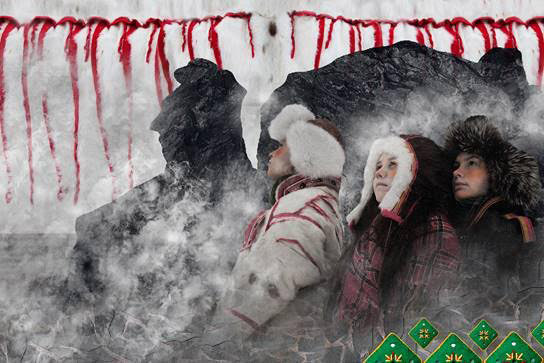
Narrated by Harry Solhaug, Manndalen 1995
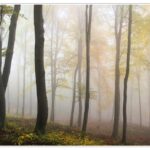
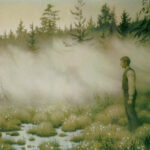
Inga-Wiktoria Påve is a visual artist who was Young Artist of the Year at Riddu Riđđu 2016. Together with young people from Riddu Riđđu's youth staff and photographer Eirin Roseneng, who has roots in Manndalen, they spent a snowy day in March photographing around Manndalen. Together they have recreated how Olmmáivággi got its name. The photographs were taken by Inga-Wiktoria Påve.
A long time ago, a man called Olmmái lived in Manndalen. He lived on the edge of a large plain.
To the east, just below the foot of the mountain, lived the neighbours. Their houses were lined up in a row, so they had a good view across the plain towards Olmmái's house.
To the north, the view was obstructed by a ridge that stretched across the centre of the valley like a giant nose. The ridge stretched over 100 metres vertically upwards. This is where Ravald lived, with a view of everyone around the plain. He built his house inside the ridge. It was a dark and scary place, but perfect for survival. He had no friends. If anyone approached his house, the dog would scare them away. Then everything fell apart. As I'll tell you later, Ravald survived. You can see the marks of his digging to this day. The ridge is called Gilvátgiedjunni.
As mentioned, Olmmái had placed his house on the edge of the plain, near the river. The house was large, you can see it as a giant gamme, no, maybe as a pyramid, because the house has corners, 50 metres high and 50 metres in diameter. Olmmái lived here with his family. His wife was called Mare, his son was called Skidu and his daughter Njivi.
Olmmái hunted in the valley and fished in the river. He was particularly fond of standing by the Fossen waterfall and watching the salmon make wild leaps in an attempt to negotiate the rapids. There they caught salmon, lit fires and cooked the salmon in pots, remnants of which can still be seen in the rock.
Such parties could be lively. They shook hands, formed a circle, sang and danced song games to the sounds of the waterfall. Today, if you listen carefully, you can also hear the sounds of the waterfall.

Jettakaillen meets the Sea King
Olmmái's wife was the daughter of Jettankaillen. Jettankaillen did not like Olmmái. He was both angry and unhappy that his daughter had married a Mandalite. The one who almost became queen of the Sea King's kingdom.
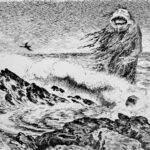
One day, Jettakaillen stood on top of a mountain and scouted out the fjord all the way to the Great Sea to see if any fish or mites would enter the fjord. His ship stood with its dredge out, moored in Skipsbukta, always ready for action. You can see the ship and dredge to this day.
One night, when the sea was still rough and there was a full north-west storm, he saw a giant sea stretcher coming into the fjord. Sitting on top of the boat is the Sea King Àhpi. The Sea King had heard that Jettakaillen had such a beautiful daughter. Now he wanted to see if she was fit to be queen of his kingdom. Jettakaillen took his daughter with him as crew. They travelled down to Skipsbukta, boarded their ship and sailed out to meet the sea king. Outside Njurtjárga, he met the sea king and shouted out: ”They must be fine people travelling in such a dignified manner!”.

”I am the Sea King Áhpi, who owns all the seas from east to west and from south to north. No king in the world has as much land as I do," said the Sea King, and sent one of his accompanying sea stretcher-bearers across the ship to Jettakaillen.
”You must have an important errand to run when you've taken the time to visit us, Fjord Finn,” said Jettankaillen.
”Mare, Mare”, said Jettakaillen to her daughter, ”Stand so that the Sea King can see you”, Mare walked right up to the bow of the boat and presented herself to the Sea King.
When the Sea King saw Mare, he inwardly cursed the sea boat that had lured him here. ”The only thing such a stretcher can do is to scull so that the fish in the spear gets seasick and has to vomit. It doesn't know a thing about queens,” he thought, and immediately realised that she was no wife for him. This is a woman who can sew cow's stomach and cook cow's stomach butter. Perhaps she can cook trail for the animals, but she is not a queen.
However, he couldn't insult Jettankaillen so he shouted over: ”Your daughter is both a friend and beautiful. I haven't quite made up my mind yet. When I have, I will come back.”
He saw that the weather had changed direction and was now blowing across Gáivuotna. It was a good fit. He thought: ”It's best to get out of here as quickly as possible. He decided to take a trip to Helgeland. There he had heard that there were seven sisters waiting for suitors.”
He sailed out of the fjord, headed south and never came back.
Mare marries Olmmái
Mare waited and waited for the Sea King Áhpi to come and ask her to be his wife. She was looking forward to becoming queen of the Sea King's kingdom.
She waited so long that her neighbours started calling the place where she stood Marebakken. Today, the hill is called Marebakken after Jettakaillen's daughter.
Olmmái in the valley had also heard about Jettakaillen's daughter. He travelled on frequent visits to Jettan. Jettakaillen did not like this. No Mandalite would be allowed to marry his daughter. Olmmái told Jettakaillen about wild reindeer hunting, salmon fishing and the fine food he could cook.
”What's the name of that dish?” sniffed Jettakaillen.
”Gisell,” said Olmmái.
”Gisell,” said Jettkaillen, ”that's something we make up and feed to the pigs!”
He thought to himself that he should put an end to this suitor. So when Olmmái went on a reindeer hunt, Jettakaillen sneaked up to where he knew the valley was narrowest. Olmmái had to pass through here.
Here he collected lots of stones. When Olmmái arrived, he threw the stones down the mountainside in the hope of meeting him. Now he would be rid of the troublesome suitor, he thought.

From afar, Olmmái saw the stones coming, so he avoided being hit. Little did he realise that it was the Jettakaill who was maliciously removing a troublesome suitor.
Even today, the mountain where this happened is called Bahávárri - the evil mountain.
In the end, Mare said yes to Olmmái and moved to Dalen to the Ravald place. They had two children, a boy and a girl.
However, Mare could not forget the Sea King Àhpi.
Olmmái and the kids on a reindeer hunt
A long time passed. The two children had become teenagers, and one day they went reindeer hunting with Olmmái. They travelled up the valley and spent the night on a large rock. Olmmái had left provisions there from previous trips. The rock has since been used for the same purpose, and hunters and others have been able to sleep here safely because no predators or enemies could surprise them.
The stone is called Áitegállu, which in Norwegian means "Supply Stone".
Undeterred, Olmmái and the children travelled on. They passed Bahávárrevuolde, under the evil mountain, but nothing happened. Jettakaillen had stopped pursuing Olmmái.
They then travelled towards Àvččevággi and up to Čahca, Some way up the mountainside, they entered a cave, which today is called Njalli after the name of Olmmái's daughter. The cave was spacious, with plenty of room for all of them, and this is where they stayed throughout their reindeer hunt.
Mare goes to Gáisi
Back home in Ravald, Olmmái's wife, ho Mare, was bored. She couldn't get Áhpi the Sea King out of her mind. He was such a great bloke to look at. Perhaps she should have waited longer before marrying Olmmái and moving to Dalen.
”It would be nice to see the Sea King again,” she thinks.
One afternoon she was sitting outside, leaning back against the wall of her house, watching Gáisi in all his splendour stretching towards the clouds, when she got the idea.
”If I climb up to the top of Gáisi, I might see the sea, and maybe a glimpse of Àhpi the Sea King.”.
As thought, so done.
She set off. It was a long way to go. When she reached the top of the mountain, she sat down, leaned back and looked out to see if she could see the sea and the Sea King.

Turned to stone
Olmmái and the two children had finished their hunt and were travelling home. They reached the narrowest part of the valley at Àvčče. There, at the mountain, they stopped and looked down the valley to admire the view. Then it happened:
A flash of light so powerful swept over the mountain, and everything that existed was turned to stone. Then darkness descended on Dalen. A violent storm and snowstorm arose. The darkness and snow lasted for thousands of years. It filled the entire valley, even up to Gáisi, which was also covered in snow. Everything that lived became dead and cold winds blew across the ice plains.
Epilogue
He stands there to this day, Olmmái, looking out over the valley. His two children have not been able to cope with the rigours of standing for so long. They both fell down.
Njivi, Olmmái's daughter, has endured the longest of the two, but fifty years ago she fell down. Her son Skirdi fell down a few years earlier.
You can see her best from Jávri, the Water, Àhka, Olmmái's bitch. She sits up there, leaning against Gáisi and looking out over the sea and the Sea King Ahpi.
As mentioned earlier, Ravald survived the big bang. Today, the plain is called Ravald, a well-known haunted place. To this day, if anyone approaches Ravald's home, they are frightened away. That's why Ravald means a dark place where there are ghosts.
Jettakaillen is still looking out over the fjord, waiting for herring and whales to come in, and his boat is ready in Skipsbukta with the dredge out, ready for a row.
The names of the places that remain can tell us about the giants who lived here before our time. Before atoms were blown up and everything turned to stone.
Glossary of terms
Àhpi - the sea begins at the coast and extends as far as you can see
Àitegállu - áite - place where predators cannot get hold of the food
Àvččevággi - ávče: juv - bahá: evil. The mountain of evil. Building on stilts.
Čahca - the last steep bend before the mountain plateau
Gáisi - mountains that rise above the others, or mountains you notice.
Gáivuotna - Kåfjord. Gallu - large freestanding stone, also skull.
Gilvátgiedjunni - embankment, sown with seeds
Jávri - water, lake
Jiethanas - Jettakaillen; stone figure in Nordnes.
Mare - Norwegian, from the word marebakken, the hill closest to land in the sea.
Njivi - name of cave
Njurtanjárga - Nordnes
Olmmái - man
Olmmáivaggi - Manndalen
Raval - place of horror
Skidu - dal
Vággi - dal
Várri - mountains
Vuolli - under