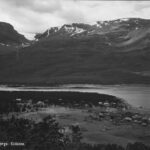
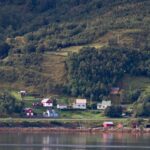
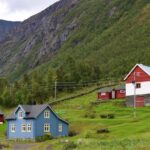
One winter's day at the beginning of February, my grandfather took me out to sea to haul cod nets. He had set the net alone two days earlier, in the ”Herman's set” which was in the ”innerhalta” of the mould. The nets were set in the ”hill”, i.e. from a distance outside the marshland and out towards the centre of the fjord. Each fisherman had ”his” spots, which others knew about and respected. This was part of the unwritten laws of the fjord.
By Øyvind Rundberg, Kåfjord
This was the year of my 10th birthday, when I was supposed to be old enough to survive a winter day at sea.
Mum arranged the necessary winter clothing: home-knitted woollen clothes on the inside, then thick trousers and a long shirt, a woollen jumper and a windbreaker on the outside. Wool has the property that it forms an air-insulating layer and retains much of its properties even if the body releases moisture during work. I had new, large, white home-knitted woollen mittens and a leather hat. On my feet were big, brown ”Viking” rubber boots with woollen socks and laces inside. A pair of soles in the bottom of the boots provided extra insulation against the snowy ground.
My grandfather gave me a large pair of yellow oilskin trousers that I pulled over the top, and I double-crossed the braces over my back and shoulders. They were still a bit too long.
But now my mates should have seen me, tough ”grown-up” man!
Then it was time to get the boat out to sea. It stood outside the boathouse, was called ”Bindalingen” and was a 2 and a half bedroom Nordland boat built in Bindalen in Nordland in 1946.
Some snow had blown in and in front of it. ”You'll have to shovel the snow,” said my grandfather, handing me a shovel. He had a Sami/Finnish background and couldn't say ”y”.
Grandad made other necessary things, brought some spare stones and pebbles for the nets, some rope, a knife and ”the blessed one” or kleppen. But that word mustn't be used because it could ruin the fishing luck. The barrels were smeared with a little ”grakse” (precipitate of fish liver) so that the boat would glide more easily over the barrels on the shore. Then he put the nugla in the bottom of the boat, and it was off to sea.
The weather was decent, with a north-westerly breeze and light snow in the air.
Since this was at half past seven in the morning, it was still so dark that we couldn't see the ”German rod” that marked the furthest end of the net. But my grandfather knew roughly where it was.
Sure enough, we found it, and my grandfather started pulling up the rope. This was heavy, because at the end was attached a large, heavy stone, the ”crab”, which would hold the net along the bottom and ensure that the bottom current did not carry the net away.
The crab was lying at a depth of around 70 fathoms (approx. 105 metres), slightly submerged in the clay at the bottom. Therefore, the line was first pulled up a few fathoms, then stopped for a few seconds so that the crab and the nearest net stones came loose from the bottom. The fact that the boat was bobbing a little in the waves also helped to get this work off to a good start.
After a while, my grandfather had to take a break from trekking because the weight was a constant strain on his arms and shoulders.
When he started again, I took the rope and wrapped it around one of the pegs. That way, I could help to pull up the chain. Or at least hold back the weight, so that my grandfather's arms could rest a little between the roofs. Since the ile was wet with seawater, my mittens also got wet and cold. But it didn't matter, because the arm movements and the good mitts kept my hands warm anyway.
I stood on, limped and pulled, but I didn't really think this would be of any particular help to my grandfather. It seemed infinitely heavy, and it got worse, because as you pulled, the weight of the line added to the weight of the crab.
After Grandad had taken his second rest, I didn't put the rush around the stick when he started again. Then Grandad cleared his throat low and in his careful way he made an arm movement with the ferret, as if he wanted to put it round the pole. Oii, I was quick to comply. My work was important, I mattered, I was to be reckoned with, I could take part in adult work! My self-confidence grew. My grandfather made me good, and without saying a single word to me!
Finally, the crab got into the boat and we could start pulling the nets. But first, we had to make sure that we started correctly with the rolling pin and stone ropes. The rolling pins had to be placed neatly in the rear bulkhead so that they came out ”on their own” when the chain was put back in place. The stones, which acted as nailers, were placed neatly one after the other at the second rear bulkhead in the boat.
The first yarn was made of cotton thread and had no fish, but the next was made of thin hemp and looked promising. The two yarns went against each other into the sea, and air bubbles appeared and burst on the surface! Grandad looked down into the sea behind his back and gave me a sly smile.
”I don't care,” he said with a twinkle in his eye. Soon, the first large cod came up over the reel. The mesh was tight around its head, and the fish was firmly tucked into a sack formed by the yarn line. My grandfather taught me how to spin the cod out of the sack first, and then pull the meshes forward over the cod's head at the end. He then shook the line, which soon settled into the right folds again.
The fish was killed by opening the main artery behind the head, under the gills. This is called bleeding. The cod was then placed in the centre compartment and the work of pulling the chain continued.
The yarn was pulled ”straight”, i.e. the chain could be deployed immediately after the last yarn and end stone had been pulled up.
Most of the fish were caught on the last nets, which were closest to land. That's why we started setting the nets a little closer to the shore, but in the same place. I sat at the front and rowed the boat, while my grandfather threw out the flat stone bags as we went along. The buckets slid out by themselves as they should. I watched the net slowly sink into the depths. But not too slowly either, because then the current could carry the yarn over other yarn sets and create ”breeding and washing”. This was not very popular. It was best if several people set their nets at the same time, especially when the tide/spring conditions were such that the ocean current was at its strongest. "People often waited for each other and set their yarns at the same time," said Grandad.
One of the stones that was thrown out made a special slapping sound when it hit the surface of the sea. Grandad cleared his throat and nodded his head. This was a sign that the nets would catch a lot of fish in the coming night.
After the crab had been thrown overboard and spat at, the ferry was rowed further out into the fjord. When everything was rowed out, the end was secured in a tollegang, and the boat was laid across. The nets had to be stretched, and I had to push against the wind so that the chain wasn't pulled over towards other people's nets. It was important that the chain formed a 90-degree angle with the shoreline. This was also an unwritten law in this part of the fjord. Everyone had to obey it, otherwise you could get ”queer” comments in the shop or in the post office in the evening.
The weight of the crab and the nets pulled the boat slowly towards the shore for some distance, but eventually the line became slack and the boat's pull stopped. The crab and the line had reached the bottom. Since it was a spring sea, the seine had to have a few extra fathoms so that the double wouldn't be pulled under water by the tide. Grandad then threw the double into the sea with a half-hearted wish: ”Fish well!”
I rowed slowly towards the shore, while my grandfather cleaned the boat, throwing out seaweed, pebbles and debris that had been pulled in with the nets. The bailer was also used to throw out the water that had accumulated.
"As we approached the shore, we saw mum, grandma and a neighbour coming down to the dock. They were probably going to help us up with the boat, but also to see if there were any fish.
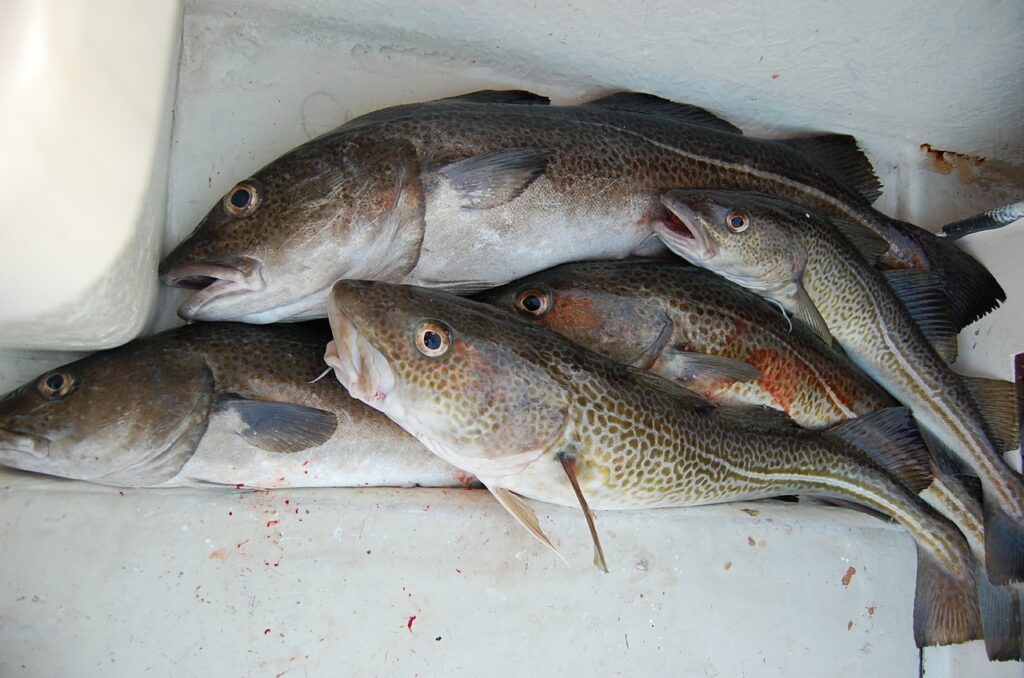
The catch was taken off the boat, counted and placed at the seaside. In the 12 nets that made up one chain, we caught 15 cod, ranging from about 3 to 7-8kg. These were fine winter fish, even though most were a bit ”small”. But it was still early in the winter fishing season.
The boat was pulled up and secured outside the boathouse, and was ready for another trip out to sea in two days' time.
The catch was then pricked, i.e. gutted, blocked, rinsed in the sea and then hung up to dry on the reel.
My grandmother showed me how to gut the fish; first open the belly and then cut off the head so that the vertebra at the head was cut across. An incision was then made on each side of the head, the fish was turned onto its belly, and with both hands gripping the head, the fish was pressed against a fuse so that the head was pulled off. It was important that as little of the fish's neck as possible came with the head. The aim was to maximise the weight of the cod that was hung up to dry.
My grandmother had arranged round barrier nets that were wrapped around the tracks of the fish, two by two were tied together.
Three cod were not hung. They were picked out for boiling fish. One was given to the neighbour who had helped us. It was quite common to give ”boiling”, without payment, of course, because another time it was perhaps we who helped and were rewarded with such a reward. Sometime in late autumn, a neighbour came to us with freshly smoked, lightly salted (sprinkled) oats. It tasted fantastic! Boiling was also an unwritten practice, a good custom, and a safety net for the village if illness or other conditions meant that someone couldn't get out to sea.
The cod heads were bundled together with old counting wire and hung to dry. This was called guano, and was of course much cheaper than the stockfish itself.
The liver was put into large buckets and used to make cod liver oil. The intestines were preserved and later boiled in a large pot. This became supplementary feed for the livestock, cows and sheep. There was nothing on the cod that was thrown into the sea!
As the final ritual, the mittens were splashed with bile from the cod and rinsed in the sea. Bile foams in seawater and acts like soap. The mittens were cleaned and dried by banging them against a large, round stone. This was repeated several times until we thought the mittens were clean enough. In this way, the freshly knitted mittens were felted, making them thicker and even warmer, but somewhat smaller than before. That's why they had been so big when I got them. The mittens could also be placed in the snow and stepped on. The snow sucked out most of the sea water.
Once inside the warmth, it was around noon. A slice of bread with brown cheese and jam tasted really good, and I had to have a cup of coffee with lots of milk in it, just like my grandad. And I got a sugar cube too, but only one!
It was a good feeling to realise that I had contributed to the community.
But for me, the excitement when my grandfather said: ”That's enough!” gave me a thrill in my body that was indescribable. I still have that feeling - more than 50 years later - when there are signs that you're catching fish!
Later there were many fishing trips, both summer and winter. The year I turned 15, a neighbouring boy and I fished all winter. I borrowed my grandfather's cod nets and earned 522 kroner. The money was used for a year at a folk high school.
For me, these fishing trips with my grandfather were very important for my self-image. You were treated like an adult, we were two equals in the same boat. I was a full member of the community. I was expected to make myself useful. But of course based on my age when it came to physically demanding tasks. There were a lot of fishing trips, and I thought they were a lot of fun even though it could be tough in bad weather.