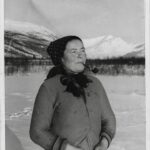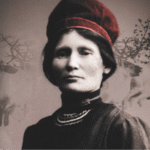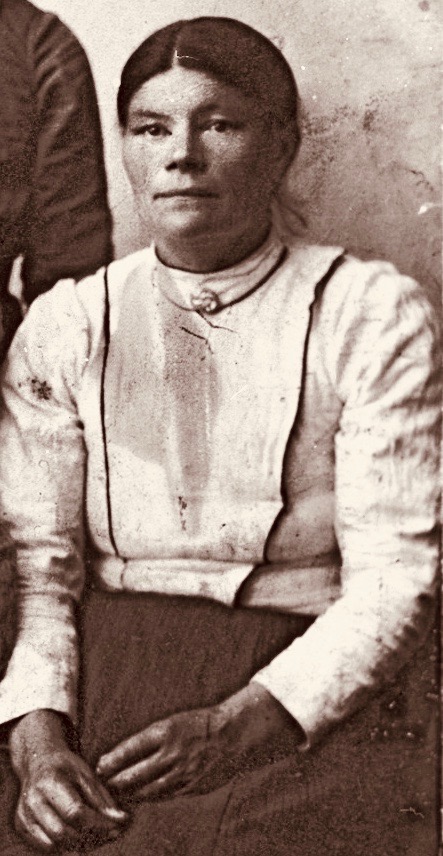
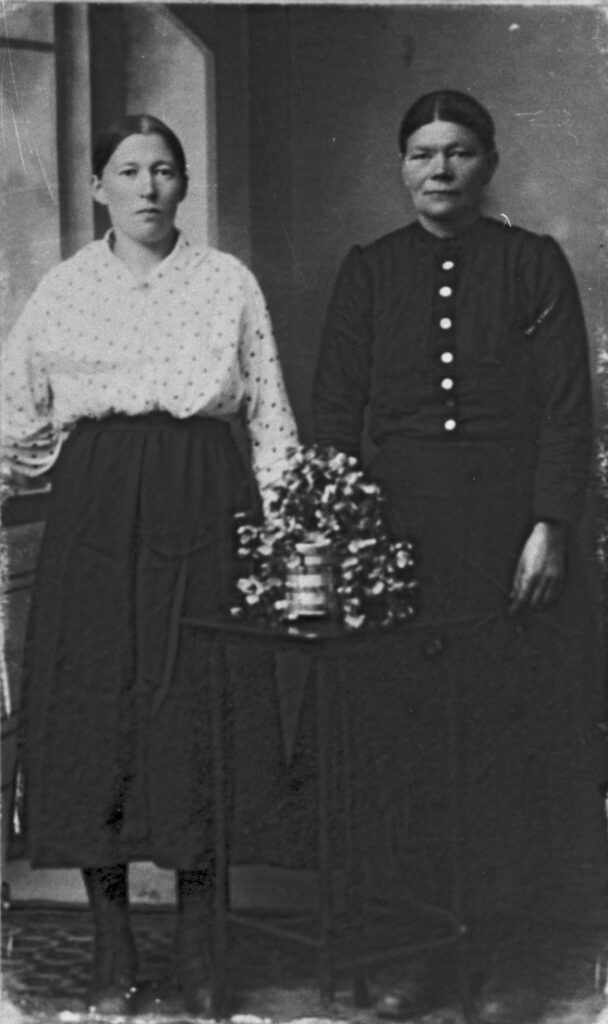
She slaughtered animals, rowed fish, sewed, braided, traded, organised, healed and acted as a midwife. Alette Pedersen in Olderdalen, also known as Stor-Aletta, has been described as an indispensable woman in her time.
Alette Pedersen, Olderdalen (1872 – 1942)
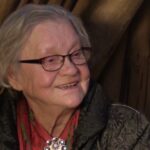
If she had been around today, she would have been famous, but back then everyone was used to her, so.... there was nothing that was.... unusual. Astrid Olsen
Alette Pedersen lived alone in a small house by the beach in Olderdalen. She never married, but took in a foster daughter when she was well into her teens. She was the one people turned to in times of birth, illness and death. She received newborns, performed emergency baptisms, cupped and blew away illnesses, and mended and sewed shrouds for the dead. It was said that if you saw Alette with the white scarf on her head, a new citizen of the world was on the way.
Alette had a big heart and was always in business. She travelled around the markets selling goods that the women in the village sent with her. She took the local boat to Tromsø to sell potatoes and meat for the poor, and rowed across the fjord to the priest to register children, marriages or deaths.
Skilled at sea
It was said of Alette that she was more than a man. She could handle all the farm work, but was also a skilled fisherwoman and boat handler. Alette was called upon when animals needed to be slaughtered or castrated. Her healing abilities were well-known. Whether it was cupping, blowing, or reading, Alette could, saw, and heard more than others.
Alette didn't particularly like men, and it is said that she got very upset when the girls gave birth to «illegitimate children». Then she could use her mouth violently. Perhaps this strong reaction came from the fact that she knew what the future held for these women, at a time when women had to be married before giving birth. Alette was also at the forefront of efforts to improve women's rights and conditions. This can be seen in the newspaper debate below.
«The intermediary» and «the driving force» were words used to describe Alette and her organisational work. She spoke out, even against authorities. When, in 1902, the municipality's teacher complained in a newspaper article in Nordlys, among other things, that the state of education and the Norwegian language in Olderdalen was poor, she threw herself into a heated newspaper debate, responding, among other things:
«So much information is here, however, that we can translate Danish into Norwegian, Norwegian into Lappish, Russian into Danish, etc. And if you are a teacher and can handle these languages, then be welcome as a bringer of information to us and our children, but if not, then stop your reformation..» ( See excerpts and PDF of the newspaper articles below).
«One autumn evening as she sat sewing a shroud, she received a visit from a relative. While they sat talking, they heard noises outside. There was scratching and scratching outside the wall until Aletta shouted: «Oh, stop bothering me, I'll be finished for the funeral tomorrow.» With that, the scratching ceased..»
Excerpt from newspaper debate between Alette and teacher a. Read by Eline Petrine Johansen
Excerpts from a newspaper debate between Alette and teacher a. about the woman. The newspaper debate took place in the newspaper Nordlys 1902-03
Teacher:
- But we are not so big-hearted either. When we have food for the day and a little in the cupboard for the next, we are satisfied, especially if there is no shortage of tobacco, and the pipe is not too sour; but our language cannot bear that. As for the women, I must say that they are fairly well satisfied with their position in life. When they have a large coffee kettle, a ditto coffee container with ample contents, good and dry wood to cook with, a large lump of sugar in the cupboard and cream on the milk stall, then everything is well and good. Then they are as kind and cheerful as they can be, and many will gladly take a well-laden pipe of tobacco to show their satisfaction. But if the kettle is too small, or the sugar or coffee is close to dying, then I will certainly not guarantee good weather everywhere. There are so many of these women! They tolerate very little hardship.
Reply from Alette:
– As for «storms» among women, women's storms do not rage more here than to the south, where one would expect calmer and steadier weather. And he who wishes to seek his bread among us old countrymen must bear in mind that he must have as many claws in the sail as are required when it comes to heading down for the coffee and sugar storm blowing towards Mr. A.
Furthermore, a. states that «many women tolerate quite little adversity: But what about men? How much adversity do they tolerate? Far, far less than women. Besides, it's not to be wondered at, Mr. a., if those women tolerate less, as they are of the weaker sex.".
Answer from teacher a:
– I thank you for your remarks about how the alder-dwellers are. But I suppose you only mean the women? They are said to be the worst, wherever one goes, I have heard. And if one is attacked by «storm» and «tempest,» it is usually from that quarter.
Next, you note that women are of the «weaker sex.» But you should have kept quiet about that. Aren't women working themselves to death to gain universal suffrage? What? You know it well, you who are at the forefront of them? And when they want to stand on an equal footing with men in the matter of suffrage, they must not hide behind such a weak defence, but bravely face whatever weather blows.
Reply from Alette:
– I pity those who are not accustomed to storms for being in such an unfortunate position that they are forced to complain publicly in this regard. It does not surprise me at all that women are partly impatient and often weary of various things. Perhaps their men do not treat them with sense, as women are of the weaker sex, and man is supposed to bear woman's frailty.
A woman's nature and qualities cannot perhaps be transformed into those of a man by the right to vote.
I will now advise you to follow along so that you have the opportunity to see what your barometer shows. In all public places, e.g., fisheries, mines, railways, various kinds of workshops, and marketplaces, you will understand that it is from strange people that you hear swearing, threats, sales pitches, drunkenness, shouting, and yelling, including also from some seminarians. One rarely sees or hears women in such company. Just take a short trip on the steamboat, and you will see how one beer bottle after another is emptied, and by men; rarely will you see women drunk.
The first origin of today's newspapers, which are now blowing in Olderdalen, is not from women either, but imagine, it comes from a teacher.
Extract from a newspaper debate between teacher A and Alette, 1902. On the language situation in Olderdalen:
Teacher:
Books and magazines, literature and enlightenment in general, are less of an interest here. I can honestly say that enlightenment is very much lagging behind. If one can scrape enough from books to get to confirmation, that's good, and if one cannot, then one has to muddle along until the priest is forced to confirm the person in question.
And what is the reason, one might ask. Yes, that can vary. But first and foremost, one must consider that it is no less than three languages, Lappish, Kven, and Norwegian, if I can call the latter that.
Of these, one of the first two children's mother tongues remains, while Norwegian is merely a minor subject, which one crams in a little now and then while at school. In such a muddle, one doesn't know what is correct. In the long and arduous years the children go to school, they do read a bit; but what they read is in Norwegian, and it's only a fraction of the whole that they eventually come to understand. And no one should be surprised by this. It's as natural as can be.
Whether you or I started French or English schools, or let's say Lappish or Kven schools, then one would have seen for certain how much knowledge we would have possessed by the end of school. We would probably have ended up empty and blank both here and there. In addition, many parents are so utterly indifferent about whether the children learn anything or not. The latter is also not a good remedy.
One might well ask: «Why not give children an education in their own language, so they can learn something?» Yes, why not? No, because that would also have consequences. Firstly, we live remotely now, and if we were to remove Norwegian from the school and have no smallest influence from the Norwegian side, it would in a way be even worse. Then people here would have to have their own government and their own laws and become a nation unto themselves living within the Norwegian border. They would not be Norwegians, not Swedes, and not Russians. As long as the land is Norwegian, the education must also be in Norwegian – everything else, if not the people. But those who grow up will suffer under a deficient education because of it.
But if, on the other hand, the parents had looked after their child's best interests and taught them a little Norwegian before they went to school, then you were immediately over the worst. Of course, most of them don't know much Norwegian themselves, but they know so much that they could have taught them something. You could at least teach your child as much Norwegian before they come to school as they can when they leave it, because it is much easier for children to learn a thing at home than away. Then you could build on the school and get much, much further with the information. When the children grew up and went out into the world, they got to taste the fruits and see that they were good. They would then be able to cope far more easily and get further ahead and remember their parents with the most reverent thanks for the small, but for them so good inheritance they have received.
Reply from Alette:
«Enlightenment.» Yes, that is precisely what we love, and that is why we pay teachers and keep our children in school, where they are to receive enlightenment, if I am to call it that.
A reason for the limited enlightenment here in Olderdalen is primarily that people speak three languages. The fact that people speak several languages is, in my opinion, not a lack of enlightenment, but quite the opposite. He who has learned several languages has probably also learned other useful things.
They go on to say: «If the parents had looked to their child's best interests and taught it a little Norwegian.» I must ask: Who else looks more to their children's best interests than parents who possess fatherly and motherly love, who gladly give their children all the good things, both temporal and spiritual, that they themselves have. I admit partly that there is little enlightenment here. But there are complaints from south and north, east and west about insufficient enlightenment, that children grow away from their childhood teachings, even though there is neither Sami nor Finnish language.
The main reason is not that people speak several languages. But it must be something completely different that is the cause of poor education. Perhaps the teachers must partly share the blame with us, that there is lax morals and, if I may say so, little education among the people.
There is a lot of information here, that we can translate Kven to Norwegian, Norwegian to Sami, Russian to Kven, etc. And if a. is a teacher and masters these languages, then he is welcome as an information bearer to us and our children, but if not, then cease your reformation.
From teacher a:
As a yardstick for your enlightenment, you note that you can translate into four different languages. Yes, that's perfectly fine, but it's still nothing to get overly excited about. With your linguistic enlightenment, you won't get beyond your own village when it comes to social and political matters.
And finally, you might even get a raisin to bite into. You can, from what I've heard, not manage it at all. Your languages are influenced by each other, so it's all a confused mess, like a strange stew.
I can't believe that knowing many languages is any proof of a teacher's skill, as it's not foreign languages you have to learn at school. But you have to know one, and that's Norwegian. If you speak more than one, the Russians will come and take them one day.
Reply from Alette:
I have been told that there should be language teachers in both the training college and in the secondary school. If it was not for instruction, what good would it be for the students to learn it?
When a Norwegian comes to Germany and learns German, is this to be characterised as enlightenment? If I understand nothing but Lappish and Finnish, then I am unenlightened in other languages, but if I have learnt Norwegian, then I am no longer unenlightened in the Norwegian language.
There has been much discussion among the authorities as to whether or not the Lappish language should be removed from the schools, but they have come to the conclusion that it should be used as an auxiliary language in all Lappish districts in Tromsø County. So there is no point in changing it.
Finally, a little morsel to taste. In the Norwegian language, there are great dialectal differences. Almost every village has its own language. And if we are to have one teacher for the children from Nordland, another from the West Country, and if we are to make ourselves truly understood by them, then we would need an interpreter, even more so the children. If the Lappish language is a jumble, then the Norwegian is no less so, it is a veritable mishmash of several village dialects. Now soon it will be more like "lapskaus" (a stew, but also slang for a jumble).
If we speak several languages, we don't fear the Russians anyway. Nor do we call for resistance against him. He provides us with cheap flour for the poor fish he gets from us during the spawning season.
Goodbye then, Mr A. We must not stop writing to each other. Perhaps we can become better acquainted, and then there could be advice for you. Those of you who are not very familiar with the sea should make a short trip to the sea with me, who are familiar with the sea, so that you can learn to distinguish between fish and birds, and at the same time learn that you shouldn't put the whole fish with the guts, liver and head in the cooking pot and cook it that way, but that you first have to take the guts out of the fish and then cut it into pieces and then cook it. Then I could teach you how to cook the bird in the same way.
Newspaper debate 1902-1903
From Olderdalen, Nordlys, November 1902, teacher A, pdf
Reply to Fra Olderdalen, Nordlys, December 1902, Alette and others, pdf
Reply to Alette and others, Northern Lights, January 1903, teacher A, pdf
Reply from Alette to A, Nordlys, January 1903, from Alette, pdf
Reply from Alette to A, Nordlys, February 1903, pdf
Continuation of Alette's reply to A, February 1903, pdf
Henrik Albrigtsen, The fish farmer's everyday life in Olderdalen:
The children were naturally born at home. There was no midwife in the village, but Alette Pedersen acted as the midwife. She was a single woman and lived alone in a small house by the beach on Hans Pedersen's property, and when one saw her on the go with the white scarf on her head, one knew that a new citizen of the world was expected. When someone died, Alette was fetched to wash and prepare the deceased before they were placed in the coffin.
Of course, Alette didn't get paid for her work, but she did receive some meat, fish and other items in kind. It is possible that she sometimes received some cash from people who had money.