Silbarahka is a silver collar worn by women for festive occasions. Some brides from North Troms have chosen to give new life to this stately garment, which had disappeared from our area for a long, long time.
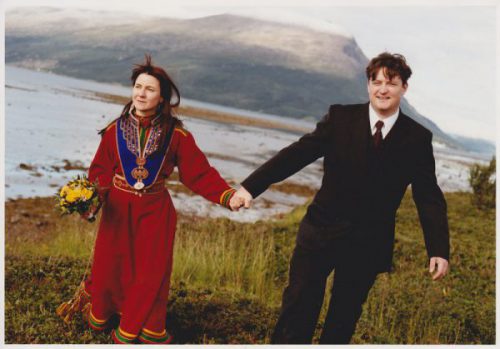
When Rita Lindvall from Kåfjord said yes to her Ole-Bjørn in Sábetjohka in 1999, she was the first bride from our area to choose to get married in a silbarahka in modern times. The collar was sewn by Berit Sivertsen from Olderdalen, and this particular collar has since been worn by several brides, including Rita's daughter Cecilie.
When Berit heard we were getting married, she said she really wanted to sew a silbarahka for the bride «...but with lots of crow's feet, because that's what it has to be!» I'm very proud to be the first person in recent times to use the silbarahka again. Berit was with me on the mountain as a safe bridal helper, lashing the wedding bands and organising the equipment.
Rita Lindvall, married in 1999
The women's cardigan does not have a collar like the men's cardigan, and the silbarahka is basically a loose collar decorated for festive occasions. The silbarahka is another way of decorating the bride.
Ole Thomassen describes the garment as follows in «Lappenes forhold»:
In the same way, a garment was made which was only worn round the neck by the women, and the edges of which extended a little way down the chest, shoulders and back, but not so far down as to require armholes. It was only used for the city and was made of dark blue cloth with a strong lining inside. The silver was arranged in the same way as described above, but here it was only stuck between the cloth itself and the lining. It was fastened at the front with small spherical silver studs, which served as buttons. It was usually edged with silver-plated ribbons, and along the edge, as well as around the neck, the above-mentioned silver daggers were also attached. Its name was silbarahka. Only on a few occasions did I see the men's jackets decorated with crow's silver, but only the neck piece.»
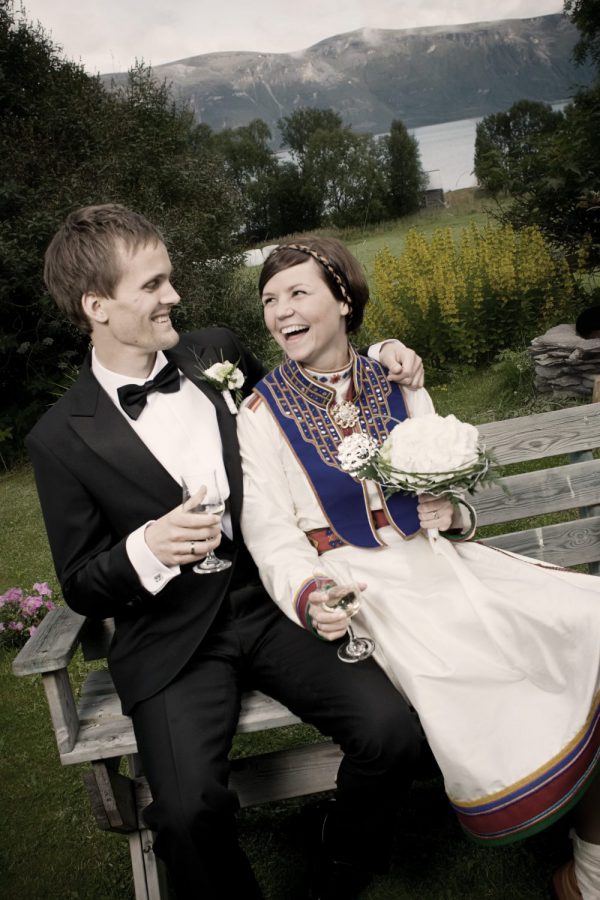
Putting on the silbarahka did something to me. It made me feel a stronger connection to my Sami heritage on that special day. I remember thinking about the woman who had sewn the silbarahka, about those who had worn it before me, and about all the people from our area who hadn't been able to get married in a kofte.
Ragnhild Dalheim Eriksen, married in 2013.
Silbarahka is still in use in the South Sámi and Lule Sámi areas, there are only a few from the North Sámi area. The reason may be that it went out of use earlier in this area. Almost all the silver collars that we know of are decorated with pewter wire, none with crow's nest silver, and they have many silver hooks and eyelets below each other on the front.

Tim Wendelboe and Cecilie Lindvall Wendelboe got married in Oslo in June 2015. Photo. Thomas Leikvoll.
When I put on the silbarahka, it was like having all my foremothers with me on my big day. I was so full of adrenaline and butterflies, but the calm came when I put it on. I felt so strong, proud and, not least, like the most beautiful bride in the world.
Cecilie Lindvall Wendelboe, married in 2015.
Current links
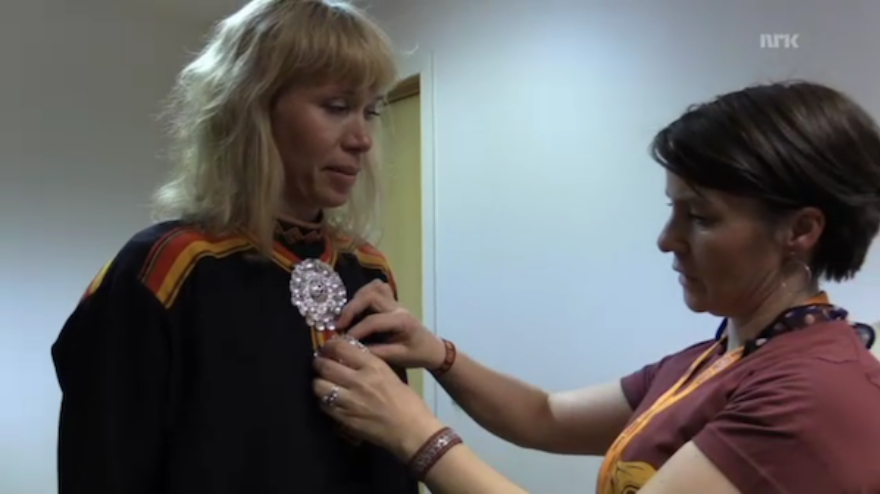
See «Who can wear a cardigan?», NRK
Workbook for Lyngenkofta, National Library of Norway
Source: Sea Sami clothing in old Lyngen