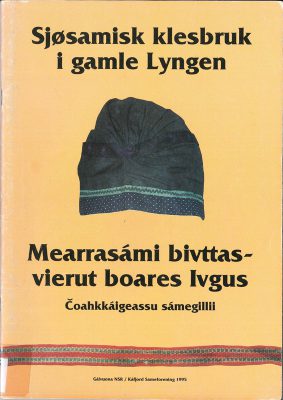
Gáivuona Sámesearvi (Gáivuona NSR) was responsible for the reconstruction of Lyngenkofta. In 1995, the source material was published in a booklet. The booklet is now sold out and we are therefore publishing the text online.
Foreword
By Mary Mikalsen Trollvik.
When Gáivuona NSR (GNSR) now presents the Sea Sami cardigan to Lyngen, it is an old dream come true. "For a long time, we didn't believe that a kofte had been worn here, as no-one could remember such a thing. The only thing that could be traced back to Sami clothing and kofte use was a hat, komager and komagband. Today, all self-respecting Sami areas wear kofte, so why not us? After all, the area has a living Sami language and other Sami traditions.
Fortunately, there were also people here who, on their own initiative, grabbed what little we had and started researching sources. One such person was Berit Sivertsen from Olderdalen. We can thank her for taking the initiative and for the basic source research she carried out. In order for her to complete the project, she entered into a partnership with GNSR along the way. However, both Berit and the Sami organisation needed more partners, especially on the professional side. A number of unfortunate circumstances meant that the collaboration did not work well and the project ground to a halt. Attempts were made to get the project going again, but for a long time it seemed that the knot was difficult to untie. The solution was to find people who could work together and with whom a constructive co-operation could be established. In this phase of the work, Lene Antonsen was contacted and linked to the work of getting the kofte project going again.
She was the right person, in the right place, at the right time. She knew how to cooperate and organise, and suddenly the work was in full swing again. New source material was also found, and this material provided a good description of the cardigan as it must have been in the Lyngen area before it went out of use in the second half of the 19th century. Problems with co-operation turned into professional disagreements, which in turn contributed to a more critical review of the source material.
As we now present the cardigan, we owe a great deal of thanks to Berit Sivertsen and Lene Antonsen. In addition, Henrik Olsen has been employed as a project worker in the final phase, and Kjellaug Isaksen has participated in several museum visits, test-sewn models and prepared sketches. Without their efforts, we would not be where we are today. We would also like to thank Inga Hermansen Hætta and Susanna Jannok Porsbo for their valuable professional help and support. We would also like to thank everyone who took part in the workshop and everyone else who has contributed in any way. Last but not least, we are grateful for financial contributions from Kåfjord Municipality, the Sami Culture Council, Lyngen Municipality, Storfjord Municipality and Troms County Council.
We hope that the cardigan will be of great use and enjoyment to everyone who wants to wear it. We also hope that this booklet can help to arouse interest in old clothing traditions in Lyngen and that this leads to further research on the subject. We are more than happy to receive comments and input from people with knowledge and who work in the same field.
The Borderland - A Cultural History Introduction
By Henrik Olsen
Lyngen is used here to refer to the geographical area in Nord-Troms that today covers the municipalities of Storfjord, Kåfjord and Lyngen. Until 1902, Sørfjord was also part of Lyngen. Lyngen is located well north of the Arctic Circle, on the west coast of the vast Siberian tundra that surrounds the Arctic.
Lyngen is thus part of the Arctic region. A complete picture of its history, geography and people can only be obtained by viewing Lyngen and the North Calotte in a circumpolar context, in relation to developments in other Arctic regions in Russia, America, Canada and Greenland. A common approach is to see the North Calotte exclusively as part of European history. This gives an incomplete picture. Not least the history of textiles reveals this.
From a bird's eye view, Lyngen appears as a long, narrow fjord arm, surrounded by mighty rock formations, stretching from the Arctic Ocean towards the Swedish and Finnish borders. Lyngen lies to the north-west, Storfjord to the south, while Kåfjord is a smaller side fjord to the south-east. With this geographical and climatic starting point, it's easy to understand why a type of human being has evolved that has created wonder throughout the ages and given rise to many fabulous stories from explorers and adventurers who travelled here from southern latitudes. Historical literature is full of stories about the small, furry people who lived so far north, and about the darkness, the light, the cold and the sea (1).
Despite the «extreme» conditions, people knew how to survive on the fish, game and crops available here. In fact, resources were in abundance. The idea that the Sami were poor and destitute does not correspond with historical research. Rather, this is an impression that has taken hold in recent times, partly as a result of Europeans' lack of insight into and respect for the Sami culture, but also as a result of a growing social welfare gap between the Sami and Norwegians in recent history.
We know from earlier times that the Sami were subject to heavy taxation by outsiders. In the 14th century, Lyngen was the south-western border of the Russian Tsar's tax territory. The border line stretched from Lyngstua, through the Lyngenfjord and to Halti. The Sami paid most taxes to the kings of Sweden and Denmark/Norway. At times, the Sami paid taxes to three kings at the same time. To just one of these, a single Sami could pay taxes equivalent to the value of the taxes paid by ten large farmers in eastern Norway (2).
Lyngen is a borderland in many ways. Geographically, Lyngen is located in the heart of the North Calotte, bordering both Finland and Sweden. As such, Lyngen has become a gateway for human contact, trade, religious currents and great power conflicts. This is where people have met and where the kings« envoys have met; Sami, Norwegians, Swedes, Finns and Russians. In years of hardship, Lyngen has welcomed an exhausted population from the northern parts of Sweden and Finland, fleeing war and famine. Idar Kristiansen has written marvellously about this (3). At times, the country has functioned as a »terra nullius", a no man's land, and a buffer zone for a growing Norwegian population in search of unploughed land, the riches of the sea and the minerals in the mountains (4).
The cultural frontier
In this way, Lyngen has become a border area for many cultures and many peoples. The Sea Sami population is probably the oldest and has always made up the majority of the population in Lyngen (5). No specific research has been conducted into their use of natural resources, but experience from neighbouring areas makes it natural to assume that this has long been a pastoral community, with seasonal migrations for the resources. The language was Sami, the form of living was earthen pots and the clothing was kofte.
Another group of traders, the reindeer herding Sami, also developed here, utilising the resources in the outlying areas.
Kven is the common name for those who came from Sweden and Finland. The hardships of the 18th and 19th centuries led many across the border, down Skibotndalen. Some stayed here temporarily before moving on to Finnmark, or they returned home. Others found what they were looking for and settled down. The Kvens were not a uniform group. They spoke Finnish, Sami or Swedish. They were skilled farmers and built houses from timber. This is how new customs and impulses came to Lyngen.
The 18th century also saw the arrival of the Norwegians. The first were traders, missionaries and civil servants. Later, Norwegian farmers and fishermen also arrived. There weren't that many of them at the time, but they would eventually become very influential.
A border area for Norwegianisation
Historical descriptions of contact between the settled ethnic groups testify to a peaceful coexistence. However, marriages across ethnic boundaries were rare, with the exception of those between the Sami and the Kvens (6).
The Norwegians were involved in a certain amount of missionary activity. The first church was built as early as 1722 (7). In the early days, missionary activity centred purely on matters of faith, and much of the missionary work was carried out in the Sami's native language (8).
Later, new attitudes crept in. The strong nationalistic currents of the second half of the 19th century, mixed with a vulgar social Darwinist understanding of culture, had consequences for the Norwegians' attitude and behaviour towards the Sami. It became an expressed goal that the Sami language, religion and culture should be replaced by Norwegian. The best means available to the authorities to implement Norwegianisation were the school system and the church. Later, the agricultural and fisheries authorities also became a part of the Norwegianisation policy.
Lyngen was defined as a transitional district, an area where the pressure for Norwegianisation intensified particularly from the 1880s (9). The authorities considered the opportunities for Norwegianisation to be easier among the Sea Sami than among the Mountain Sami in the interior. Resources were set aside to carry out Norwegianisation in the most efficient way possible.
However, the authorities did not achieve as good results as expected. There were constant complaints that the Sámi children were not switching to using the Norwegian language (10). Fogd Drejer expressed his concern about the position of the Norwegian language in Lyngen in this way;
«In Lyngen, more precisely in Kaafjorden, whose inhabitants, with few exceptions, are Finns, and where the Norwegians who live among them speak Finnish (Sami) as well as Norwegian, it has become a disgrace to be able to speak Norwegian. It is at least the case that the youth who seeks to acquire the Norwegian language and to use it is mocked by his peers.»
(From a letter to Mr Hvoslef, Director of the Seminary, 30 December 1856).
A well-used explanation for the Sami's strong resistance to the pressure of Norwegianisation is Laestadianism, a religious social revival that emerged in Sami communities from the mid-19th century (11). The Sami cultural traits were emphasised and presented in opposition to the Norwegian culture. The Sami language was labelled the «heart language». Laestadianism helped to maintain several distinctive features of the Sami culture. However, it cannot be said that Laestadianism had any significant preserving effect on the Sami clan tradition. In any case, kofte wearing in Lyngen did not survive the transition to the 20th century.
It is possible to speculate on why certain Sami cultural traits survived
longer than others. The Sami language was used as a daily language in most of Lyngen right up until the last war. Other cultural traits, such as clothing customs, disappeared earlier. A contemporary observer sarcastically comments on the new trend: «Most people lack a razor (...) but lately there has been more interest in acquiring a razor, especially young people, who are keen to resemble the Norwegians as much as possible» (P. A. Mikalsen, Manndalen, 1896/97). If the Sea Sami wanted to downplay their ethnic background in their encounters with the outside world, it would naturally be easier to dress in their costumes, in this case skirts and suits, than it would be to adopt the language, which is a far more complicated affair. Clothes symbolise belonging and background in a direct and often provocative way.
The Lyngen Sami, who had extensive contact with the outside world through trade and fishing, were not unaffected by the fashions and industrial developments of the time, as the quote from Mikalsen also testifies. Gustav Peter Blom, who visited Tromsø in the 1820s, expressed his admiration for «the elegant dress and beautiful dancing of the ladies», referring to the Parisian dresses of which there were many in Tromsø (12). The close contact Northern Norway had with the continent, through the extensive trade in fish, quickly brought new trends, makes and techniques northwards.
New times, new customs
Many of the traditional Sea Sami cultural traits survived the turn of the century and the following decades. The authorities' policy of Norwegianisation did not completely overcome the Sami language. With a touch of modernisation, the traditional Sámi industries - a combination of agriculture, fishing and handicrafts - continued to dominate, with little in the way of a modern cash economy (13).
The evacuation and burning during the latter part of the Second World War resulted in a break with the Sami cultural background. In the final phase of the war, Lyngen was to become a border area for the Germans to dam up the advancing Russian forces. The scorched earth tactic was implemented all the way from East Finnmark to Lyngen. A fortification was to be erected here, impregnable to the Red Army. The fortress was erected, the houses burned and the people sent away.
The months of exile have clearly made a strong impression on the evacuees (14). For a long period of time, the people of Lyngen lived in a culture that differed greatly from what they were used to. The houses, the language, the footwear, the customs were so very different. After the war, they returned full of impressions, back to a country that was to be rebuilt from the ground up. The houses, the tools, all physical characteristics from before the war were gone. And, as one Kåfjord man remarked, «What hadn't been burned, we threw on the scrap heap ourselves».
It wasn't just the houses and barns that were rebuilt according to a new template, without regard for local traditions. The handing down of other cultural traits, such as the Sami language, legends and storytelling traditions, was also disrupted by the war (15). It is no small paradox that the few months the population spent in exile in the south had a much greater Norwegianising effect than 70-80 years of the authorities' harsh Norwegianisation policy.
The first decades after the war were a vacuum for Sami culture.
Although the authorities broke with the previous Norwegianisation policy, this had little impact as long as the schools were still dominated by Norwegian teachers and the teaching was based exclusively on Norwegian values (16). The Sea Sami no longer wanted to define themselves as Sami. Sami belonged before the war, and what was before the war was «just nonsense» (17). In contrast to the 1930 census, where more than 50% in Kåfjord claimed to be Sami, fewer than 1% people considered themselves Sami in 1950 (18).
The authorities no longer considered the Sea Sami areas to be Sami areas either. It was the reindeer herding Sami who were emphasised as the bearers of the genuine Sami culture. The authorities lacked the knowledge and will to distinguish between the Sami groups. In 1956, a committee was set up to investigate and propose measures to preserve the Sami culture. Characteristically, the consultation paper from the Sami Committee was only sent to the Sami municipalities in Inner Finnmark. The Lyngen municipalities, which probably had the largest concentration of Sami population at the time, were not considered as a consultation body by the authorities. Nor did any of the Lyngen municipalities ask to be consulted in the 1950s.
The shame, and eventually the ignorance of the Sami cultural background, spread through the generations. A village book author from Lyngen gives the following characterisation of the local Sami culture: «For a long time, the cultural level of the Sami - children of nature as they were - was very low» (19). Acknowledging a Sami background to the outside world was a burden.
Sami flourishing
The first organised attempts to preserve and revive Sami culture came in the latter half of the 1970s. The initiative came from young people inspired by the academic environment in Tromsø and the revitalisation taking place in other Sea Sami areas. Gáivuona Sámiid Searvi/Kåfjord Sami Association was founded in 1976. The establishment of new local Sami organisations followed closely throughout the 1980s and 1990s: Kåfjord Sea Sami Association, Storfjord Sea Sami Association, Lyngen Sea Sami Association, Kåfjord Sami Youth, Storfjord SLF and Fjordfolkforeninga, the latest addition, was founded in 1995.
Issues to which the organisations devote their work include the collection and registration of Sami place names, Sami language training and the recreation of Sea Sami clothing, which this project is now provisionally concluding. The organisations are also actively involved in Sami politics locally and through their membership of the National Sami Federation (SLF) and the National Association of the Norwegian Sami (NSR). The work is also directed towards the Sami Parliament and the municipal and state administration. The most important political issues include increasing the status of fjord fishing and agriculture and Sami language and cultural education in schools.
These initiatives to revitalise the Sami culture have not gone down smoothly. There have been strong local reactions to what is perceived by many as ripping open old wounds. As the Sami groups have gained greater political clout and Sami culture becomes visible through Sami teaching in schools, the introduction of the Sami Language Act (in Kåfjord from 1992), Sami place names on signs and in the telephone directory, protests against the «... Sami oppressors», as one writer put it in the local newspaper, are also increasing (21).
The debate about Sámi language and culture has revealed that old, negative, inherited attitudes towards the Sámi are still deeply ingrained in many people. Recreating the characteristics of traditional clothing traditions is part of people's efforts to visualise their cultural background. Bunads are the most prominent symbol of Norway's nation-building at the end of the 19th century. Likewise, taking back the cardigan is a sign of maturity and pride in relation to one's own cultural background.
The fjord people start wearing their national costume after a long break.
Litteratur/henvisninger
(1) Hans Lindkjølen 1993; «Nordisk saga. The Sami in literature» and Nils M. Knutsen 1993: «Mørket og kuldenes rike»
(2) Andreas Holmsen 1977: «Finneskatt og nordmannsskatt»
(3) Idar Kristiansen 1981: «The grain and the fish I-IV»
Einar Niemi 1977: «Disruption and adaptation»
(4) Ottar Brox 1984: «Northern Norway. From commons to colony»
(5) Emil Larsen 1976: «Lyngen bygdebok»
The censuses
(6) Turid Hausner 1994: «Land in exchange for a spouse. Marriage between the Sami and the Kvens in the 1800s, a barter?» Semester course History, UiTø
(7) Larsen -76
(8) Eivind Bråstad Jensen 1991: «From Norwegianisation policy to
cultural diversity»
(9) Jensen -91
(10) Jensen -91
(11) Ivar Bjørklund 1985: «The Fjord People of Kvænangen»
(12) Knutsen -93
(13) Turid Blytt Schøtt 1958: «Settlement and occupation in Manndalen»
(14) cf. Schøtt -58
(15) Øystein Steinlien 1984: «Cultural change and ethnic
continuity», Master's thesis, UiTø
(16) Jensen -91
(17) Schøtt -58
(18) The 1930 and 1950 censuses
(19) Larsen -76
(20) Framtid i Nord 21. 02. 95
About the work on the project
Lene Antonsen
It took many years to reconstruct the Lyngenkofta. Here, Lene Antonsen explains how the booklet «Sjøsamisk klesbruk i gamle Lyngen» came about, and who contributed.
This article is a summary of what we know about the Sea Sami costume in old Lyngen, i.e. what is now Kåfjord, Lyngen and Storfjord municipalities. The many questions show that there is a need to account for the source material and assessments of it. It is important that the source material is available to anyone who is interested.
Berit Sivertsen and I first wrote a report on the work she had done. In order to move the project forward, and not least because new important sources emerged, I wrote this new report, in which interpretations of the source material make up a large part. What really pushed the project forward was the discovery of Just Qvigstad's manuscripts and information collected at the end of the 19th century. This material lay unregistered and uncatalogued in a vault at the Ethnographic Museum in Oslo until it was rediscovered in autumn 1994. Qvigstad handed it over to the Ethnographic Museum in 1938-1945.
I'm no expert in this area, but I've always had a great interest in historical source material. I have some experience of sewing cardigans and belts, but the basis for my interpretations and assessments of this material is first and foremost what I learnt in the project work that was part of the artefact registration at the Sámi collections in Karasjok, where I looked at Sámi clothing from area to area. I was amazed at all the commonalities, and how little actually differed between the areas. This applied to the design of the garments, decoration, techniques, use and, not least, the words used to describe parts of the costume and the techniques used to make it.
I have not gone through an important source, the probate records, in detail, but have gone over them with a harelab. A number of items of clothing are described with colours and accessories, not least in the probate records of the 18th century. Lists of artefacts are now also available from probates in the 19th century. I have taken some random samples here. There are few details about the clothes in these lists, but a thorough review could of course provide a more detailed description of where and when the cardigan and silver collar went out of use. But this is a time-consuming job. One interesting observation is that in the 18th century, cardigans were described in terms of colour and material, and whether they were used or new. A new cardigan had the same value as a dairy cow. In 1850, the cardigan is only listed as a cardigan or «finery cardigan» without any further description, and has nowhere near the same value as before.
I have avoided breaking up the text with too many references, but the list of sources at the back should be helpful. The quotes are reproduced in their original language, except for the quotes by Anders Larsen, which I have translated from Sami. I have not used Qvigstad's translation from 1950 because it is not entirely accurate. Furthermore, I have corrected the Sami terms to a new spelling to make them correspond with the glossary at the back of the booklet. I emphasise the Sami terms throughout, as they are important when interpreting the source material. The terms often provide very good descriptions of garments and patterns, and through the language we also find similar garments and patterns in other Sami areas.
Kjellaug Isaksen and I visited a few museums in January 1995. We were largely given free rein in the museums' storerooms. Both the garments we looked at and the discussions with Kjellaug were very useful. I would like to thank Rolf Gilberg at the National Museum in Copenhagen, Elisabeth Brundin at the Nordic Museum in Stockholm, Espen Wæhløe at the Ethnographic Museum in Oslo, Leiv Pareli at the Norwegian Folk Museum, Henning Siverts and Aud Bergli at Bergen Museum, Dikka Storm at Tromsø Museum, Inga Hermansen Hætta at the Duodji Institute in Guovdageaidnu and Susanna Jannok Porsbo at Ájtte Museum in Jokkmokk. Reidar Breivik has patiently read through many drafts and given good advice along the way. I would also like to thank Bjørn Jordahl for reading through the manuscript and helping me with the language.
There's certainly a lot to put your finger on, but all the work I've put in here has been done in my spare time, and time is limited. I hope that this material can be of use to both historically interested people and craftspeople. The material can be the starting point for sewing a kofte as a festive garment/village costume, but it can also provide inspiration for taking up old patterns and methods for decorating handicraft products in the area, as well as ideas for new products, all based on old traditions. Spruce weaving is a good example of how local handicraft traditions both provide financial income and are important for pride in identity and one's own hometown.
The use of Sami costumes comes to an end in Lyngen
» As already touched upon above, the young people follow Norwegian customs both in dress and in behaviour, although they often meet with opposition from their parents, who want to stick to the old ways. It must be noted, however, that many Lapps put nothing in the way or hinder the Norwegianisation. In the last 10 or 20 years, great changes have taken place among the Lapps with regard to Norwegianisation. As an example can be mentioned: Fifteen years ago, Lappish clothing was worn almost everywhere here in Manddalen; now, on the other hand, everything that is called Lappish has been discarded in terms of clothing for both the elderly and the growing youth.»
This is written by Peder Arild Mikalsen, b. 11 June 1870, Sami and primary school teacher from Manndalen. He wrote this in response to Qvigstad's «Guide to the examination of the conditions of the Lapps», a questionnaire that was printed in 1896. Qvigstad was headmaster of the Tromsø Teacher Training College and made extensive use of his students, the «seminarists», as informants. He also had good contact with teachers around the district. This material is in part very detailed and is therefore central to the work of finding out how the Sea Sami were dressed in Lyngen in the last century.
According to Peder Mikalsen (the letter is undated, but it was probably written at the same time as the other answers, i.e. 1896-98), people in Manndalen stopped wearing kofte around 1880-1890. This agrees well with statements we find in other sources. During her travels in Kåfjord in 1947-50, handicrafts researcher Anna Grostøl was told by older people that they remembered wearing kilts in Manndalen and Olderdalen. In the book «Polmak og Manndalen - to samebygder» (Polmak and Manndalen - two Sami villages) by Schjøtt, older people in Manndalen also tell us that old people in the 1880s wore elaborate cardigans. Two other informants from Qvigstad's survey also comment on the use of cardigans. In 1885, Edvard Kiil from Storfjord said that the Sami in Storfjord were generally dressed as farmers, with only the women wearing their own hats. In 1897, Rasmus Hansen from Pollen reports that «only 2 men still wear a kofte, 2-3 women a cap».
Nils J. Chr. Vibe Stockfleth, a Finnish missionary in Lyngen, writes that the Finns in Lyngen used their own mother tongue among themselves and in the houses, including those who could express themselves in Norwegian and who wore Norwegian clothes (1848:235). In other words, the transition from kofte to Norwegian clothes must have started as early as the 1840s, at least in parts of Lyngen.
The person who really puts us on the trail of the old clothing in Lyngen is Ole Thomassen (Skuvla-Tomma), who was born in Skibotn in 1844, but moved to Billefjord in Porsanger where he worked as a teacher. In 1898, at Just Qvigstad's request, he gave a very detailed account of the seamen's clothing in Lyngen and Porsanger. Judging from his account, the cardigan was in common use when he left Lyngen. His account is undoubtedly the most detailed source we have from old Lyngen, and he thus becomes our main source for how the clothes were worn. He writes that he describes the conditions in general, but includes major deviations that he considers to apply to an entire county. He deals with the seafarers' clothing systematically, garment by garment, and I let him tell the story in his own words. In his account, I have omitted comments on the clothing in Porsanger:
«On the women's clothes in Lyngen, a Norwegian cut was certainly used, but not on the men's. Here in Porsanger on none of the parts. The men's clothes in the heather on the upper body: Shirt, báidi, night-shirt, readdju, often called vuolidusreaddju, waistcoat, liive, jacket, gákti, dork, dorka, pæsk, muoddá. Underwear: Underpants, vuolidusbuvssat, ordinary trousers, badjeldusbuvssat, reindeer pants, stihkagálssohat, komager, gápmagat, skull komager, gállohat, Bællingskomager, nuvttahat, Komagband simple woven, njuolggovuoddagat, krinede Komagband, hearva- dahje girjevuoddagat, mittens, fáhcat, reindeer skin gloves, gistát.
Women's clothing: Linen, báidi, night-shirt, readdju, neck-scarf, čoddabirraliidni, over-scarf, badjeldusliidni, shawl, stuora liidni, a pair of stockings without the foot part, bittut, a pair of tights, buvssat, going down to the knee, a skirt, vuolpolahkki, a coat or dress, vuolpu, a pair of gaiters, gápmagat, and gaiters, vuoddagat, mittens, fáhcat, apron, firkkal.»
About the kids' clothes:
«The essential difference consists only in size. When children begin to walk, both sexes use a pair of trousers, open at the crotch, a pair of trousers, a linen - shirt - and a hat, for girls two kinds of cotton cloth and for boys black cloth with a pair of square patches of approx. 1 cm in edge pinned to the bottom of red and blue cloth.»
According to Berit Marit Hætta, children's trousers that are open at the crotch are called fálttet. It is common for Sámi children's clothes to be copies of adults« clothes. The hats described here may be of the same type as those described in »Samisk koftebruk i Ofoten og Sør-Troms" (Inga/Eriksen/Eriksen 1986). Similar hats are also used in Karesuando, Guovdageaidnu and Karasjok and are still sewn from cowhide in Manndalen.
The aforementioned Mikalsen writes about the costume after the cardigan itself has gone out of use:
» The men's garments and their names: báidi (shirt), uŋŋerbuvssat, uŋŋerreaddju, olgguldasbuvssat, suohkut, brisduka, olgguldasreaddju, gahpir ja čeabetliidni. Women's garments and names: báidi, buvssat oktan fiehtarbáttiin, uŋŋervuolpu, suohkut ja bittut, readdju, gahpir ja liidni. Firkkal.»
Although the cardigan is not mentioned, almost all the other parts of the Sea Sami costume are still in use in 1896-98 in Manndalen.
The Sami costume consisted of a number of garments. It was an everyday and working outfit, but as we shall see, parts of it were reserved for weddings and other stately occasions. Where the cardigan has been in use up to the present day, we see that variants of the cardigans have been sewn according to whether they were to be worn for everyday use or for parties. Everyday cardigans have been more simply decorated and made of cheaper material than the staple garments. Often, however, as the cardigan wore out, it became a work cardigan. Although the cardigan itself went out of use in Lyngen at the end of the 19th century, other parts of the garment remained in use until after the Second World War (e.g. komager and komagband), and knitted mittens are still in use, but with new patterns. I will come back to the individual garments.
It seems that Ole Thomassen (b. 1844) describes the conditions in Lyngen before he travelled there. Peder A. Mikalsen (b. 1870) is almost 30 years younger, and through him we get an impression of the changes that took place in the customs of the Sea Sami at the end of the last century. We will hear more about these two later in this booklet.
Kofta from area to area
Today, the biggest differences in the design and decoration of cardigans follow the differences in the Sami dialects. In other words, the differences in the design and decoration of the cardigan run from west to east, across national borders, just like the borders between the dialects, North Sami, Lule Sami and South Sami. This is not unnatural, as the dialects show in which directions people have had contact with each other.
(When I write about the cardigan and other Sami garments in general in the North Sami area, I base it partly on Berit Marit Hætta's article and partly on my own experiences).
In particular, I've familiarised myself with the cardigan traditions in the North Sami area. It turns out, when you take off the more modern shopping bands, that the cardigans are very similar. The cut is based on the pesk cut, which in turn is based on the shape of the reindeer skin and how best to utilise the skin. Placing strips of cloth between the seams has also been transferred to the cardigans from leather stitching, where it is done to reinforce the seam. Typically, there are two shoulder pieces. The back is often divided into several sections, depending on how fine the cardigan should be. The oldest cardigans tend to have the fewest sections. The cardigan was very roomy, with the shoulder seams reaching far down the arm, because it was an outer garment. Gussets have been inserted to give freedom of movement and a nice curve in the cardigan. The bottom edge, the holbi, is usually sewn on as a separate piece and decorated. The holbi is either woven on a gimp weave or torn off the yarns edge from the cloth. This means that there is no need to add or coat the edge of the cardigan.
The cardigans follow the same rules for colour selection. The order of the colours in the shoulder decoration and in the holbi is the same in all North Sami cardigans. The colours red, yellow and sometimes blue recur. Red cloth is almost always included in the decoration. In the holbi and on the sleeves there is red at the bottom, on the front shoulders there is red at the top and over the back shoulders there is red at the bottom. Next, yellow fabric is used over the red, except on the front shoulders, where the yellow is at the bottom. Around the neck opening, the red cloth is closest to the edge, usually around the edge of the wound. Blue strips of cloth have sometimes been used in addition to the yellow and red, so that the cardigan is decorated with strips of cloth in three colours. Many cardigans have dearis, or shims, in the seams. If the cardigan is white, the yellow strips are replaced with blue strips. If the cardigan is red, blue or green strips are used instead of red.
The cardigans are sewn in many materials, whatever you can get hold of, but wadding has been very common because it was home-made. Cloth has been popular, but it had to be bought/exchanged, and this has limited its use for many to just as decoration on the wadding cardigan. The width of the strips of cloth in the decoration on the cardigan thus also became an economic issue. The cardigans people used on a daily basis were often black, white or grey and less ornate than traditional cardigans.
The Lyngend dialect clearly belongs to Northern Sámi and is relatively similar to the Karesuando dialect. The dialect has a number of clear Sea Sami features, but this has more to do with the number of words than with pronunciation. Otherwise, the dialect has absorbed a number of Finnish words, which is a result of female immigration and the strong position of the Finnish language for a long time.
How different were the clothes worn by seafarers from those worn by reindeer herders? We have some sources that shed light on this. Ole Jørgen Hansen, b. 1866 in Kvænangen, describes the clothing worn by the mountain Sami in 1892 in response to Qvigstad's question. He lists all the items of clothing, but does not describe their appearance. These are exactly the same clothes that Thomassen lists as the seamen's clothing, except that he does not mention the waistcoat. He writes that they didn't wear woollen stockings and that older mountain Sami didn't wear shirts. Anders Larsen writes that «the sea Sami's clothes are much the same as the reindeer herding Sami's clothes in places where they haven't yet changed clothes and started wearing Norwegian clothes. There is almost no difference to be seen.» Fredrik Rode was a priest in Alta in the years 1826-34 and, after describing the Sea Sami in Talvik, writes that «... this was also the mountain Finns» clothing from head to toe, except for leather". The Sámi names for the various items of clothing and the parts and decorations of the garments are also largely identical in the Lyngen area and among the reindeer herding Sámi. So the clothing worn by the Sea Sámi and Mountain Sámi in the last century appears to have been largely the same.
Qvigstad writes about the Sea Sami in Tysfjord that they «stood out from the Mountain Sami». However, it is important to note that the mountain Sami in this area had their winter settlements in Jokkmokk and wore a coat of the Lule Sami type, with a deep V-cut in the neck with a decorated breast cloth, a woven holbi edge with several colours, a long, narrow woven belt and a high «top hat» sewn from six pieces. The cardigan for summer use was very well sewn from tanned reindeer skin. It is difficult to know which features Qvigstad thought were different. The kofte worn by the mountain Sami in the Talvik area was of the North Sami type, from Guovdageaidnu. Interestingly, Anders Larsen points out that the Sea Sami cardigan in Kvænangen is similar to the Sea Sami cardigan in Tysfjord. It is, of course, uncertain whether he is relying on his own observations or on Qvigstad's descriptions. Judging by Thomassen's description, the Lyngen cardigan also resembles the cardigans in these two districts.
It's not unnatural that the cardigans worn by the Sea Sami were fairly similar in large areas, given the similar conditions in the material culture. What's more, the Sea Sami met each other - the men when they were fishing, but also the women at markets and on church weekends - and this gave them new inspiration for their cardigan sewing. The Sami cardigan, like all other garments, is the result of material conditions, borrowing from other cultures and an aesthetic that perhaps sprang from a desire to express belonging and identity. The hats characterise the different areas more than the cardigans. I will come back to this.
Lyngenkofta described in the sources
We let Thomassen describe the cardigan: «The men's cardigans and trousers were of grey cotton, less often of white. The women's kilts (dresses) were most often of black, less often of grey wadding. The cardigan is a garment sewn together with a seam on the sides with a neck and chest opening. When hanging freely on the body without a belt, it reaches slightly below the knees. It is a little narrower across the centre, but insignificant.
The shape of the men's cardigans in Kistrand is used as in Lyngen, only that the stitching is somewhat different around the neck opening. Instead of the waistcoat, no similar garment is used; I have only seen the so-called raddeleahppi, which was also used in the old days, before the waistcoat became common, in Lyngen. It was a large loose hanging pocket of about a couple of metres. The ends of which were fastened to the two upper corners of the pocket and covered practically the whole breast. It seems that the mountain Finns still make use of this.
In both Lyngen and Porsanger, embroidery is only used for jackets for both sexes, and blue and red cloth is used for the embroidery, also partly yellow, which is used in 1-2 cm wide strips around the neck and chest opening, čeabeha ja ohcaráiggi birra, and partly also over the shoulders. For the men's cardigans below, two equal lengths of red woollen yarn are used, about 5 mm apart, which are sewn on with ordinary sewing thread as close to the bottom edge as possible, healmmi deaddit.
Thomassen writes that the decoration around the neck opening was somewhat different in Lyngen and Porsanger, without giving a more detailed explanation. In Porsanger today, a wide strip of red cloth forms the collar, and the cloth continues just as wide around the breast split. On the Sea Sami kilts that have been found and depicted from Kokelv and westwards, both the collar and the neck opening are edged with narrow strips of cloth in two colours, similar to what Thomassen describes in the last section. The collar is also decorated with squares, wedges and sometimes crow's feet. I realise that this may be the difference he is referring to.
He describes the bottom edge of the cardigan as it has been decorated in Karasjok, Porsanger and Tana up to the present day. "Really old men's jackets from Karasjok and Tana have proper holbi, i.e. sewn-on garment straps, while men's jackets in this area from this century have nothing more than two woollen threads at the bottom, luskkostat. In old pictures of Sea Sami, for example from Lerretsfjord (Fors/Enoksen 1991: 39), and also in the pictures from Tromsø mentioned below, the men's skirts do not appear to have holbi. Knud Leem, who was a missionary in Porsanger and Laksefjord, and later also in Alta, writes that the men's underskirts were decorated along the lower edge with coloured thread, which he calls luskuldat. This may indicate that the custom of decorating the lower edge of men's jackets only with woollen threads may be a coastal trait that has spread to Karasjok and Tana. The cardigans from the Gaimard expedition at the National Museum in Copenhagen support the theory that this was common on the coast. I will describe them in the next chapter.
As Thomassen writes, Raddeleahppi, breastcloth, was also used by the inland Sami. According to Thomassen, Mikalsen and Anders Larsen's descriptions, it seems that the breastcloth on the coast has gradually been replaced by a waistcoat, but has retained the name brøsduka or brisduka. Berit Marit Hætta writes that in Guovdageaidnu, the raddeleahppi was perceived as a permanent accessory to the breastcloth, and that it went out of use at the same time. In the end, it was only used by men.
«On the women's garments in Lyngen, a Norwegian cut was certainly used (...) The women's cardigans below are embroidered with the aforementioned strips of cloth of two or three colours; these strips are first sewn to each other and are called holbi. The side arrangement of the cloth colours varies according to taste (...) The ends of the cardigan arms in both Lyngen and Porsanger are embroidered with strips of cloth, partly of two colours, for both sexes.»
In contrast to the men's kofte and the women's kofte in Porsanger, the women's kofte was of a «Norwegian cut». This phenomenon is also found in South Troms, where some of the last women's cardigans to be worn before the use of cardigans disappeared were sewn more or less like a dress, but decorated like a cardigan.
This is the only detailed description we have of the cardigan in old Lyngen. As we can see, he writes that the man's cardigan was grey or white, the woman's cardigan was black. But when we look at the probate records from the 18th century, which contain lists of clothing left behind by the deceased, the picture changes. We find mention of cardigans made of cloth, wadding and jersey (a coarse, felted and coloured woollen cloth). Black, green, red, blue and white cardigans are mentioned among the men's cardigans. White, blue, green and red cardigans are mentioned among women's cardigans. This does not mean that other colours were not used, as most of the cardigans are listed without any indication of colour. The fact that, according to Thomassen's description, the cardigans were black or grey may be a result of the influence of Laestadianism, which came to the area around 1850. It may also be due to the fact that the last people to wear a kofte were older people who perhaps did not feel like dressing up. White, black and grey are also natural colours when the wadding is not dyed.
Lyngen Bygdebok, volume I, contains a painting from Ullsfjord from 1888. The woman in the picture is wearing a kofte. The belt may be with eyelets or crow's feet. It has not been possible to find any information about the woman, and it is difficult to determine whether she is a migrant Sami from Karesuando or a sea Sami. Details of the clothes are not visible in the picture.
Sea Sami cardigans from neighbouring areas in the latter half of the 19th century
Other Sea Sami cardigans seem to have been quite similar to the one Thomassen describes.
Anders Larsen recalls that when he was a child (he was born in 1870), clothes in Kvænangen were made of dark blue or white wadding, or of dark blue cloth. Many people in Kvænangen wore a dark grey kofte, obbareaddju. It reached almost to the knees and was buttoned with a button around the neck. They did not wear a belt. They wore a breast cloth (vest) that reached to the hips. It was made of grey wadding, but the back was made of white canvas. They wore grey wadding trousers, which were held up with a ruched waistband. Men also wore a belt when they dressed up and put on the cardigan on Sundays. He also describes how women wore gákkesbárvi, a woollen cardigan that reached below the knees. Larsen believes that people in Kvænangen wore almost the same kind of clothes as the Sea Sami in Tysfjord, and he refers to Qvigstad's description.
Qvigstad writes in 1929 that when he first came to Tysfjord, he found a few Sea Sami who differed from the others. He writes that most of the Sami in Tysfjord had immigrated from Jokkmokk and Gällivare in the course of time and differed in appearance, dress and language from the old Sami population of the fjord. The original Sami wore a kofte of home-woven grey wadding; it hung loosely without a belt and reached to the knee, in the case of the women often only down to the thigh, and was fastened at the top with a button. The men wore a waistcoat that reached to the hips. It was woven from grey wool and the back was made from white wadding. It was called a brøsduka. The trousers were plain grey, sometimes with black or white wadding, and were held up with a ruched waistband. Under the cardigan they wore a shirt of white wadding. On their heads, the men wore a top hat knitted from grey wool. Some wore their tops so long that they reached their shoulders. Rich Sami men sometimes sent their hats to Bergen and had them dyed red. Rich Sami wore knee breeches with silver buckles, a «silver belt» with lots of buckles and stockings as festive attire. In everyday life, the Sami did not wear stockings. Finally, he writes that «nowadays the Finns have adopted Norwegian dress».
In a picture taken by photographer Knudsen before 1865 in Tromsø, we see two Sami men (see picture). We don't know where they were from, but I interpret them to be Sea Sami because of the clean wadding clothes, the sheepskin thorns and the fact that there is no lasso in the pictures. One of them is dressed in a sheepskin cap, calfskin trousers, a coma jacket and a hat of cloth or similar with a tassel. The other is wearing a white cardigan with narrow straps over the shoulders, dearis at the sleeve seams and a different coloured cloth at the bottom of the sleeves. The neck opening and collar are edged with a similar strip of cloth that ends in a cross at the bottom edge of the neck opening. There is no welt in the holbie. A chequered scarf can be seen inside the neck opening. He is also wearing wadded trousers and a camisole. In another photo taken on the same occasion, we see six Sea Sami men and two women sitting together with a Norwegian. It is difficult to make out the details of their clothing, but they appear to be dressed much as in the first photo, two men in dork, the rest in cardigans. Three cardigans are white, three cardigans are darker. The women have scarves around their necks and the same hat as described below, a gobbagahpir. Due to the crossing of the cloth under the neck opening on the men's cardigans, I'm inclined to place these cardigans in southern Troms, as this is a feature these cardigans have in common with the Jukkasjärvi and Karesuando cardigans. The current yoke tradition in South Troms originated in Jukkasjärvi. But they may also have originated in the vicinity of Tromsø, as little is known about kofte use there.
In Bygdebok for Kvænangen p. 222 is a picture from the Manitoba expedition on its way to Alaska in 1898. Vilhelm Basi from Langfjorden is wearing a cardigan and hat. He is partly hidden behind the others, but we can see that his cardigan is decorated with strips of cloth over his shoulders.
One photo shows two men from Ytre Kvænangen (see photo). The man in the cardigan and hat is said to be from Olderfjord or Seglvik. His cardigan is very similar to Vilhelm Basi's cardigan, i.e. it is decorated with wide strips of cloth over the shoulder seam with dearis in the seam. The lower edge of the cardigan is decorated with woollen thread.
In Valkeapää's book «Beaivi Áhčažan», image no. 474 and 475, we see Thomas Eira and Anders Bær photographed in what may be a Sea Sami jacket, while they were in prison after the Kautokeino rebellion of 1852. Anders Bær had close ties to Kvænangen. The collar is embroidered in a similar way to the collars on the cardigan from Øksfjord. There are strips of cloth in two colours over the shoulders and along the collar and breast split. The bottom edge of the cardigan is not visible. The sleeve ends are in one colour.
Kolsrud writes about how the cardigan was worn by the Sea Sami in Rognsund. The grey men's cardigan had red and blue cloth along the lower edge and around the wrists, around the chest opening, on the collar and along the shoulders. The women coloured their cardigans black. It reached approximately to the ankles. However, there was no decoration on the back like the mountain Sami. The strips of clothing were sewn on in a kind of zigzag pattern. Most people owned a couple of cardigans. The Sea Sami had a pocket in the neck opening under the cardigan. It was made as a kind of loose wadding breast with canvas on the inside, raddeleahppi. On the right-hand side there was an opening for tobacco and a pipe. The raddeleahppi was fastened around the neck with a woollen cord. The colour was grey, but otherwise the breast cloth was embroidered with sewn-on strips of cloth in different colours, red, blue, black, yellow, etc.
There is a picture of Nils Salamonsen, Gárgo-Nilla, Burfjord (1836-1912), wearing a cardigan (see picture). This cardigan differs somewhat from the other cardigan pictures. The cardigan appears to have an open V-neck opening. The collar does not extend as far forward as on the cardigans in the previous pictures, and the collar ends are cut straight. In the picture, the neck opening appears to be very sparsely decorated, with woollen threads or very narrow strips of cloth. There is a small square of cloth at the bottom edge of the opening. The picture is said to be from 1910. Gárgo-Nilla was a preacher for the Finnish Mission, which may explain why the cardigan was very modestly decorated. He was born and raised in Gárgo, but was married to a woman from Guovdageaidnu.
In 1910, emissary Bertrand Nilsen delivered to the Ethnographic Museum a black man's jacket from Øksfjord in Loppa, a brown jacket, a loose jacket collar, jacket belts and a horn cap from Øksfjord and Ullsfjord in Loppa. The horned cap and the brown cardigan have disappeared. The only thing that remains of the missing cardigan is the description in the protocol: «18538 Brown cardigan, neck and shoulders edged with red, blue and yellow bands, sleeves with wider edging of red and brown bands. Length 90 cm. Ulsfjord, Øksfjord, Finmarken.» The man's cardigan is sewn from black cloth and is decorated with strips of cloth in three colours - red, yellow and blue - over the shoulders, and with two colours along the collar and around the breast split. In addition to two strips of red and yellow cloth, the holbi also has a tagged edge of yellow cloth. The cardigan consists of a front and back piece, shoulder pieces and gussets. The back is split in two, but the pieces are straight and sewn together so that it could just as easily have been one piece (see photo).
A white wadding cardigan has been found in Revsbotn (Kokelv) in Kvalsund municipality (see photo). This type of cardigan is also found in several of Bonaparte's pictures. The cardigan is decorated with strips of cloth in two colours over the shoulders, along the collar and around the breast split. The shoulder decoration on the back goes straight across the cardigan. The sleeves and the holbi are also finished with two-colour piping. The collar is decorated with cloth strips and curves. The back piece consists of two parts and there is a dearis in the seam.
As we can see, the descriptions of the cardigans from these areas contain many of the same features. The cardigan from Øksfjord stands out with a jagged edge at the bottom. The cardigan from Kvalsund stands out with the dearis in the seam on the back and the shoulder decoration across the back. Gárgo-Nilla's cardigan stands out with a relatively wide V-opening. It seems to have been common for the Sea Sami men's cardigan to be finished only with woollen threads at the bottom. Gjessing refers to Henrik Kvandal from Bjerkvikmark-Troms in his book «Lappedrakten». He, too, describes the luskkostat, the edging at the bottom of the cardigan consisting of woollen threads.
Sea Sami cardigans before 1850
Older source material includes de Capell Brooke's photos. Around 1820, the Englishman Arthur de Capell Brooke sailed north along the coast. He met Johannes Olsen at Andselv or Loppa and drew him wearing a cardigan. The cardigan he is wearing does not appear to have a collar. It is open at the neck, but the neck is not cut straight down in a V.
The shoulders and neck opening are decorated with a strip in a different colour. Gjessing also refers to Brookes's drawing of a man from Havøysund in a kofte. The upright kofte collar is decorated with a zigzag band that runs across the entire collar. Gjessing interprets this as an old Sea Sami feature.
P. A. Siljeström was a Swede who took part in the Gaimar expedition in 1839. He writes about the Sami people in Talvik near Alta that the men's costume consisted of a kind of short blouse of mostly white, but also black, grey or blue wadding, decorated with several «sirats» around the collar, on the shoulder pieces, etc. On their legs they wore calfskin leggings, with a variegated woven band that was tied around the shinbone and which in turn was attached to the shinbone.
Around their necks they wore «a narrow, carelessly fitting scarf, which only imperfectly conceals the fact that they lack linen.» He writes that the women were dressed like the men, but their clothes were more decorated with silver and brass wire. Around their necks they wore a larger cloth.
There are also some prints of Sea Sami on Seiland made from paintings from the Gaimar expedition (see image). They show a kofte with strips of cloth in several colours over the shoulders, along the collar and breast split and dearis in the sleeve seam. The holbi consists of one or more strips. Below the breast split is a small square.
Fredrik Rode describes the sjøsamekofta in the Alta area at the same time as Siljeström as follows:
«The Finns have a distinctive dress code, which is essentially the same for everyone and from which they do not deviate. This consists mainly of a wide wadding jacket, almost exactly the same cut as a shirt and frequently made of undyed wadding. But for formal occasions, blue is often used, as well as green or brown in some cases, and sometimes even red, and whatever colour this is, it is sewn up at the seams, and the hands and bottom are lined with cloth of other colours, especially red and yellow.
Underneath this cardigan, another similar but less carefully sewn or old and half-worn cardigan is worn immediately on the body, because the Finns never wore linen. In hot weather in summer they also wore only a single kofte, but in winter a kofte of lambskin, then called mud, on the inside of the body. The whole thing was encircled by a leather belt, which was tightened in such a way that the cardigan was pulled up slightly so that it fell in rich folds above the belt and was mostly wrinkled at the back. (...)
They finally have a kind of neck scarf (raddeleahppi), though less for warmth than for hiding money and other small items. It is shaped like the old-fashioned long silk-knitted purses, and is tied from behind once round the neck in a single knot, so that the ends hang down on the chest. Finns don't use pockets in their clothes, but larger items are tucked into the bosom of the spacious cardigan and small items into the neckerchief.
In the main, the women's clothing is not very different from that of the men. Their cardigans are of roughly the same cut, but do not have the high standing collar, in whose place a small cotton scarf lies over the shoulders. They (the cardigans) are longer and perhaps not quite as wide, at least they fall closer to the body in the way the ladies know how to fold them. The Finn ladies, like everyone else, favour a narrow waist, but they do not use any other kind of lace than their belt, which is not excessively tight.»
The National Museum in Copenhagen has a man's and a woman's gown collected in 1839 by the Danish travelling botanist Jens Laurentius Moestue Vahl (see picture and sketches). He also took part in the Gaimard expedition.
The cardigans have a very similar design. Both are made of grey-white wadding and consist of a front and back piece plus shoulder pieces, side pieces with gussets on each side and set-in sleeves. The cardigans have a false seam at the front and back, which makes it look as if the front and back consist of two parts. Both the neck opening and the shoulder seams are embellished with blue, red and yellow cloth, decorated with woollen threads. At the bottom edge of the neck opening, there is a small square of fabric decorated with woollen thread. The bottom edge of the cardigan is decorated with 3 parallel red and blue woollen threads. The sleeves are finished with blue cloth edging decorated with woollen thread, and the sleeves of the women's cardigan are also decorated with red and yellow cloth.
These two old cardigans tie together the cardigan from Kokelv, the cardigan from Øksfjord, the picture of Gárgo-Nilla and Thomassen's description, the prints from the Gaimard expedition, plus most of the elements from the other source material. The shoulder ornament and cloth decoration in the centre back of the collar are almost exactly the same as the cardigan from Øksfjord. On the side of the collar we find the cloth decoration from the Kokelv kofta. The decoration of the neck opening is very similar to Gárgo-Nilla's cardigan, although his decoration is more modest.
The shoulder decoration, the end of the sleeve and the woollen threads at the bottom of the cardigan match Thomassen's description very well, as well as most of the cardigan images mentioned above. The small square at the bottom of the neck opening can be found on the Øksfjord cardigan, on the prints from Seiland and on Gárgo-Nilla's cardigan. Because the cardigan does not have a dearis on the back, and the shoulder ornament on the back piece does not go straight across as on Kokelvkofta and other cardigans to the east, or cardigans from Karesuando, I interpret the cardigan to come from the area west of Kokelv, quite possibly the Alta area. The cardigans are very similar to the Gaimard prints from Seiland.
Gilberg and Rasmussen assume that the cardigans are from Guovdageaidnu or Karesuando, but do not support this assumption with anything other than the fact that it was part of Vahl's itinerary and that there is a belt of the Guovdageaidnu type. A visit to the museum revealed that this belt was woven with hooves, which is atypical for Guovdageaidnu and Karesuando. The other belt was very reminiscent of the crow silver belts, without the crow silver under the pieces of cloth. The woman's hat was a typical horned hat from the area from Kokelv to Øksfjord. Of course, we don't know for sure that these garments were bought together, but they seem to fit well together. The cardigans also appear to have been sewn by the same person. Vahl stayed several times in the Tromsø, Hammerfest and Alta areas. I believe that all these items of clothing were purchased in the Alta area (Seiland?).
The oldest detailed description we have, and which may be relevant to our work, is by Knud Leem. He was a missionary in Porsanger and Laksefjord, later also in Alta, in 1725-1734. He describes both overcoats and undercoats. The man's cardigan had a collar that was decorated with figures of coloured threads. Around the neck opening and sleeve opening there was a strip of cloth in a different colour. Over the shoulders there was a strip of cloth, which could be cut into tongues. The lower edge of the cardigan was decorated with coloured thread, luskuldat, and the upper edge of the cardigan was decorated with a strip of cloth in a different colour. Under the neck opening was a hook and an eyelet for hooking the cardigan together. The women's cardigan did not have a collar, but the collar protruded from the cardigan. The women's overcoat was cut in half and sewn together at the waist and gathered at the back.
Koftas neck opening and raddeleahppi
The North Sami cardigan today is associated with a round neck opening with a slit down the chest, as worn by the Inland Sami. Only the men's cardigan has a collar. The opening is closed with silver hooks or braided bands. As already mentioned, the Lule Sami cardigan has a deep V-opening. A decorated breast cloth, sleahppa, is used under the cardigan. As we can see from the quotes above, a breast cloth has also been used in the North Sami area.
There is a wealth of photographic material of the Sea Sámi cardigans in the Kokelv and Nesseby area, and all of these have a «North Sámi» neck opening. Anders Larsen writes that the cardigan is fastened with a button at the neck, as does Qvigstad about the Sea Sami Tysfjord cardigan. The Karesuando cardigan is also fastened with buttons or ribbons at the neck. We also know that a breastcloth has been used with this type of neck opening until more recent times, but then the breastcloth has had the function of being a pocket for small items in addition to functioning as a scarf. It is often sewn from chequered cotton cloth and decorated only on and around the «waistband» around the neck.
As we saw above, Kolsrud describes the Sea Sami in Rognsund's raddeleahppi as a kind of pocket/loose chest made of wadding with canvas on the inside. On the right-hand side there was an opening to put in tobacco and a pipe. The raddeleahppi was fastened around the neck with a woollen cord. The colour was grey, but embroidered with sewn-on ribbons in different colours: red, blue, black, yellow, etc.
Based on the above sources, it would be natural to assume the same function for the breastcloth in Lyngen, at least in the mid-1800s. Peder A. Mikalsen and Anders Larsens talk about a waistcoat called brisduka or brøsduka. This suggests that the original breastcloth was later replaced by a waistcoat for the men.
It is only the picture of Gárgo-Nilla that points to a deep V-opening, but he is not wearing a headscarf and the picture is from as late as 1910. The headscarf went out of use, and Thomassen tells us that the women used both liidni (headscarf) and shawls. The Sea Sami in the drawings in Knud Leem's book from 1767 (probably from the Alta area) also have a «North Sami» neck opening, and the women wore headscarves.
The two Gaimard cardigans from before 1839 in the National Museum in Copenhagen, which I interpret to be from the Alta area, have different neck openings. The men's cardigan has a round neck opening with a breast split, while the women's cardigan has a V-opening. As it seems that the same person may have sewn the cardigans, this shows that both types of neck opening were used at the same time. The fact that the women's cardigan has a V-opening may be an advantage when breastfeeding. Both cardigans from Sør-Troms and Karesuando may have neck openings that are cut in a V.
We must not see the cardigan in isolation from the garments it has been used with. It has been part of a garment and has functioned together with other garments, which has certainly influenced its design and function. So what other items of clothing were these? As we will hear further on, the codpiece was important. Both men's and women's dorks had collars, and they were decorated, as we will see in the section on crow silver. The dorque collar protruded from the cardigan, thus influencing the design of the neck opening.
On the cardigan from Øksfjord at the Norwegian Folk Museum in Oslo, we can see that it was closed with hems under the neck, not all the way up, but about 5 cm below where the collar begins. The cardigan has a clearer Y-opening. This also explains why the ends of the collar are straight and not rounded as usual on inland cardigans. This closure is both decorative and certainly practical when using a dork underneath and the collar of the dork would stick up inside the cardigan collar.
Scarves, jewellery, bridal crown and hairpieces
The North Sami cardigan today is associated with a round neck opening with a slit down the chest, as worn by the Inland Sami. Only the men's cardigan has a collar. The opening is closed with silver hooks or braided bands. As already mentioned, the Lule Sami cardigan has a deep V-opening. A decorated breast cloth, sleahppa, is used under the cardigan. As we can see from the quotes above, a breast cloth has also been used in the North Sami area.
There is a wealth of photographic material of the Sea Sámi cardigans in the Kokelv and Nesseby area, and all of these have a «North Sámi» neck opening. Anders Larsen writes that the cardigan is fastened with a button at the neck, as does Qvigstad about the Sea Sami Tysfjord cardigan. The Karesuando cardigan is also fastened with buttons or ribbons at the neck. We also know that a breastcloth has been used with this type of neck opening until more recent times, but then the breastcloth has had the function of being a pocket for small items in addition to functioning as a scarf. It is often sewn from chequered cotton cloth and decorated only on and around the «waistband» around the neck.
As we saw above, Kolsrud describes the Sea Sami in Rognsund's raddeleahppi as a kind of pocket/loose chest made of wadding with canvas on the inside. On the right-hand side there was an opening to put in tobacco and a pipe. The raddeleahppi was fastened around the neck with a woollen cord. The colour was grey, but embroidered with sewn-on ribbons in different colours: red, blue, black, yellow, etc.
Based on the above sources, it would be natural to assume the same function for the breastcloth in Lyngen, at least in the mid-1800s. Peder A. Mikalsen and Anders Larsens talk about a waistcoat called brisduka or brøsduka. This suggests that the original breastcloth was later replaced by a waistcoat for the men.
It is only the picture of Gárgo-Nilla that points to a deep V-opening, but he is not wearing a headscarf and the picture is from as late as 1910. The headscarf went out of use, and Thomassen tells us that the women used both liidni (headscarf) and shawls. The Sea Sami in the drawings in Knud Leem's book from 1767 (probably from the Alta area) also have a «North Sami» neck opening, and the women wore headscarves.
The two Gaimard cardigans from before 1839 in the National Museum in Copenhagen, which I interpret to be from the Alta area, have different neck openings. The men's cardigan has a round neck opening with a breast split, while the women's cardigan has a V-opening. As it seems that the same person may have sewn the cardigans, this shows that both types of neck opening were used at the same time. The fact that the women's cardigan has a V-opening may be an advantage when breastfeeding. Both cardigans from Sør-Troms and Karesuando may have neck openings that are cut in a V.
We must not see the cardigan in isolation from the garments it has been used with. It has been part of a garment and has functioned together with other garments, which has certainly influenced its design and function. So what other items of clothing were these? As we will hear further on, the codpiece was important. Both men's and women's dorks had collars, and they were decorated, as we will see in the section on crow silver. The dorque collar protruded from the cardigan, thus influencing the design of the neck opening.
On the cardigan from Øksfjord at the Norwegian Folk Museum in Oslo, we can see that it was closed with hems under the neck, not all the way up, but about 5 cm below where the collar begins. The cardigan has a clearer Y-opening. This also explains why the ends of the collar are straight and not rounded as usual on inland cardigans. This closure is both decorative and certainly practical when using a dork underneath and the collar of the dork would stick up inside the cardigan collar.
The woman's hat
It is the hats that are the clearest signal of which area a Sami comes from. We also see good examples of this in Prince Bonaparte's photos from 1884. The square predecessor of the men's star hat and the women's hat with a separate piece of cloth over the ears, the bealljebilttu, is only worn by permanent residents in Varanger, otherwise by the migrant Sami. In several photos, the floating Sami and permanent residents in the Kokelv/Kvalsund area are wearing the same kofte, but the hat is not the same for either men or women. In Karesuando, men whose ancestors are originally from Guovdageaidnu wear the star hat, while the others wear a kind of top hat with a tassel, cuipi.
About the hats, Ole Thomassen talks about Lyngen:
«The women's main garment was the same in both summer and winter; it was their own black hat shape, which from the bag upwards formed a flattened bag with stuffing, gahpirdeavdda, of hemp cloth. (...) The women still wore the same hat; only in winter was a scarf worn over the hat. (...) Women in Lyngen twisted their hair in a simple twist and rolled it up over the neck so that it came to lie under the hat. Some braided it, but even then it was arranged so that it was hidden by the hat.»
To get a better impression of the hats, we need to go to other sources. 2 photos taken by teacher Liljedal (1921-22 in Olderdalen) show branch weaving. The weaver is wearing a Sami woman's hat (see photo).
Many informants remember such hats in use, both in Olderdalen and in Manndalen. I reproduce some of them here. For example, Lars Albrigtsen, born in 1905 near Olderdalen, remembers that a wife from Manndalen, who used to stay at their home, wore such a hat. She later moved to Kvænangen. She lived to be 103 years old and smoked a pipe. The hat was grey/black, dark green with stripes, decorated with ribbons all the way around the hat. He says the hat was almost like an Alpine hat.
Karoline Monsen, born in 1918 in Manndalen, says that Marja-Inga (Inger Jonsen, born 1893) wore a hat like this. The hat was black and round, with a bag that went backwards. There were ribbons around the hat in green, blue and red. She can remember the ribbons. Presumably some of them were hook laces. She also remembers that several other women wore similar hats.
Elfrida Hansen, Olderdalen, b. 1906, remembers the hat worn by the oldest women in her childhood. The hat was black with a pull, decorated with cotton ribbons. Elfrida particularly remembers an «old maid» who was always fingering ribbons for the hat. She often changed the ribbons and used different colour combinations and patterns. Most often, the ribbons were fingered, but Elfrida also remembers that the older lady wove ribbons.
Helene Mikalsen, Manndalen b. 1905, has a photo of Inger Hansa wearing a hat. Helene remembers that her father's sister, Elen Andreassen, wore such a hat until her death in the 1920s. It is from this memory that Helene and her sister Amanda (1890-1969) «reconstructed» Auntie's hat in 1938-40. The hat is made of thin black wool.
At the bottom, it is embellished with a wide, dark fabric and above it a blue silk ribbon. At the very bottom there should be a bit of white, which the seamstress (the owner) points out was very important to have. I don't know why, but this white edge is also found on hats from other areas. The hat has wrinkles at the front and back, and lacing at the back. The pillow lies backwards and is filled with yarn, etc. or nothing at all. Below the pillow is a loose-fitting, wide black silk ribbon, fastened at the centre front and centre back. She calls the hat gobbagahpir or sámegahpir.
Bergen Museum has a woman's hat made of black cotton fabric edged with green silk ribbon and white dotted blue cloth (BM. E. 003071). There is a black silk ribbon around the hat, which is attached to the hat in a couple of places. The hat was collected in 1934 in Lyngen (see photo).
We realise that the hat must be an old model from an engraving from 1698, where we see two «seafaring wives» wearing a similar hat (Lilienskiold, Speculum Boreale, vol. 2). Lilienskiold writes:
«They surround the court wood with a white linen cloth, which is wrinkled together against the night, and tied twice around the court wood with a coloured band.» (p. 136).
Anders Larsen from Kvænangen describes the same kind of hat and continues: «In winter, when the women were outside, they wore a scarf over their heads as well as a hat. But in the summer and when they were indoors, they only wore a hat (...) As far as I know, Sea Sami women used such hats in earlier times in Lyngen, Skjervøy, Kvænangen, Loppa, Talvik and Alta. In Kvænangen and probably other places, the Sea Sami women have stopped wearing such hats. They wear headscarves or go bareheaded in the same way as non-Sámi women.»
According to oral sources, women often wore shawls over their hats. From the beginning of the 20th century, women began to prefer wearing just a shawl over their heads. The shawl was usually black and had fringes. It was called diehppeliidni. The hats gradually disappeared, but a few continued to wear them at least until the 1920s.
The same type of hat has been and is still in use in other Sami areas, including South Troms, where it is called deavddagahpir. In older times, the hat was used in Karesuando, but a different type of hat has been adopted here. In Karesuando and Jukkasjärvi, the hat is called duorran. In all these areas, woven bands in white and red, sometimes with a little blue thrown in, are used around the hat. The informants in Kåfjord call the hat gobbagahpir, nissongahpir or sámegahpir. The word gobba may be the same word used locally for insects with large, round hindquarters. The word thus provides a good description of the hat.
We see two Sea Sami women in photographer Knudsen's picture taken before 1865 in Tromsø. We don't know where they were from, but they are probably from Troms. The women are wearing the same hat as described above, the gobbagahpir. These images give an idea of how the hats have evolved and the original purpose of the loose band around the hat. The hats are much taller than the later hats, and are filled with so much senna grass that a forward-curved «horn» is formed. The band tightens around the hat and holds the filling in place. This gives the hat the same shape as the horned hat, the ládjogahpir, which was used in Finnmark as far west as Øksfjord until the latter half of the last century. But the horned hat was sewn in a different way and had a wooden brim. A smaller horned hat is still used by East Sami women.
Mannslua
When it comes to the men's hat, the sources are not so clear. The reason may be that the men stopped wearing the original hat at an earlier stage than the women, a clear tendency we also see in inner Finnmark today. There, the men generally don't wear hats with their cardigans, while the women wear hats even if they don't otherwise wear Sami clothes.
Thomassen writes: «The men's main garments vary: In winter a leather hat, viergegahpir, either bought or self-made, in summer a round crocheted hat - gođagahpir (in older days a red top hat bought in the shops, ruksesgahpir), in rainy weather a waistcoat with the same name.»
In another place he writes: «The men in Lyngen usually used home-knitted hats in the summer, also partly south-west, especially in rainy weather. In the winter, they wore ordinary leather hats, partly the leather hats customary in the trade, partly home-made from dog skins.»
Brooke's drawing of a sailor in a summer costume gives a good impression of the male figure. According to Bjørklund, it is a seafarer depicted at Andsnes or Loppa in 1820.
Lilienskiold writes (vol. 2, p. 135): «... furthermore a small cloth hat of red, green or blue cloth, which colour they prefer to love, or with it bound cloth or linen over the head when the winter journey is made in snow and fog; which headgear Fieldhætter is called.»
P. A. Siljeström writes from Talvik in Alta that the headgear was «a round cap, without folds, similar to a skullcap, composed of alternating yellow and red, or even of black and green pieces, but some, who seem to be sprättar, used hats.»
Fredrik Rode writes about the Sami people near Alta that they wore a small hat or skullcap, which was sewn together from four pieces, usually of blue cloth, so that it almost fell to the head, yet large enough to be pulled down over the ears. It had a brim of red and yellow cloth, and at the top was a red and yellow tassel.
There are similar hats in the photos from the Gaimar expedition and stored at the Norwegian Folk Museum (see photo). This type of hat is actually the same one used in Karesuando, Jukkasjärvi and southern Troms, except that it has a large tuft of yarn on top and is often shaded with leather. The hat is called a cuipi. Susanna Jannok Porsbo writes that the older type of hat in this area is similar to the one in the Norwegian Folk Museum, and that it is called birasgahpir.
The two Sea Sami in photographer Knuden's picture both have hats of cloth or similar with tassels. One of them is edged with leather, viergi. The hats are sewn according to the same principle as the men's hats at the Folk Museum, but they are pointier and higher, like a top hat, and thus more similar to the hat described by Thomassen. They match Knud Leem's drawings and descriptions from 1767 very closely (see sketch).
But Thomassen also writes about knitted hats, gođagahpir. In a watercolour from 1868 by H. J. Fr. Berg, we see two Sami from Ibestad with «top hats» that may have been knitted and which are very similar to Thomassen's description. The picture can be found in Berit Marit Hætta's article. Qvigstad also reports from Tysfjord about top hats knitted from grey wool yarn. Wealthy Sami used to send them to Bergen to have them dyed red.
According to Knud Leem, poor Lapps in Finnmark sewed men's hats from prepared salmon skins in earlier times, and also made hats from loon skins.
Fur and dork
Thomassen writes: «Clothes of prepared chamois leather. The reindeer skin bags are usually bought ready-made (...) Skulls, reindeer licking shoes, reindeer hides, gloves and bags are never bought ready-made by mountain people. They only buy the so-called raw material, which is then made by themselves. Less commonly, bags are made from waxed reindeer skins, which are the cheapest, but are only used by the poor. Preferably, bags are made from year-old reindeer calf skins; the bags are very pretty and therefore expensive, but are not as strong as the former.»
«The neck opening of the trousers (the chest opening is not used) is edged with a strap of red cloth about 2 cm wide. The ends of these straps are approx. 15 cm. longer than the neck opening itself and hang loosely down to the chest. The ends of the arms are covered around the outside with either red cloth or white-haired skin of approx. 5 cm board.»
The description of the bag is very similar to the bag that the reindeer herding Sami have used and still use to this day, even though it has partly been superseded by the scooter suit. It is similarly decorated with red strips of cloth hanging loose from the neck opening. The coats also have gussets and backs in several parts, depending on whether they are made from adult reindeer or reindeer calf skin. Red cloth is placed between the seams as a dearis. The deed of gift records indicate that there was a green cloth border at the bottom of the dagger.
Dorken was worn on the inside of the body, under the cardigan, with the hair close to the skin. It has been worn throughout the North Sámi region before, sometimes as the only garment in the summer, and in the winter under the cardigan and pesken. It is usually sewn with one or two slits in the neck and a collar. The Sea Sami sewed it from sheepskin, the Mountain Sami often from reindeer skin. Thomassen writes:
«The codpiece is of the same shape for both sexes as the yoke is for them. The neck of the coat is lined with finer white-haired skin, the neck of the jacket is generally lined with barked reindeer skin, barked with elder wood, and edged either with black dog skin or also with the skin taken from the front paws of the fox skin. The ends of the arms are lined on the outside with the same black leather as the neck. The decoration with crow's silver, riebangolli, I have only seen in Lyngen as a child, and was only used on the women's dresses (...) The women's dresses in Lyngen were after the Norwegian pattern as a full dress.»
Two of the Sea Sami in photographer Knudsen's pictures are dressed in sheepskin thorns similar to this description. The wigs are quite similar from area to area.
Anders Larsen from Kvænangen writes that when the Sea Sami rowed out to sea, they used leather clothing, skidnamuoddá, skidnabuvssat ja sørveasta. Instead of beaska, they often used muoddá of sheepskin in winter, describing it as an outer garment. Elsewhere he writes that he has seen a muoddá that was decorated with crow's silver that was visible through small holes in the red cloth on both sides of the breastplate.
Fredrik Rode writes from the Alta area that when the seafarer was in his boat, he wore bellings of thin barked leather. In the rain or bad weather, he wore a leather jacket, which was like a somewhat short cardigan.
Skinnstakken and muoddá are probably the same as pesk or dork. The word muoddá is also used in the probate records, and it seems from the descriptions that the word was used for both dork and pesk.
Riebangolli and silbarahka
Thomassen writes about riebangolli (crow's silver): «I have only seen the decoration with crow's silver, riebangolli, in Lyngen as a child, and it was only used on the woman's skirts around the neck and on both sides of the chest opening, covered with a thin, barked leather strip of approx. 4-5 cm board, full of small square holes through which the crow's silver could be seen. The sides of the chest opening are called ohcabeallát.
In the same way, a garment was made which was only worn round the neck by the women, and the edges of which extended a little way down the chest, shoulders and back, but not so far down as to require armholes. It was only used for the city and was made of dark blue cloth with a strong lining inside. The silver was arranged in the same way as described above, but here it was only stuck between the cloth itself and the lining. It was fastened at the front with small spherical silver studs, which served as buttons. It was usually edged with silver-plated ribbons, and along the edge, as well as around the neck, the above-mentioned silver daggers were also attached. Its name was silbarahka. Only on a few occasions did I see the men's jackets decorated with crow's silver, but only the neck piece.»

(The picture shows a reconstructed silbarahka, sewn by Kjellaug Isaksen.)
The silbarahka is still in use in the South Sámi and Lule Sámi areas, there are only a few from the North Sámi area. Phebe Fjellström believes that the reason for this is not that the silbarahka has been less used in this area, but that it went out of use earlier. "Almost all the silver collars we know of are decorated with pewter wire, none with crow's feet, and they have many silver hooks and eyelets below each other on the front. There is a silbarahka from Karesuando at the Nordic Museum in Stockholm (NM 107. 130), and it is very similar to the other collars, with pewter thread embroidery along the collar. All silbarahka have hanging buttons on the front of the collar, which may be the same as what Thomassen describes as round silver studs.
We also find silbarahka mentioned in probate records from the 18th century in Lyngen. In a probate from 1774 after Ellen Svendsdatter in Trollvik, there is mention of a «Fin collar with 2 pairs of gilded silver buttons, 1 pair of gilded hooks and 5 pairs of gilded eyelets». In another probate from Kåfjord 10 years later, a collar with 4 buttons and 6 eyelets is mentioned.
The women's cardigan does not have a collar like the men's cardigan, and the silbarahka is in practice a loose collar decorated for festive occasions. This is reminiscent of the custom among North Sami inland Sami of decorating the bride with silver streamers down her chest at weddings. Silbarahka is another way of decorating the bride.
Lilienskiold writes (vol. 2, p. 136) «... which is covered around the neck and in front of the chest with a different kind of cloth (...) and with a changing colourful patch of cloth behind the neck (...) For the chest, they adorn themselves with some inauthentic glittering cloth, gilded breast clasps and buttons...»
This description is reminiscent of silbarahka. Johannes Schefferus also describes the silver collar in his book «Lapponica» from 1674.
In Gjessing's book on the origins of the Sami costume, Efraim Pedersen, Storfjord, tells us that in the old days, the men wore crow's feet as decoration around the kofte collar and down along the chest opening. Gjessing also writes that kofte collars with crow's feet seem to have been quite common. They have been documented from Grovfjord, from Lyngen and Storfjord, from Rafsbotn in Alta and from Kautokeino. The custom must have fallen into disuse before 1890, and appears to be largely an old «seafaring tradition». Henrik Kvandal wrote in 1896 in response to Qvigstad's question that crow silver was unknown on clothing in Hellefjord in Tysfjord. Lars Gaino from Guovdageaidnu replies to the same question in 1896 that «in the old days they wore crow's feet around their necks». In the photo from Seiland, it looks like the man on the left has riebangolli in his collar.
The cardigan and cardigan collar from Øksfjord are decorated with woollen yarn embroidery and pieces of cloth. Although this cardigan does not have a riebangolli, these sources suggest that it may have been customary to place riebangolli under the pieces of cloth if they were available. Similarly, belts from Loppa and even one from Karasjok have been found with applied pieces of cloth, but not all have riebangolli. The cardigan that Fors and Enoksen have reconstructed for the Loppa and Kvænangen area has riebangolli under the pieces of cloth on the collar and on the chest under the neck opening.
Belter
Thomassen writes: «Belts in Lyngen for everyday use were leather belts, for city belts cloth belts of about 5 cm were used. Boards of white or blue-coloured wadding with a thick lining on the inside and lined with thin, barked leather. These belts were rounded at both ends, with a twisted leather cord fastened in them to bind them firmly. These belts were stuffed with blue, red and yellow cloth, cut into strips about half a centimetre wide, from which horizontal crosses, transverse strips, round rings, polygonal stars and similar figures were formed, and were then called hearvaavvi. I saw similar belts in Hasvik and Hammerfest counties, only that the strips of cloth were more narrowly cut.
The women's belts were made of about 2 cm wide red cloth without separate edging with attached buttons with about half a cm. Space from end to end, boalloavvi. The belly of all the buttons was stuck through the belt, and a thick hemp thread was threaded through the hole in the belly of all the buttons on the inside of the belt; in this way the buttons were attached to the belt. The boalloavvi described here I have seen only in the heather in my childhood, but went more and more out of use. I have only seen such a belt, boalloboagán, by chance, even in later times, but with the difference that the belt itself is somewhat wider and the buttons are made of square silver plates, partly with a small silver dagger, lávggastat, hanging in the centre of the lower edge of the said silver plate. This belt is actually called silbaboagán.
In Lyngen, only leather belts were used for everyday use, whether you wore a cardigan, a coat or the sheepskin cork, obbadorka, sewn in the shape of a cardigan.»
Gutorm Gjessing received information from Efraim Pedersen, Storfjord 1928, that the women used crow's feet to decorate their belts. "The girls sewed their own silver belts, as long as they could find silver.
Anders Larsen writes from Kvænangen that the women wore a belt around their hips that was more than five centimetres wide, made of wadding and lined with white leather. The belt used to be padded. The men also wore such a belt when they dressed up and put on their cardigans on Sundays.
The Norwegian Folk Museum has five belts collected from Loppa in 1910. The belts are made of red, yellow, white or dark blue cloth, appliquéd with blue, green, yellow, red and black pieces of cloth in squares, triangles and crosses. The belts are edged with leather and fastened around the waist with leather loops and twisted leather bands. These belts appear to be of the same type as those described by Thomassen and Larsen. Some of the belts are decorated with crow's-feet silver, with riebangolli under round holes cut in the pieces of cloth. One of the belts has round silver buttons. All the belts are quite narrow and it is difficult to tell whether they are women's or men's belts. The sources above may indicate that they were worn by both women and men.
Tromsø Museum has a belt that looks very similar to the belts at the Norwegian Folk Museum, but it is applied in reverse. In other words, it's sewn onto the jagged edge along the edge. In this way, it's a cross between the belts from Loppa and the belts from Karesuando. Small round holes have been cut in the cloth applications, but no riebangolli has been placed under them. The belt was collected by Qvigstad, but we don't know where. It is very likely that it is from the coast of Troms (TSL. 675).

One of the belts that Jens Laurentius Moestue Vahl brought back from the Gaimard expedition to the National Museum in Copenhagen resembles Thomassen's description of hearvaavvi. It is sewn from red cloth, edged with tanned leather and decorated with stars and squares cut from the cloth, as well as metal thread. The belt is fastened at the front with a silver hook.
Fredrik Rode in Alta writes that the men wore leather belts and the women wore cloth belts, decorated with «Xirats» of different colours and embroidered with pewter thread, or for the wealthy, decorated with massive silver buttons and buckles.
We find belts with silver mentioned in many estates. One of them is described in more detail, from 1782, Horsnes: «1 gilded silver belt with 12 square and 6 round plates, as well as buckle and plate on the ends».
We hear about another type of belt in an interview that Anna Grostøl had with Berit Olsen Rydningen, Olderdalen (b. 1876). She tells us about a band to fasten up the skirt with, which was fingered. All the women used it on Sundays, older women as well. The ribbons were over three cubits long, with bows and knots on both hips and large tassels at the ends on both sides. The ends hung down towards the knee.
Marit Olsen, Skardalen (b. 1890), says in 1949 that geahcanbáddi were like old coma bands: red, blue and yellow. That was about 30 years earlier.
Anna Sivertsen, Olderdalen (b. 1906), tells us about geahcanbáddi. It was a flat braided belt with a herringbone pattern. Red was the main colour: 2-3 rounds or threads, then green and/or blue 1-2 rounds and yellow 1 round. Gihccejohk-Gája (Karen Hansen) made these belts all the time. The ribbon had large tassels of braided cord about 40-50 cm long. Nord-Troms Museum has two of these belts, but they are woven on grey cloth.
In the dictionary (Nielsen/Nesheim 1979) we find the word geahcat focalised as «kiltre op, binde op (kläderne; obj. ;koften, pesken el. far´dâ).
In Susanna Jannok Porsbo's book, we find similar bands described as an accessory to the Gällivarekofta in the 19th century. Gähtjambáddi served as both a band and a belt. The term comes from the word gähtjat, which means to pull up, and thus corresponds to the word geahcat. The term avvebáddi occurs in Jukkasjärvi and means belt band. This suggests that a band with the same function as gähtjambáddi existed there too. Gähtjambáddi is also called suorak after the multi-branched tassels. Both women and men used such bands for their trousers and cardigans.
All in all, it seems that several types of belts have been in use at the same time:
- men's leather belts for everyday use
- hearvaavvi which were applied belts with or without crow's feet for men and women for formal wear
- boalloavvi which were belts with round and square silver buttons
- geahcanbáddi which were flat braided or woven belt bands for women
The belt is an accessory that is easy to replace, so it is common in the Sami areas to have several types and to easily «borrow» belts from other areas. Leather belts are very common as everyday belts for men. Many sources about the last people to wear a kofte in the Sea Sámi areas emphasise that they did not wear a belt. Even in Karasjok, women in particular did not wear belts on a daily basis when they were at home or in the village.
As a curiosity, I would like to mention that the Norwegian Folk Museum in Oslo has the remains of a very special belt, called «Lappish magic device» on the registration card (11073). Unfortunately, there are only a few stones left, but in a photo taken before the belt disappeared/disintegrated, we can see that it was made of black leather and hung with magic stones and leather bags. The registration card states that the belt was described as a «Runering» and belonged to Isak Vik, who lived in Skibotn and died in 1901 at the age of 96. He is said to have inherited the belt from his parents. The belt has symbolic figures carved into it with a Christian
Mittens
Thomassen writes: «The colour of the mittens in both Lyngen and Porsanger is both grey and white. The city mittens in Lyngen were stuffed after the knitting of the same was finished, just as grey - dohppejuvvon. On the back of the mitten, in the centre of the thumb root, the basic shape of the padding was plainly made of red woollen yarn, sewn about 4 to 5 cm square. Within this square, both red and blue yarn was used to sew several patterns of different types of figures, varying according to everyone's taste.
»At the top near the edge, a double, tightly sewn wreath of blue and red woollen yarn was sewn in, riesaldagat (rarely only a single wreath), so that the ends of the threads hung down about 1 cm in length. The wreath went round the mitten. Hearvafáhcat (...) In Fiskesø, mittens are only washed, but extremely rarely and only when they are completely soiled.»
Some people remember woollen mittens similar to the ones Thomassen describes. Oliva Hansen from Manndalen has knitted mittens for handicrafts, gárdefáhcat, the same kind she used to knit in the past. She knits the mittens in white homespun wool yarn with a coloured square on the back of her hand. The square is knitted, not embroidered. Johanna Øverli, b. 1915, also remembers similar mittens and thinks that they could also have fringes above the back of the hand. Mittens with a square on the back of the hand are also knitted in Guovdageaidnu.
Mitten patterns have changed over time. People also tell of mittens with different pattern stripes in several colours across them. These mittens were common before the advent of selbu mittens and peasant mittens in the 1920s and 1930s. Another kind of mittens are bonkos mittens made of thick homespun wool yarn. The mittens are knitted in the sheep colours black, grey and white, and felted. They can be embroidered with coloured wool yarn around the wrist. They have been very popular in recent years and have become a kind of hallmark for the handicraft community in Manndalen. Bonkos mittens are said to have originated in the Torne Valley.
Coma band
Thomassen writes: «In Lyngen, woven njuikojuvvon Komag bands were only used by men, partly crocheted, hearvavuoddagat, partly uncrocheted - njuolggovuoddagat. The weaving thread there is called njikun. The warp threads are of woollen yarn, čoalleláiggit, and are used interchangeably with red, blue and sometimes white yarns.»
«Kriningen - patterns - are produced by pressing some of the warp threads up and down during weaving, according to a certain rule, if the threads that usually come up and down each time during weaving. The warp thread, gođaláigi, is made through the opening. Uncrimped ribbons are woven only after the opening formed by the warp. It should be noted here that the warp thread does the same job as the heddles in the loom. The warp thread is white.
The warp threads are laid so long that both coma bands are woven together and both the beginning and ending ends are left unwoven so long that a special type of braid is woven, vuoddabárggeš, round like a cord of approx. 3/4 metre in length and a tassel - diehppi - is formed at both ends. The weave is cut and a twisted leather cord, vuođđagarca, of approx. one metre in length is attached to both ends. Length.
The women's Komag ribbons are not woven, but braided, lohttojuvvon, with a special type of braiding, so that the finished ribbon is flat, like the woven ribbon. First braid approx. 4 to 5 dm. Length, as far as can be remembered, of only blue woollen yarn, then a similar length of either red or yellow woollen yarn; then comes the round braid bárggeš also of solid-coloured yarn as desired; finally the tassel, which also consists only of solid-coloured yarn.
(...) The different patterns on the chains are also very uniform (in relation to Porsanger, my note) and bear different names such as: dihkkalgirjjit, njeallječalmmátgirjjit, gávccičalmmátgirjjit, and perhaps even more names that I do not remember. In order to be able to chalk regular patterns, a lot of practice is needed.»
Anders Larsen explains that in Kvænangen the men used wide, woven komagbands, while the women used narrow, plaited ones. Simple komagbands (njuolggovuoddagat) without a pattern were used by the men when they worked. Skáhpelastavuoddagat (rowan leaf komagbands) were prettier. The Sea Sámi in Kvænangen and Tysfjorden wore these komagbands. Woven komagbands with a flap, čuoldavuoddagat, were worn on Sundays and when travelling to church. The women's komagbands were usually braided so that one half was made of yellow yarn and the other half of brown or black yarn. The komagband ended in a braided band with a small tassel at the end. The children's komags and komagbands were the same as the adults', there was no difference.
The komag bands went out of use along with the komags after the war. Many informants in Lyngen talk about them in detail. Some of them were interviewed by Anna Grostøl in 1949. Several women say that women's komag bands were flat braided. At the bottom, there was red 2-3 times around the foot, then an equally long yellow piece, and the last piece was blue and slightly shorter. The colours had to be bright and strong. Lohttat is the name of this type of braiding. And there were «tufts» at the end with all three colours. Both women and children wore flat braided bands, but the adult women eventually started wearing plain blue komag bands. Children wore red and yellow. Karoline Monsen, Olderdalen (b. 1918), calls braided ribbons for small children luoddit.
For men, bands were woven in grind. These cowhide bands could have a white cotton base. The cotton thread was thin, so you could get a nice pattern even if the bands were not very wide. Cotton thread in the komag bands was more attractive than thick woollen bands.
Tromsø Museum has a pair of komagbands, flat braids of homespun red, yellow and blue woollen yarn. These were bought by Alette Pedersen, Olderdalen, sometime before 1930. The bands are 150 cm long.
All of these sources from Lyngen are fairly consistent, namely that the men used woven komag bands, with or without picking (pattern), and that the women in older times used flat braided bands in the colours red, yellow and blue. Thomassen and Larsen only mention two colours, but tri-coloured bands have been found in the area, so they may have been a variant. In southern Troms, both two-piece and three-piece komag bands were also used for women.
These descriptions correspond well with Fredrik Rode's description from the Alta area: «The difference in the Komag bands is that the men's are woven in patterns or figures of three different colours of wool yarn. The women's, on the other hand, are probably also tri-coloured, but in pieces of the same colour, so that e.g. 1/3 is blue, 1/3 red and 1/3 yellow.»
Flat braided bands in three colours are also described by Susanna Jannok Porsbo from Karesuando and Jukkasjärvi, where they were used until the 1900s. Today they are used in Gällivare, where they are called tjavága. According to Porsbo, tjavvit is the way of attaching the different parts together, each of which is a different colour. Other names in the same area are låduga and lohttonvuoddagat. Gjessing describes that these bands were previously used throughout the Sami area.
The last bands used in Lyngen were also woven for women and were used until the 1950s. They were njuolggovuoddagat, i.e. woven without picking. Petra Nilsen, Skardalen (b. 1907), talks in 1949 about weaving komag bands. "You used to have 20-22 threads for a man's komagband, but only 18-20 threads for a woman's band. And even less for children, depending on how big the children were. She goes on to say that for women's cowl bands, the pattern stáidnárbánit, a row of red on black at the bottom of the band, was common. The pattern in other bands is called ceahkkumat.
The word ceahkkumat is used in other Sami areas to refer to transverse stripes in the weave, e.g. on woven belts. I interpret this word to refer to bands with crosswise stripes. However, there seems to be a consensus among informants interviewed in recent years that it was the women who used komag bands with transverse stripes, and that the men used komag bands with a longitudinal pattern, stáidnárbánit. Anna Grostøl may have been slightly inaccurate in her notes.
Comas and shells
Thomassen writes: «Comas and skulls are similar in shape for men, women and children. The so-called comas with short bellies (calves) bear the common name, čázehat, the so-called shells, goikkehat. Comagas with short bellies are also called vuoddagápmagat; for such are used comag bands. The so-called shells, goikkehat, are of two kinds: the actual shells: gállohat, and the bell cakes: nuvttohat.
For the shell, gállohidii, and for the sole, vuođđun, Reindeer panda skin is used: gállu, hence the name gállohat. For the upper part, Bællingskind is used, i.e. The skin of the feet: gápmasat. The front of the bodice is called alddas, and the back is called ruojas. During sewing, a depression is first made in the sole: joccaga goarrut. Then the back of the upper is sewn to the sole, ruojastit; finally, the front of the upper is sewn to both the back and the front part of the sole, during which the sole, especially its front tip, is strongly folded in the upper to make room for the foot and mould in the shell itself. The sewing of this part is called guohpat.
In the seams between the front and back parts of the bodice, a cap, gavla, is sewn into each seam to fasten the coma band. Bællingkomager, nuvttohat, is made in the same way and from the same three main parts, namely the sole, the back and the front, with the difference, however, that the Bællingskin, gápmasat, is used for all parts, just as the sole itself has two parts with a transverse seam in the centre of the sole so that the hair layers of both parts of the sole face each other; and this with the intention that the foot is not so prone to slipping either forwards or backwards when walking.
What has been said here about the making of shells and its... This also applies to cowhide. Cowhide soles are commonly made of cowhide; partly also of cowhide. Reindeer skin is used for the upper. Both parts of the upper are sometimes called by the common name: ladjasat, of which the front part alddas is also called ovdabájas, and the back part ruojas: maŋŋebájas. The preparation of skins for shells is only that the skin is scraped well with the so-called scraping iron: jiehkuin, and washed over with boiled bark water, however, so that the hair side of the skin is not touched in any way so as not to lose its shape.
Skins for cowhides are prepared as usual by removing the hairs and debarking the skin itself two or three times, the cob skin even four times. For sewing thread, a thread spun from reindeer is used, which has the property of stretching and contracting in the seam as the sewn material shrinks or expands. Shells and Bællingskomager are usually sewn so that the seam faces inwards, and only when the sewing is finished is the hair side turned out. Cobbler's shoes are also sewn in this way, but less often and then only for children and women.»
Anna Grostøl also tells of komager from Kåfjord with the seam sewn in, and Anders Larsen mentions that Sea Sámi women in Kvænangen used komager with the seam sewn in. At the National Museum in Copenhagen, there are two pairs of seamed komager (K. 1410 and K. 1411).
Thomassen goes on to write that «Komagene is usually patched in such a way that the holes in the bottom, both under the heel and under the toes, are cut round, about 3 to 4 cm in diameter. The edges of the hole are well trimmed to form a broken edge. Fit the patch of good leather to the hole. The sewing or patching is begun in such a way that áibmi - a needle with a triangular tip, golmma borát áibmi, is first inserted through the edge of the patch and then through the edge of the hole and finally through an approx. 2 cm. wide leather strap, dearis, which on the outside must follow the edge of the hole around the hole. The patching is then continued, with the next stitch being inserted first through the above-mentioned leather strap, and so on. The patch stitch is thus not an overcast stitch, but like a lace stitch, but with a single thread - not with two threads, as shoemakers use.
If the patch is made of thinner leather, it is either doubled, or a piece of leather about 2-3 cm wide is placed across the patch, and the ends of the piece are sewn on under the patching. The piece of leather is called a rovvi. The seam thus forms a thick protruding edge, so that when both holes on the same flap are patched at the same time, and the flap is stepped on in the snow, two round holes appear in the track, which the flaps themselves jokingly call Ole Olsena muorramearka.»
After woollen mittens, komags are probably the part of the Sami costume that has been in use for the longest time, right up until after the last war. Properly cared for, cowskins were waterproof, while the senna grass made them warm and comfortable to wear. When the bands were properly fastened around the leather bellows, you could wade across rivers without getting wet.
Quakers and Norwegians also used a lot of good cowskins, as they were footwear for which they had the materials themselves and which were not so difficult to sew. But not everyone was as skilful, and each village tended to have its own specialised seamstress. Komags had a toe and were also used as ski boots. According to living informants, komagas were used all year round on the coast, while shells were rarely used. This may be due to both access to materials and the humid climate.
Underwear, vest and legwear
Thomassen writes (1898): «In Lyngen, undergarments, nightdresses, waistcoats, women's nightdresses, aprons and skirts are made from home-made cloth consisting of cotton gutters and woollen interlining. The men's leggings and jackets and the women's dresses, vuolpput, of homespun cotton, all wool. (...) Shirts of both canvas and wool cloth and underpants are used of white colour, also the women's linen of the same colour. «
The nightdress for both sexes was usually blue, less often red. The interlining was dyed before weaving began, in the common indigo colour of the time. The men's waistcoats and women's skirts were woven with wefts of blue, yellow and red yarn, partly also of white, with a few shuttles of each colour, but so that one of the colours should form the widest warp as the ground colour for the garment. The men's jackets and trousers were of grey wadding, less often of white.»
Elsewhere Thomassen writes: «In Lyngen the usual underwear was used (...), namely a shirt with a nightdress and underpants. The women a linen and a night skirt without a bodice, called vuolpolahkki (...) The underwear is used differently; less often only one week; usually 2, sometimes also 3 weeks depending on the circumstances. Socks seem to belong to the rarest of rarities.
The equipment in both Lyngen and Porsanger depends on economic conditions. For woollen underclothes in Lyngen, the best harvest wool was preferably used for interlining to obtain finer yarn and thus fine cloth.
Sewing is usually done by hand. In the past, the more skilled cost the most on machine sewing. The seam is either coarser or finer according to skill and perseverance. Often the seams are only sewn so that the loop of thread goes over both edges of the cloth, badjelsávdnjái goarrut; in some cases the seam is sewn as a basting seam, čada-čada goarrut. The thread then appears in the seam as follows. A basting iron is not used. Woolen garments are usually sewn with spun two-thread wool yarn of the same colour as the cloth. I have also, in a few cases, seen a cotton canvas shirt patched with fine woollen yarn.
The form of the women's clothing in Lyngen is (...) after the Norwegian pattern, except for the (...) mentioned bittut, tied with blue woollen yarn. On the other hand, it should be noted that the shirt was commonly worn without the so-called arm bands around the wrists, whereas such bands were used on the nightdress, only very rarely without.
On the leggings, the buttocks were formed by a square piece of cloth, the corners of which passed to the four seams meeting in the buttocks. If the said piece was of a suitable size, it could not be much noticed; if not, it was at most a prominent bag. The upper part of the leggings did not extend much higher than above the hips, and was folded into the so-called two-finger wide waistband of double-layered wadding, buksalihtet, which just reached from end to end around the body. The waistband was passed so that its ends came together on the front of one of the thighs, where a slit of about 15 cm in a downward direction was cut in the trousers themselves. The ends of the waistband were fastened together with a button, more rarely with crochet hooks.
The waistcoat is usually single-breasted, but in the shortest pass, so that you can usually see the nightdress between its unbuttoned edge and the waistband of the trousers.»
We don't have equally detailed sources from the neighbouring areas around Lyngen, but Anders Larsen in Kvænangen also mentions the waistcoat as an important part of the men's attire. Apart from the waistcoat, underskirt and undershirt, these items of clothing are very much in line with what was worn up until recent decades by the Sami in inner Finnmark and in some coastal areas, such as Porsanger.
According to Thomassen's description, the wadding trousers appear to have been sewn on the model of the trousers described by Anders Larsen (see sketch). What distinguishes these trousers from traditional fiehtarbuvssat is that several seams meet in the crotch. In other words, they are sewn in much the same way as modern Western trousers, except that they have a patch in the crotch. Traditional fiehtarbuvssat are sewn so that the seam on the trouser legs is on the outside (see sketch). Bittut can also be found in Guovdageaidnu, where they are loose bellows sewn from reindeer skins, fastened with straps to a waistband or to wadding trousers. We can assume that bittut in Lyngen were also loose, like stockings without a foot, but they were knitted from blue yarn.
Peder Arild Mikalsen from Manndalen writes (true 1896-98): «The Lapps (sea Lapps too) keep their underpants and shirts on when they sleep; the women, on the other hand, wear a single skirt and báidi. The women also wear trousers, but these are cut between the legs. There is no button in women's trousers, but they are fastened together by means of a band called fiehtarbáddi (...) Shirts of linen are used by many patches; but woollen shirts are preferred; likewise woollen stockings are used everywhere as far as I know (...) Underwear is used 2 or 3 weeks before it is changed.»
In the book «Vår folkedrakt» and in May-Lisbet Myrhaug's thesis, informants talk about trousers that were also open at the crotch for women. These trousers reached down to the knee and were called fálttetbuvssat.
Thomassen mentions men's leather trousers in the introduction, but nowhere does he describe them in more detail. We can assume that they are similar to those used in Guovdageaidnu and Karasjok, stihkagálssohat, which are belling trousers for men sewn from reindeer skin. In 1871, sheriff Oxaas in Lyngen reported that goatskin was primarily used for leather clothing, and that reindeer skins were also bought from the migrant tribes.
Production of wadding and leather
The cutting of clothes and clothing was done by whoever could do it, often by someone outside the house. Even some of the most difficult stitching could be done by others. For example, there was an art to sewing clothes so that they were waterproof. Peder A. Mikalsen writes (1896-98) that
«Clothes for the people of the house are sewn by the housewife or even by the daughters when the latter are trained in this; however, in recent times, especially the youth, much home sewing has been discontinued, but the clothes are sent to the tailors to get a genuine Norwegian model, which the young people crave.»
People wove wadding themselves with a four-shaft loom when they had access to wool and spun the yarn themselves. The colour was usually the natural grey, but it was also possible to dye the wadding.
The wadding had to be tamped. Thomassen says that large pieces of wadding were placed in a barrel without a bottom. Two people, one from each side, lay with their feet together and tamped the wadding with their feet. Mikalsen says that a trap was hung on the wall so that it formed a 20° angle with the wall. Two girls in underwear stamped lying down in the same way as above.
However, as mentioned in the section on underwear and legwear, other types of woollen clothing were also woven, where the yarn was dyed before weaving, resulting in stripes in the weave. Cotton yarn was also available. For dyeing, people used both plants they found in nature and bought dyes (e.g. indigo). There has been a great deal of trade in the Sami area since the early Middle Ages, and it was also possible to acquire cloth and foreign fabrics, but this was of course for fine clothing. The means of payment were skins, fish (the pomor trade) and stockfish (to Bergen). Nord-Troms Museum, Gamslettsamlinga, has many samples of woven fabric for underwear, both from the end of the last century and from the beginning of this one.
Sheriff Oxaas explains that leather trousers were made from goatskin or reindeer skin. Thomassen and Mikalsen explain how the skin was skinned and tanned. "A rope was tied to the hide and it was placed in the sea or in a stream and left for a few days. It was then left near the fireplace (in winter in the cowshed) until the hide began to smell and smoke, navaldit. Another way was to fold the skin several times with the hair side out and leave it in a warm place or in a sack until the hairs came loose. The hairs were then torn off and willow bark and water were boiled. When the bark water was milk-warm, the skin was placed in the water, where it remained for 24 hours. This was done 2 to 4 times and each time the bark water was stronger. The skin was dried and scraped between each time.
Sheepskin that was to be used as fur was scraped with jiehkku on the flesh side and smeared several times with a mixture of old fish liver, lactic acid and flour, after which it was washed and dried. During the drying process, it had to be rubbed to make it soft (Thomassen).
Conclusion
Why do we go to the historical sources to find out about the Sea Sami costume, instead of just designing something? "I think the answer lies in the fact that we want to know for sure that the costume is based on something that has been. We need to preserve the distinctive features we find in the sources, but at the same time, we mustn't think that our cardigan necessarily has to be so much different from the cardigans in neighbouring areas. Nowadays we think in terms of municipalities and counties, and we also make a clear distinction between Mountain Sámi and Sea Sámi, but this distinction is probably more a result of the Norwegianisation process and doesn't necessarily have much relevance to earlier times.
It is likely that other distinctions were important, and just as important was to emphasise the cohesion between the Sami. Above, I have discussed the kind of clothing used by the Sea Sami in other areas, especially from Kvænangen to Alta, but because of Lyngen's close connection to Karesuando, it may be just as relevant to draw comparisons in that direction. The reason I haven't done so to such an extent is that the belts Thomassen describes seem to be of the same type as those used in Kvænangen and other Sea Sami districts. The fact that the men's cardigans were only decorated with woollen threads along the bottom edge, and that he doesn't mention anything about the cardigans being decorated on the back, makes it natural to compare with the area from Kvænangen to Alta. However, as we have seen, there were many features that were similar throughout this area, from West Finnmark and via North Troms to Karesuando, e.g. the women's komagband, lohttonvuoddagat, the women's hat, duorran/gobbagahpir (not in the area east of Øksfjord), the use of breast cloth, and geahcanbáddi.
The seaside costume in Lyngen consisted of many parts. It's not realistic to think that people will use all the garments, from the inside out, simply because it wouldn't be practical for our lives today. Our houses are too warm, we spend too much time indoors, and when we're used to western, modern clothes, it seems cumbersome to dress in Sami clothes. The Sami costume takes on a different function than it had. We want to wear it as a festive garment or for special occasions, not as a work garment. I reckon that it's the cardigan with belt and breast cloth or silk scarf that people will primarily wear. Next, it will be a jacket with a band and a hat. Young people in areas with an uninterrupted kofta tradition don't wear hats to any great extent, and we have to assume that this will also happen here in our area, even though, as I said, the hat is the clearest sign of geographical affiliation and has also been a very important part of clothing.
It's probably not realistic to expect the dorks to be used again. For the women, this means that they will lose the collar, which was decorated with crow's feet. Without the dork underneath, the cardigan will have to be designed somewhat differently than before for it to be appropriate to wear. We also want the clothes to be more fitted than before. This kind of modernisation of the cardigan has taken place in all the places where the cardigan has been in continuous use until today. The development of the cardigan in these areas has also been influenced by access to new materials, better advice, the advent of the sewing machine and the possibility of buying cloth, machine-made bands, etc. and also by the fact that the cardigan has gone from being an outer garment over other clothes (dork and other cardigans) and an everyday garment, to becoming a garment for indoor use and for money.
The personal variations in the decoration of the cardigan in the areas where the cardigan has been in continuous use have generally diminished over time. This may be due in no small part to the fact that the cardigan is increasingly being sewn by specialised cardigan seamstresses, and new cardigan seamstresses are learning the art on courses. One exception is Guovdageaidnu, where the majority of cardigans are still sewn in each family, and the cardigans are also very individually decorated. There are also several versions of the cardigan, for everyday wear, summer wear and formal wear. Nevertheless, they have a common touch that means you will always recognise the Guovdageaidnuukofta.
In the old Lyngen region, the tradition of weaving was interrupted before the turn of the century. If you're going to take up this tradition again, you also have to decide whether to take up the tradition where it was interrupted, i.e. try to recreate the clothes as they were in the middle of the 19th century, or go further back and look for something more «original». This raises new questions, not least because we then have almost no accurate sources, and also because we must realise that Sami clothing does not necessarily become «more Sami» just because we go further back in time. Clothes have changed continuously. The first written sources we have about the Sámi, from the centuries after the birth of Christ, describe that they were dressed in leather from head to toe. What we now associate with Sami clothing is the result of new ideas borrowed from other cultures and what was practical and considered beautiful from a Sami perspective.
Another question is how historically correct you should be, or whether you should create a freer design inspired by what you like in the source material. «I'm in favour of the »historically correct' line, but it too must allow for variations. Not all the details can be found in the source material, and we have to assume that not everyone has done everything the same way in the past either.
Whatever is agreed, if it is agreed, there will probably still be personal variations in design, decoration and colours, which there should be room for. Just how much variation you can «allow» and still call it a Lyngen cardigan is a discussion that will probably never end, and this is also the case in areas where the cardigan has been in continuous use. Costumes that are in use will always be able to evolve in the use of fabric, decoration or in the design of details in the cut. Young people will often do something different to the older generation, and it will vary whether they want to take up new fashion trends or go back to older source material. This is part and parcel of having a living costume tradition, and not just an authorised national costume. Hopefully this booklet will familiarise you with the source material to such an extent that you get a sense of which variations will be natural.