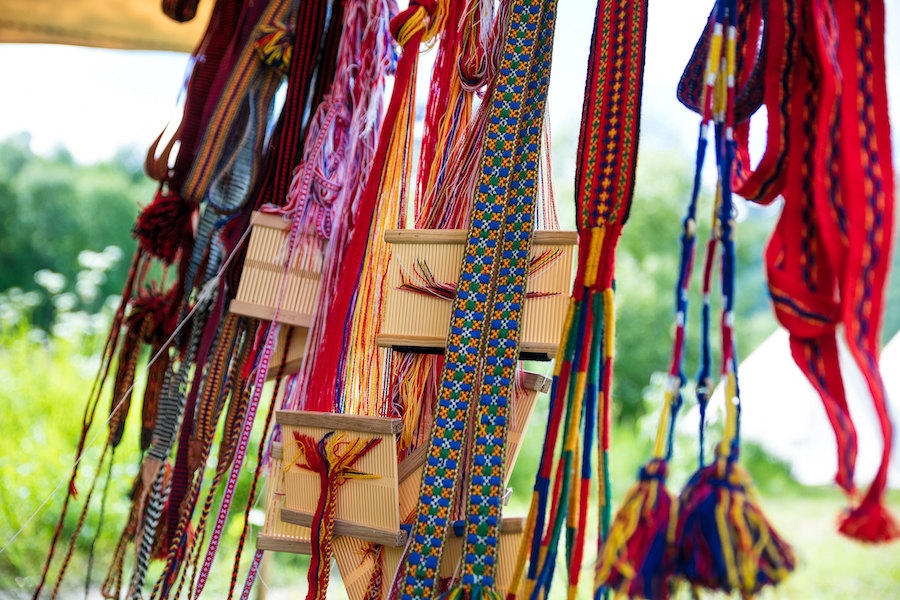
Plant dyeing is an ancient colouring technique. Yarn in different colours was made from local plants. The plant-dyed yarn was primarily used for branches, which were a highly sought-after product.
From the 1920s onwards, chemical dyes were also used, and plant-dyed yarns were rarely used in the 1950s, 60s and 70s. As demand for spruce increased, plant dyeing became common again, and spruce is now only woven from plant-dyed yarn.
Local plants were used for colouring. Purchased natural dyes such as madder, corchenille and indigo are also used for red and blue colours. A good reason for dyeing yarn is that you can utilise all the wool. Old wool and wool that is not completely white is often dyed before it is used.
The colours most commonly used for branches are: stone lichen, birch leaves, alder bark and lady's mantle.
Colouring with stone lichen:
Crush dry stone lichen and soak it in water. Layer stone lichen and yarn in an iron pot. Fill with water (approx. 5 litres for 100 g of yarn). Put the pot on the heat and heat the water to 90 degrees. Leave it to soak for an hour. Stir the pot gently from time to time. Leave the yarn in the dye bath until it has cooled, preferably overnight. The yarn must be shaken well before rinsing.
Colouring with alder bark:
Use 1 kg alder bark for 100 g of yarn. Crush the alder bark and soak it for 24 hours. Boil it for 2-3 hours. Add the yarn and leave to soak for an hour at 90 degrees. Leave the yarn in the dye bath until it has cooled.
Colouring with birch leaves:
Stain the yarn with 16 g of alum salt per 100 g of yarn before dyeing. Dissolve the alum in water and add the yarn. Heat to 90 degrees and leave to soak for an hour. Soak 100 g birch leaves, preferably overnight. Boil it for an hour and strain the coloured water. Add the yarn and leave to soak for an hour at 90 degrees. Leave the yarn to cool in the dye bath.
Watch the film about Oliva Nilsen from Manndalen who experiments with plant dyeing.
In the film, we meet Oliva Nilsen from Manndalen, who has experimented a lot with yarn dyeing. Here, she is dyeing yarn from red onion husks and stone lichen.
Oliva fires up a pot of water on a campfire in the countryside. For five litres of water, she uses five grams of salt in the water. The water should be at about 90 degrees centigrade, and the plants are placed in it to soak for about an hour. She then adds the sheep's wool yarn, which is also left to soak for about an hour.
This is Oliva's first time dyeing yarn with red onion peel. She had expected the peel to dye the yarn red, but instead it turned a deep, dark yellow colour. Stone lichen gives a nice brown colour.
Oliva rinses the yarn in vinegar water so that the colour stays on and doesn't come off. The yarn is then hung up to dry.
"In the past, only women dyed yarn," says Oliva. "It was all about housework and duodji. Even if you were busy with other work, you had to make time to dye yarn from time to time. Coloured yarn was especially necessary for the branches. Branches with plant-coloured yarn were in great demand.
Oliva also uses the yarn to knit the most beautiful mittens and blankets.
More about plant colouring
Plant colouring, Esther Haukeland, National Library of Norway
Methods and recipes for plant colouring, Sunniva Lønning, National Library of Norway
About plant colouring, Manndalen Husflidslag
Plant dyeing - recipe and tips for dyeing wool yarn and wool, naturfag.no
Current links
Interview with Sámi woman from Manndalen 1975, National Library of Norway