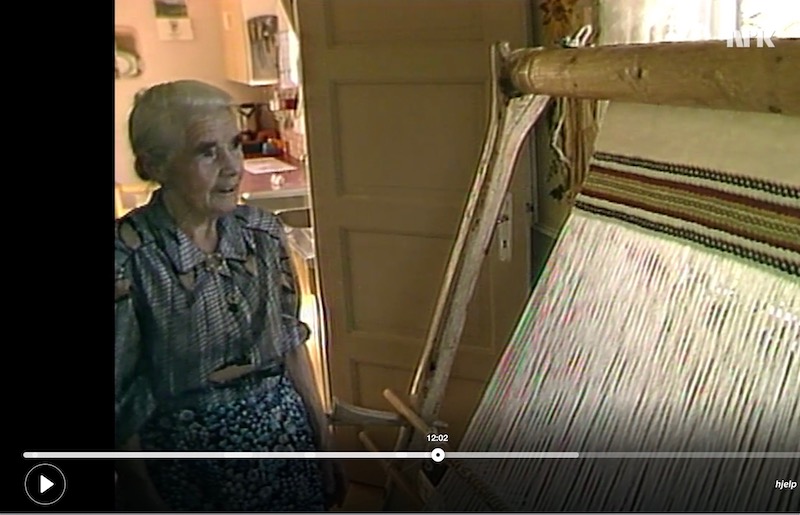
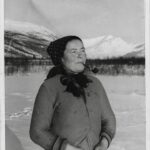
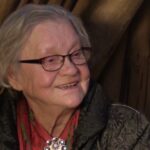
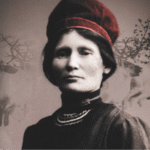
Helena learnt to weave at an early age and continued to weave day and night. She was widowed at an early age, and branch weaving became the lifeline for her and her children. She wove her way to a gold badge of honour as a handicraft veteran.
Helene Aslaksen, g. Mikalsen, Manndalen / Olmmáivággi (1905- 1996)
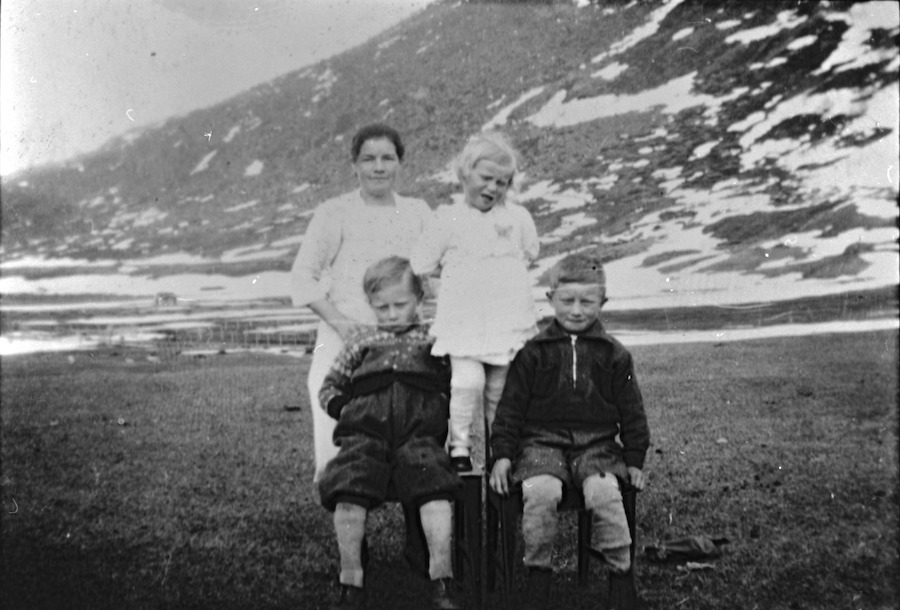
In Helena's childhood home, weaving was done on both flat looms and backstrap looms, and she learnt at an early age. She married her husband Mikal and they had three children within a few years. Her husband died of tuberculosis aged just 37. The youngest child was only a year old.
To save the farm from foreclosure, Helene had to sell animals and place the two youngest children with aunts in the village for a period. It wasn't possible to run the farm alone with three young children. The eldest, aged five, became a good labourer on the farm. Weaving and selling other handicrafts saved Helena and her small family. «Branch weaving became the lifeblood,» said Helena herself in her old age.
Oh yes, the days were never enough, I had to rely on the nights. I often wove until six o'clock in the morning. Then I'd lie down for a while before getting up and taking care of the barn.
Branches to Baalsrud
In the spring of 1943, the resistance fighter Jan Baalsrud in hiding at the top of Manndalen. The men of the village, led by Helena's brother Aslak Fossvoll, were responsible for getting him transported to Sweden. To get the reindeer herding Sami to take Baalsrud across the border, they needed two large branches in Manndalen. Aslak asked his sister Helena, and she set about the task. Over the course of two days, she wove the branches, night and day. At night, she hung cloth over the windows so that no one would suspect that something extra was going on.
Before the evacuation, valuable artefacts, including Helena's looms, were buried where there was sandy ground. Helena and her children were evacuated and lived in Svolvær for a year. After the war, the looms were found again and Helena was able to continue weaving.
Wool deliveries and handicrafts
For several years, Helena was the middleman for the village's wool deliveries. Wool was sent to spinning mills in the south via Helena. She kept the accounts herself, and the home was characterised by temporary storage of wool and people coming and going.
In the 1960s, she was one of the women who started the handicraft society in Manndalen. Branches and branch weaving had attracted external interest, and the women wanted their tradition to be preserved for the benefit of the village. Helena was a member of the first board as treasurer. In 1971, Helena was honoured by Norges husflidslag with a gold badge of honour as a husflidsveteran for her branch weaving.
"My branches would fill a large room if they were gathered in one place. But now they are scattered over a large area, both at home and abroad, including in America.
Helena is remembered and referred to as a hard worker. She was good with animals, ran the farm on her own and saved her family thanks to her skill at the loom.