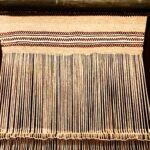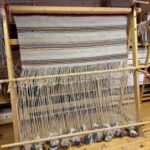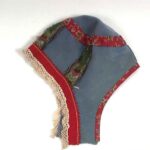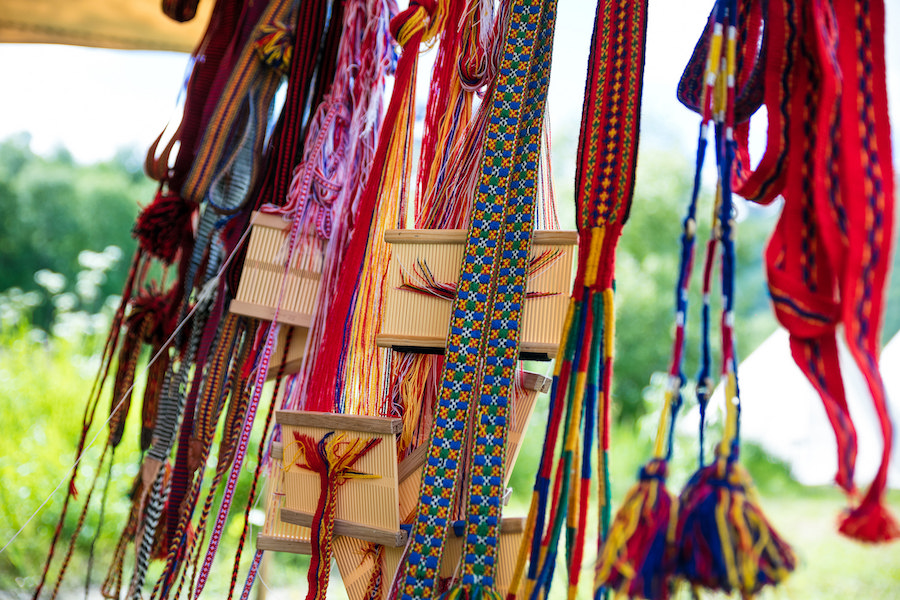
Gate weaving is an old tradition that used to be carried out by women in many Sami homes. The tradition is very much alive, and today the loom is used by both men and women.
Cowhide and skull bands, belts, cowhide bands, sack bands and more are woven on the power loom. There are many different patterns and techniques, and the combination of colours tells you which area you belong to.
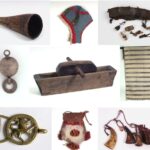
Gate weaving was originally made of bone, horn or wood, often with carvings and decoration. It was small and easy to transport and was therefore always available. The loom has also been a popular proposal gift throughout the ages.
In the different Sami areas, there are different techniques for weaving, how the grind is held or how the auxiliary tool is used. A shuttle, traditionally made of bone and horn, is used as a tool.

Komagband and skalleband
To keep the footwear on the foot and prevent snow or water from getting into the comas or shells, they were laced together with woven or braided bands. The bands could be up to 2 metres long for the men.
In Nord-Troms and the Lyngen area, men traditionally used woven komag bands, while women used braided bands. The women's ribbons were woven with 18-20 threads, while the men's were woven with 20-22 threads. Smaller threads were used for the children. Today, woven bands are also used by women.
The Sea Sami in Kvænangen considered it very bad if a boy wore a woman's komager or a girl wore a man's komager. The same goes for the komag bands. Where there is no difference between the komagas, there is no difference between the komag bands. But where there is a difference in the komags, there is also a difference in the komag bands. In Kvænangen, the men used wide, woven komag bands, but the women used narrow braided ones.
Anders Larsen, About the Sea Sami

Grind tissue collected from Ytre Bakkemo farm, Biertávárri/Birtavarre, Gáivuotna/Kåfjord, and delivered to the Norwegian Folk Museum in 1952. Ownership transferred to the Centre for Northern Peoples in the Bååstede project.