Vicious people could ruin your fishing gear, and the appearance of the fish could say something about both fishing luck and future fishing conditions. Fishermen didn't just rely on their gear, but also had to take into account hidden forces and powers that could not be controlled.
Here are some notes from Ole Thommasen and Anders Larsen.
When rowing out to sea, you should always turn the boat towards the sun. If you didn't, you wouldn't do well at sea.
You shouldn't lie about people who are at sea, because it could go wrong for them.
Seafarers who came ashore were not supposed to say anything about how many fish they had caught, because then people would start to envy them. This would make them lose their fishing luck.
When you cut a fish and don't hit the joint, the Sea Sami said: Du har løiet (Kvænangen, Kavlasund).
Malicious people could bewitch fishing gear so that the fish would not bite them. If they stuck pig bristles in the lines, there was no point in putting them in the sea until they found the pig bristles and removed them.
Women were not allowed to cut the lines when the fishermen baited them. This would cause the fishing gear to lose its fishing luck.
When the first fish they threw into the boat struck with the rod, it was a good sign. It heralded more fish.
Bahá čalbmi - evil eye
If you have normal fishing luck and are asked to show off your fishing gear, it's best not to do so, as you could lose your fishing luck. A person can have bahá čalbmi - evil eye - whose view of nature has an unfavourable effect on posterity. It is even more effective if such a person comes into contact with the fishing gear.
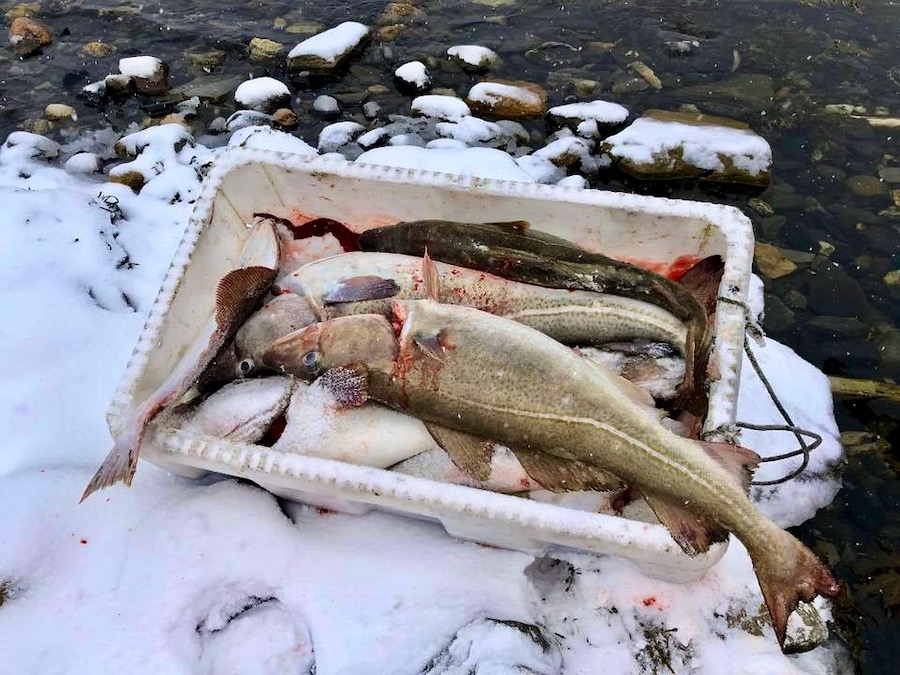
If you have rowed and caught fish, you should put the largest and most valuable fish at the bottom of the boat, especially if you have caught salmon, halibut, redfish or similar, just in case there are people on shore who you do not want to have the opportunity to view the entire catch for fear of unfavourable effects in the future.
Seine fishing
If you use a net, either with a drag net or a loop net, you are likely to catch a redfish, guorža guoli, especially lumpfish, it is considered a warning of a fishing accident, at least for the fishing trip where this occurs.
If you cast your net several times in a row without catching anything, the fishing gear may be goarton, spoilt by someone who wanted to take revenge. This type of gear is rigged in such a way that it sinks so slowly that the fish have ample opportunity not to be caught. Self-catching fishing gear, such as lines and nets, can also be corrupted to such an extent that you either catch nothing or an insignificant amount compared to others under the same time and circumstances. They are spoilt so that the fish avoid the gear.
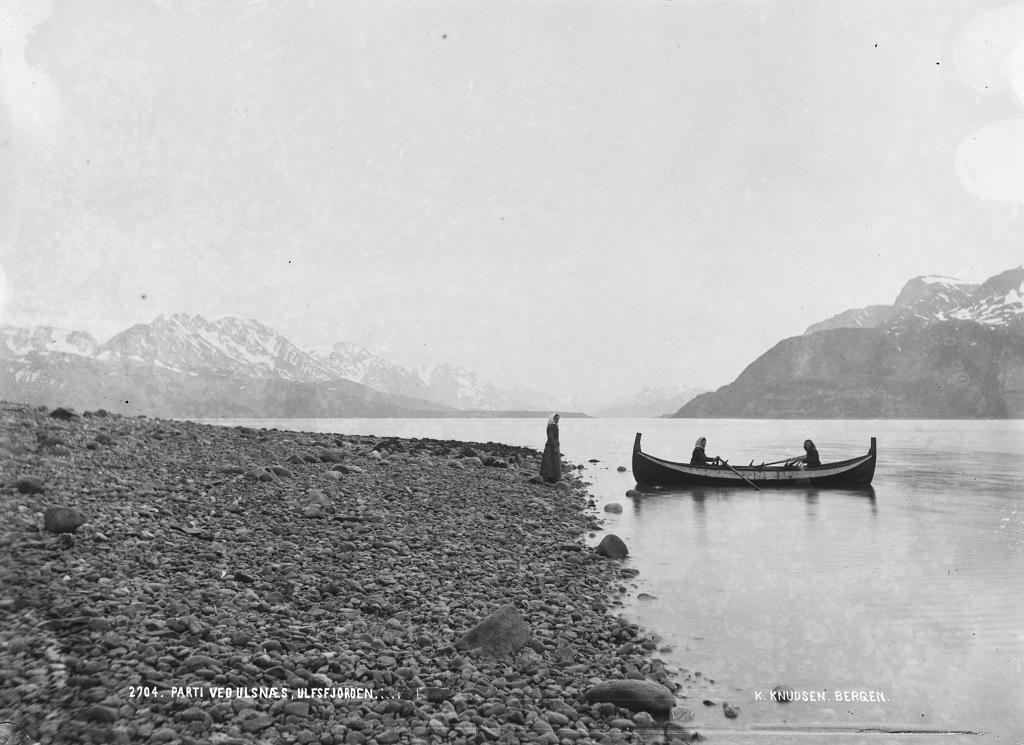
Herring fishing
If, during the herring fishery, which used to be conducted mainly with nets, a herring was caught that was redder than others, and which, within moments of being caught, turned blood red all over, it was considered a sure sign that a murderer had also arrived at the place of capture for the purpose of catching herring. The rumour of such a trapped herring, varrasallit, It was also a sure sign that the herring hunt was over, for the herring cannot tolerate that someone who has shed human blood should be hunting.
If you get a fish, of any kind, with an elevated (convex) brain capsule, more prominent than normal, it was a sign of future good luck. Such a fish is called the King of Fishes.
As future fishing luck is also such a case, when there are either two or more participants, and after sharing there is one fish left over; bázii vel nuppadássii juoga juohkit, you say; there was something left over to share next time.
My father told me that when he was young, they sometimes shot a clapper mussel. Whoever shot it licked its blood as they rowed to shore.
Anders Larsen in Om sjøsamene, 1950
The Sea Sami also used to tell fortunes by the fortune-telling bone (krukkuldakte). When they ate fish, they put the «krukkul» bone on their heads. For example, they would ask: Will there be sea weather tomorrow? If it fell wide open, it meant «no». But if it fell the other way round, it meant «yes». The Norwegians also have this custom. They call the leg «fortune teller».