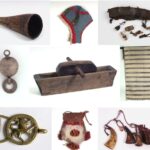
Davvi álbmogiid guovddáš / Centre for Northern Peoples has recovered a number of artefacts that can be linked to various duodji and craft traditions. These artefacts can tell us a lot about people's ability to adapt.
The artefacts also provide us with identity and knowledge about our culture, which was disappearing from our everyday lives during the Norwegianisation period. Traditional knowledge was lost, both in terms of how we make tools and how we use them, and the importance of such artefacts in terms of belonging and identity, to nature, landscapes, places, and in understanding how all of life was connected.
NFSA.1113 Guottahat / belting

The guotta hat / belt ring is made of cast brass. It is decorated with relief, a round disc with a mythical creature, a hoop at the edge and a crossed eye in the opposite direction. The width is 6.2 cm and the thickness 4 mm. Belt rings were attached to the belt and made it easy to keep necessary equipment such as a knife, scissors and sewing kit readily available for everyday duodji and other work. Niibeguottahat is a term used in older museum protocols, and is described as being used in the belt as a knife holder (Káren Elle Gaup, 29 June 2017).
NFSA.1113 The guottahat / belt ring was received by the University Ethnographic Museum in 1908 from Bertrand M. Nilsen, a deacon in the Sami mission. The letter from Nilsen, which included a list of collected artefacts (22/1908), states that this belt ring has been found at Duikkášmuotki/ Alteidet, Návuotna/ Kvænangen, North Troms. These areas have been, and still are, summer grazing areas for reindeer herding families from Kautokeino. The owner of the ring is unknown.
NFSA. 1573 Nállogoahti / needle housing

Nállogoahti/needle houses are traditionally used to store sewing needles and sinew thread. The nállogoahti/needle house itself is made of horn/bone and has a leather and cloth pincushion that can be pulled into the house. The needle cushion's leather cord has a horn bead inserted at the top of the needle housing, with a ring of horn attached to the end. The length of the needle body is 22.2 cm and the ring at the end is 2.3 cm. Both the needle body and the ring are ornamented.
NFSA. 1574 Nállogoahti/ needle case has inscription: O J N. 1910, indicating that the artefact was made in 1910. It was collected in Sálašvággi/ Tromsdalen, Romssa/ Tromsø and sold to the Ethnographic Museum of the University of Tromsø in 1918 by emissary Lars Larsen.

Nállogoahti/the needle house is a practical object that is easy to carry around. The artefact also tells of the close historical relationships and interaction between reindeer herding Sámi and permanent Sámi populations.
The photograph shows a woman working with duodji, showing her horn belt ring to the photographer. Necessary duodji tools such as a needle case and scissors are attached to the belt ring.
The photograph is from Anna Grostøl's collections (Norwegian Folk Museum). Grostøl was a teacher and folklore researcher who gathered knowledge about handicrafts and craft techniques and working methods from all over the country. The collection contains photographic material and notes from her work in Troms and Finnmark 1947 - 1955.
NFSA. 1568 Duhpátbursa / tobacco pouch
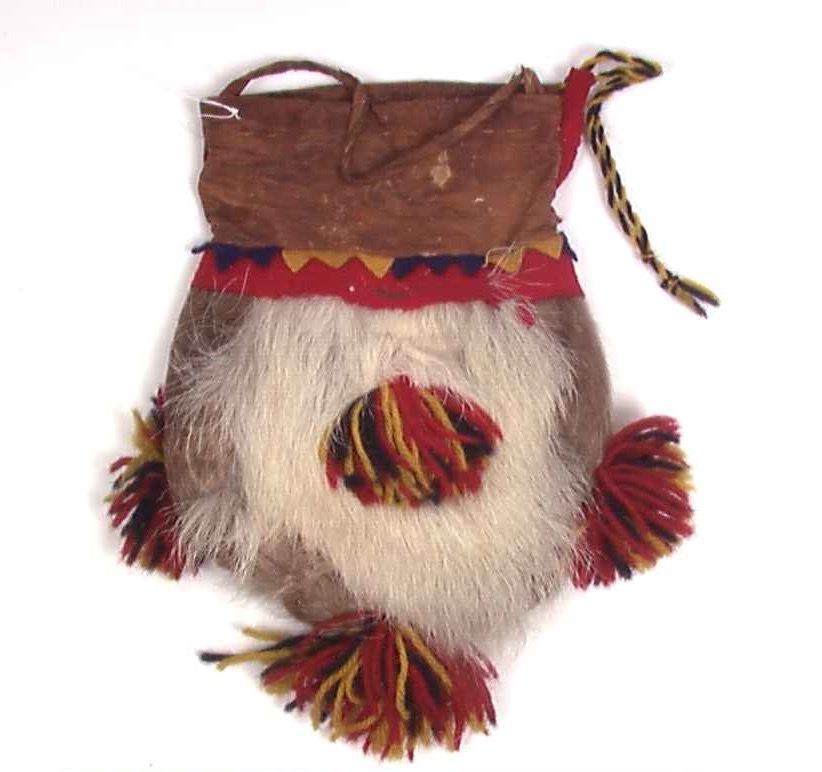
NFSA. 1568 duhpátbursa / tobacco pouch is made of reindeer skin and decorated with red wool fabric and zigzag borders in yellow and blue, and tassels of wool yarn in red, yellow and blue colours. The purse closes with a ribbon of twisted wool yarn and has a leather cord for hanging. Length 20 cm and width, without tassels, 13.5 cm. NFSA. 1568 was collected in Sálašvággi/ Tromsdalen, Romssa/ Tromsø and sold to the Ethnographic Museum of the University of Tromsø in 1918 by emissary Lars Larsen.

NFSA. 3138 Niikun/ belt gate

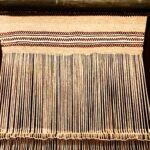
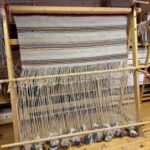
Ribbon grinders have been important in the manufacture of essential textiles such as komagband and in the ginning process of branch weaving.
This small niikun/ribbon gate is made of horn. It shows signs of having been used a lot and has been repaired with steel wire. Length is 12.2 cm. and width 7 cm, it has 12 slits with a double set of holes. NFSA. 3138 was collected from Ytre Bakkemo farm, Biertávárri/Birtavarre, Gáivuotna/Kåfjord, and came to the Norwegian Folk Museum in 1952.