When people live in close contact with nature, their spiritual beliefs are also strongly characterised by this. In the Sami worldview, nature was filled with powers and forces that people had to relate to.
The physical and spiritual contact with nature was necessary to live, it was in nature that they found their anchors.
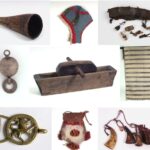
Spiritual culture is rooted in our regional landscapes and the living conditions that have shaped worldviews, beliefs and worldviews that are still with us today. The artefacts being returned are carriers of elements from ancient Sami nature religion, customs and traditions. Healing traditions are important elements in this, as illustrated by a smallpox horn.
NFSA. 3129 Guhppenčoarvi/ koppehorn
NFSA. 3129 Guhppenčoarvi/ cup horn is made of horn and is elaborate with a carved spout and is ornamented with stripes at the top. Length 10.5 cm and top width 5 cm. The artefact has been used in Njoaski/ Njosken, Moskavuotna/ Ullsfjord. It was produced by Ole F. Nilsen, Sørstraumen, and was received by the Norwegian Folk Museum in 1952.
Cupping horns were used for healing / curing. Cupping as a method of healing is described by Ole Tommassen in The Lapps' relationship : «Cupping is used in such cases when the pain is more concentrated in a particular part of the body, and was used where the pain was centred, for example in headaches, backache, chest pain, pain in the arms and sometimes in eye and ear infections« (1999: 116).

NFSA. 0139 Einnostanávvi / divination belt
The Einnostanávvi / divination belt is an artefact we consider to be very unique. It is associated with the ancient nature religion of the Sami. From our region, this is a rare, distinctive and precious artefact, and it's great that it's being returned to the area where it belongs.
The Einnostanávvi / divination belt is a wide leather belt, with attached leather cords with leather pouches and stones (rocks/gems/jet) with fossil imprints. It is approximately 54.5 cm long and 5.4 cm wide. The belt is ornamented with symbolic figures carved into the leather: hearts pierced with lines, an all-seeing eye in a triangle with crosses on the sides and lines of different lengths. A total of four stones and eight small leather bags, or pieces of them, were attached to the belt. Einnostanávvi / divination belt is from Bassevuovdi / Helligskogen, Oamasvuotna / Storfjord. The fortune-telling belt dates from around 1750 and was donated to the University's Ethnographic Collections in 1903.
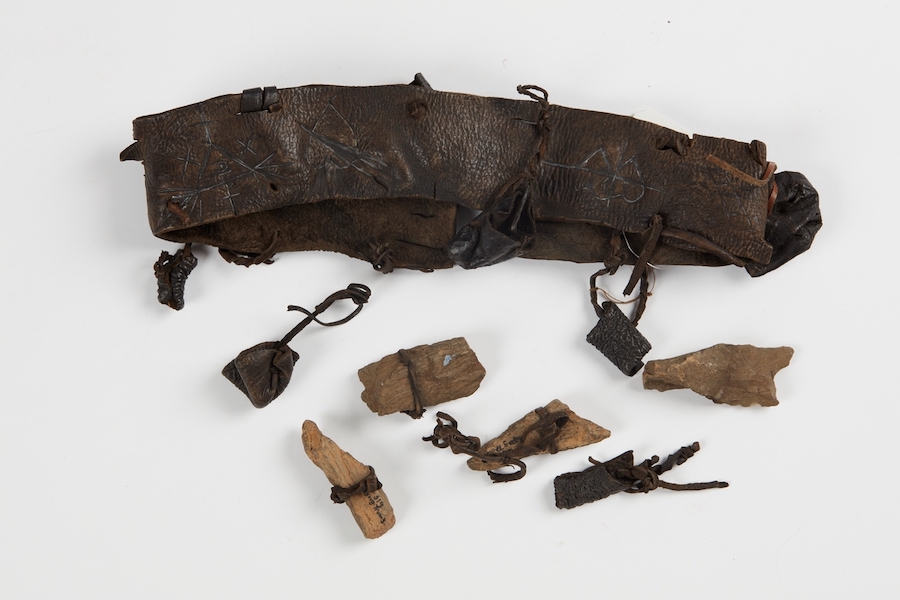
This einnostanávvi / divination belt is labelled as Women's belt of leather and wrinkle ring in older museum records. It has been described as being used for healing and to see into the future. Yngvar Nielsen, historian and director of the Ethnographic Museum, 1877-1916, has described einnostanávvi / the divination belt: »Through a conference with QUIGSTAD, it was later revealed that the practice of taking warnings of things to come by looking through a woman's belt has really been known to the Lapps, if only rarely mentioned. It is therefore reasonable to assume that a very valuable piece has been acquired here, shedding light on old Lappish superstitions» (Nielsen 1907: 94f.).
NFSA. 1579 Šiella/ silver bullet, silver dagger
Šiella/silver ball, silver dagger is made of silver and has ring fastenings at both ends and a flat ring in the bottom fastening. The ball is 3.4 cm long and 1.3 cm in diameter. The Šiella/silver ball was collected in Sálašvággi/ Tromsdalen, Romssa/ Tromsø, and sold to the Ethnographic Museum of the University of Tromsø in 1918 by emissary Lars Larsen. Šiella/silver balls have been described as protective and auspicious amulets, and as comet balls. (The term njiehceboallu is also used for such comet balls. Reference: Duodjeinstituhtta, Kautokeino. Káren E. Gaup, 22 May 2017).

Silver balls and silver daggers are also used as decoration on silbarahka/silver collars. Ole Thommassen describes silbarahka/silver collars in Lyngen: «In the same way (with crow's silver) a garment was made, which was only worn around the neck of the women, and whose edges reached a little way down the chest, shoulders, neck and back, but not so far down that you needed armholes. It was only worn for formal occasions, and was made of dark blue cloth with a strong lining inside... It was fastened at the front with small round silver studs, which served as buttons. It was usually edged with silver-plated ribbons, and the above-mentioned silver daggers were also attached along the edge and around the neck. Its name was silbarahka». (Thomassen 1999: 40).
On this silbarahka/silver collar, which is said to be from Senja in Troms, you can see the same type of šiella/silver ball, silver dagger attached to the upright collar.

NFSA. 1570 bearalčikŋa silbaboaluin/ pearl necklace with silver ball
Bearalčikŋa silbaboaluin/ bead necklace with silver ball is made of coloured glass beads strung on twine. Chain length: 37 cm, the diameter of the beads is 0.9 cm. A silver ball with 5 small rings is threaded into the centre of the pearl necklace. This type of silver bead is also known as a cress bead, a protective and auspicious amulet.
NFSA. 1570 was collected in the area Sálašvággi / Tromsdalen, Romssa / Tromsø by emissary Lars Larsen, and sold to the University Ethnographic Museum, 1918.
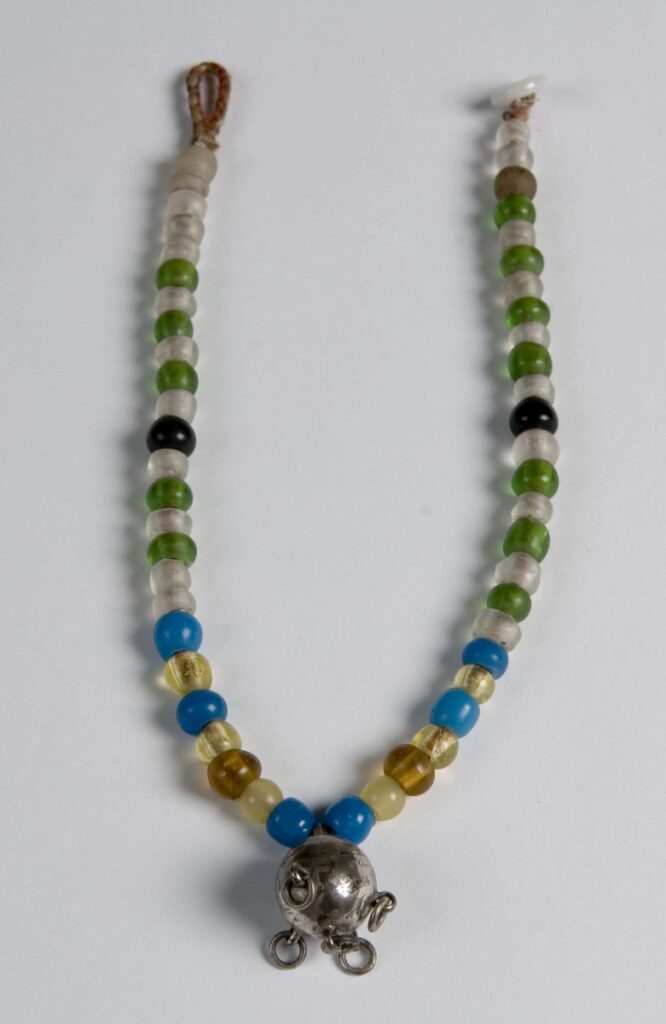
The artefact refers to the connection between spiritual and material culture. Such chains were used for protection, for example by hanging on the child's chest.
The Centre for Northern Peoples will receive a copy of this item.