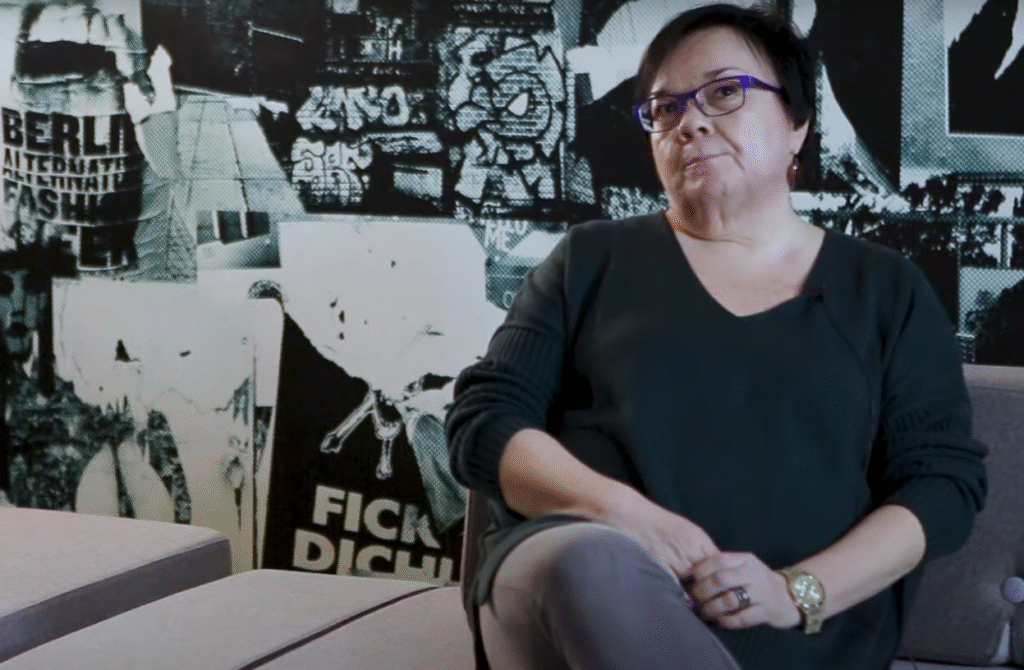
Author Bente Pedersen from Skibotn talks about her Kven and Sea Sami background, and about her writing.
I'm from Skibotn, which has been a gateway to Norway for many Finns, where I grew up in a family with three cultures: Sea Sami, Finnish and Norwegian. When I grew up in the 1960s, everything was of course Norwegian. But when I became a teenager, I realised that we were also Finnish, because the secret language in my home and in my village was Finnish. When the children didn't want to hear or understand, the language changed from Norwegian to Finnish. We always heard the expression: «small boilers also have ears», and then the interesting stories were told and we understood nothing. My mother spoke Finnish, and my grandmother spoke Finnish and Sami, because her mother was Sami and her father was Finnish.
We grew up in this «boiling» culture, and it was layer upon layer. At the top of the «status pyramid» you had Norwegian, then came Finnish, then came the Reindeer Sami, and finally the Sea Sami, which was our background. The Sea Sami were the lowest of the low.
Of course, this has changed over the years. Now people are digging into the cultures. But it's still very hard for my mother's and my grandmother's generation to say that they have a Sea Sami background. My grandmother died in 1996. In the last year she was very ill with cancer, and we talked a lot about family and where we came from. She often said she wished she knew more about her mother's story, about where she came from. I looked up where her mum came from on the big internet. She was born in a village just across the fjord. We should have known her story, but we didn't, because she had that shameful Sea Sami background. We knew everything about my grandmother's father's side. The family that came from Tornedalen. We had loads and loads and loads of stories about the Finnish, and it helped a lot that my great-grandfather's mother came from the Grape family. If you dug deep enough in this family you could even find wall signs from relatives from Germany. Those were the good stories, and that's what we heard, but we didn't hear anything about the Sea Sami.
It's still hard for my mother's and grandmother's generation to say that they have a Sea Sami background.
These were the people who fought, and up until the end of the First World War, Sea Sami and Norwegians had the same status in the village. They did the same jobs, they fished and farmed, and they had the same poor houses. They traded flour for fish from the Russians who sailed around the fjords. In 1917, this trade stopped as a result of the Russian Revolution. When you could no longer get flour from the Russians, you had to buy flour from the Norwegian merchant. Now the Norwegian farmer suddenly had a lot of advantages, because he understood the language and was almost on the same level as the merchant. The Sea Sami only knew Sami and had fewer opportunities to interact with the merchant. From 1918, the Sea Sami became the poor in the small villages, because they no longer had the same opportunities as the Norwegian farmers. From then on, it became shameful to be a Sea Sami. They were seen as dirty, poor and worth less than the Norwegians. Of course, people weren't stupid. They no longer wanted to be Sea Sami, and they tried to learn Norwegian and adapt to Norwegian culture. Sea Sami more or less died out. My mother's generation still says that maybe they spoke Sami, but they didn't wear Sami clothes, so they weren't really Sami. The language died out, it took three generations before the language was gone. When you lose the language, you lose part of the culture. They wanted the best for us, of course, when they wouldn't teach us the language. They wanted us to have every opportunity in Norwegian society. But it would have been nice to know both Sami and Finnish. After all, language is the greatest carrier of culture in the world. Through language, you express yourself and tell your story, and pass on stories and knowledge to the next generation. We lost the fairy tales, the songs, the music, everything. We became Norwegian.
"They wanted the best for us, of course, when they didn't want to teach us the language. They wanted us to have every opportunity in Norwegian society. But it would have been nice if we knew both Norwegian and Sami.
In my region, in the period between the world wars, Finnish families received Norwegian weeklies for free. This happened in Lyngen, in Finnmark, and all areas where many Finns lived, because the idea was that they would learn Norwegian culture in a «friendly» way. Of course, people like everything they get for free, so of course they read the weeklies. It was very common in the 60s when I was growing up for everyone to have magazines, and you might wonder why, and ask if everyone had bad taste? I found out that the state actually gave money to this project, and that the priest and the military picked out the people who needed these magazines. I always say that it's not a flaw in my cultural upbringing that makes me write novels, it's part of my cultural heritage. They also had boxes of books of Norwegian literature in these places on a permanent basis. In Skibotn, we had hundreds of really good Norwegian books that gave us Norwegian culture, right up to the 1960s, until the regular libraries arrived. They did their best to make us Norwegian, and we became Norwegian. People knew that if you kept your mouth shut, they would get the jobs that the state provided, and that was important in small villages like Skibotn. The generation before me knew that if they had Finnish names, you wouldn't get land near the border. It was accepted, and they took Norwegian names, and allowed the Finnish names to disappear. Only a few families have kept the Finnish name.
They did their best to make us Norwegian, and we became Norwegian.
I came across a number of stories in the 1980s, when I was studying to become a teacher. Among other things, I came across a little sentence that said that people from the Torne Valley sold their children to the Sami, who took them to Norway. It was frightening and felt wrong. But at the same time, I remembered that my grandmother used to tell me that her father's foster mother came to Malangen with the Sami when she was five. I had never asked any questions about the story. But then I asked: did Eva come over here alone? Well, yes, I thought you understood. I didn't, and then I started digging to try to find out what really happened. It was a time of poverty, of course, and desperate parents sometimes had to send their children to Norway, where they might find a home. The Sámi who travelled back and forth between their seaside summer homes in Norway could take these children with them. This was mainly in the early 1800s, but also in the 1860s, which were really hard years in northern Finland. We find these children in written sources when they are confirmed, they have no parents, they might remember where they come from, and you might find some words in the church books, saying that they are sold for five riksdaler, 10 riksdaler, 2 barrels of flour, maybe a cow. We don't know, and that's what's so sad, that people haven't dug into this. I know there was a lot of writing in Swedish newspapers around 1838-1840. We have Lars Levi Læstadius, who said that the parents themselves had sent their children with the Sami or with relatives, and he thought it was OK that the Sami received some compensation for the journey when they came to Norway. But many people were against this, and because of all the writing, the practice died out around 1840, until it started again a few years into the 1860s.
My great-grandfather's foster mother arrived in 1858. I found her story. She was born in the Karesuando region. Her mother died when she was five years old. Her father wasn't able to keep the children together, so all the children were scattered, and Eva came to Norway. We also know that the poor children in Norway, Sweden and Finland were put up for auction, where they were placed in families and the families were given some money to take care of them. Those who demanded the least got them. It was a kind of sale of children, before we had the welfare institutions in Scandinavia. I've heard that this happened right up to 1910 in my region. There was a lady who was «sold» in this way when she was two years old. But I read the laws, and according to the laws, this should not happen anymore in Norway in 1896, but from saying that something should not happen, until it actually no longer happens, can take time. It can take as long as 10 years, but that's another story we don't want to tell.
We know of families who have inherited the farm they came to, because they came to families that had no children. But we also see that many of them became servants and probably didn't have a good life. You have to dig into the church records and try to follow them to find out what happened to them. It has been little explored.
When I started writing, I started writing about the girl who came here from Finland. From the moment the book came out, I got phone calls from people telling me about their great-grandmother or great-grandfather who had the same fate. There must have been at least a few hundred, and there were many, when you realise how few people lived in these areas. In the 1860s, they didn't just come over here with the Sami. They came with relatives, or other people who were also Finnish or Swedish, but the parents sent one or two children with someone they knew. But, again, we don't talk about the sad stories. We don't want to know about what's painful. So there wasn't much talk, and even in Norway, there is little knowledge that a hundred years ago children were put up for auction, because no one could take care of them. "When I tell these stories, people look at me strangely. They don't want to know, because it's painful. Of course it's painful, but it's part of our stories.
We don't talk about the sad stories. We don't want to know about what's painful. Of course it's painful, but it's part of our history.
I haven't found much, you have to imagine a lot. I know that our Eva was a thin, little lady, who became a dedicated Laestadian. They didn't have children themselves, but took in children who didn't have parents. My great-great-grandfather lost his parents in 1882. They came from the Muonio area. Josefine was 18 years old and Kalle was 31 years old when they started travelling. He was a farmer's son and she was a priest's daughter. There are some indications that her family did not like her choice of husband. She was pregnant when they started the trek. The eldest was born in Pajala and was baptised by Læstadius. They came here in 1860. They had their little home, 11 children, three of whom did not survive, and in 1882, when she was forty-something and he was fifty-something, they both died of influenza three weeks apart. Marie, who was 22, got married one day in June, and two days later she buried her parents. Those who died in the winter back then could not be buried until summer. Two days after the funeral, she baptised her youngest brother Fredrik and took him to Kvænangen. There he grew up with her family. The other children were scattered. Another flock of youngsters that were scattered around. My great-grandfather Jakob lived with Eva and her Johan. He inherited the farm.
When you start digging deeper into these villages, you find many of these stories. Broken families, families that stick together, help each other and fight. There's no wealth, just small grey huts, fishing - the hard life on small, small farms.
There is no wealth, just small grey cabins, fishing - the hard life on small, small farms.
In Norway, we are good at long historical series. The first was Kjell Hallbing, who wrote about the Texas Ranger, which was a big hit. Then they realised that women read more than men, so they had to find someone who writes for women, so they headhunted Margit Sandemoe, who is a big name in Sweden, Norway, Denmark and Poland and has sold more than 30 million books. She showed that it is possible to write historical novels about women. In Margit's novels, there was a mixture of several worlds, and they wanted someone more down to earth. "I had been writing for magazines since I was 16. I financed my studies by writing about true love. When I came across the story about the children from Tornedalen, I was 22 years old and thought that of course I could write the story. I rang the editor and asked if he thought it was a good idea, and he was stupid enough to say yes.
When I was 23, I sent the first draft of the book, and it was sent back and forth many times before it was finally published. They really didn't know if northern Norwegian history would catch on, and they didn't know if there had been enough northern Norwegian history for it to become a series. This triggered me, and I said that I could write from around the 18th to the 20th century, and that there would be twelve books. I wrote the story of Raja covering the period 1718 to 1752, and it turned into 40 books. It took 10 years of my life, but it made it possible for me to write. I've written seven series since then, and have just published my 200th book. I've been published in all the Nordic countries and in Poland. The Raja story didn't do so well in Finland. The explanation is that no-one in Finland wanted to read about that time when Finland was poor. I've sold around eight or nine million books.
I write about women who are outwardly active, who are not objects but subjects in their own lives. I think that even people who like to read about love want strong heroines.
Next week I'm launching a new series. It's set in Tromsø in the 1920s. I find the time between the two wars very fascinating. It's a time when, if you're a woman from a rich family, you could study, you could become a doctor. I saw a picture of a beautiful lady on the tail of a Norwegian plane. They told me she was the second Norwegian female pilot in Norway, and she was born in Narvik. I had never heard of her story. She was born around 1908. I thought, when will I write about a girl born at this time, who learns to drive a car and learns to fly, and can go as far as I want her to go. I write about women who are outwardly active, who are not objects but subjects in their own lives. I think that even people who like to read about love want strong heroines. They are very strong women. After my first Raja story, there was a professor in Bergen who said that my stories were not historically correct, because in my books women were at the top during sex, but according to him women were not at the top until around 1950. I don't think he could have known about women from the Arctic north.