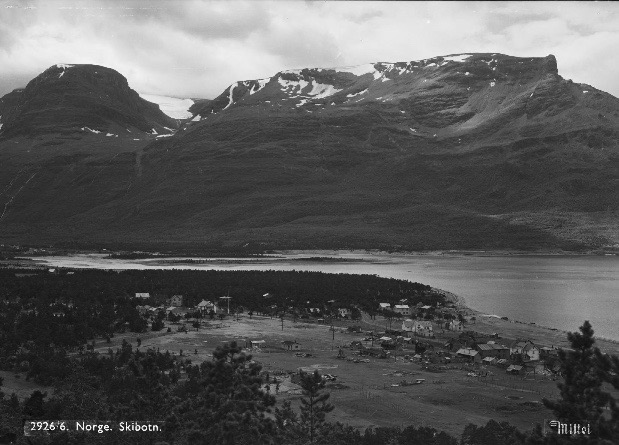
In Skibotn, Storfjord, was one of the most important markets in Northern Norway, Ivgobađamárkan / Skibotn Market. The market was a natural meeting place for people from inland and coastal areas.
The Skibotn market has roots that probably stretch back to the Middle Ages. At the old marketplace Nálluvuohppi in Skibotn you can clearly see goahtesajit / gammetufter in the terrain. In 1820, the market was moved to the north side of the river, to what is now known as the market square.
The market was a meeting place for reindeer herding Sami, traders from the Torne Valley, Norwegian traders and Norwegians, Sami and Kvens from the market's neighbourhood.
Until 1916, the market was organised three times a year: January, March and November. After 1916, the market was organised twice a year: 20 February and 12 November. The earliest markets could last from one to two weeks, but gradually the market days were reduced to 3-4 days.
For a long time, Torenå was a centre for a significant flow of trade goods from the northeast (the Kola region) and eastern Russia to northern Norway, and a flow of stockfish went in the opposite direction. The same trade routes were used by the Sami with their seasonal reindeer migrations. There was also room for people in this traffic, and many Kven immigrants to northern Troms and Finnmark followed these trade routes with Skibotn as their gateway.
Lapp market and women's market
The autumn market was often referred to as the Lapp market, but the market after Christmas was called the Kven market. The November market was the largest and coincided with slaughter time. During this time, the men were also home from fishing and could participate. The weather in the autumn could present challenges for the Finnish traders, who travelled the long way from Tornio by reindeer and sleigh, and later by horse and sleigh.
People travelled by sea from the surrounding fjords. Nordland boats were lined up below the market square. From 1870, there were local boat calls to the market, which carried merchants from Tromsø and elsewhere.


Goods of all kinds
For many people, the markets were the highlights of the year and expectations were high. They attracted people from all over the North Calotte, and large quantities of goods of all kinds, both necessary and unnecessary, were sold. For the women, the market was an opportunity to find paid work through the sale of various duodj products, such as knitted clothes and branches. The men sold salted and dried fish, but also frozen fresh fish. The Finns in particular bought a lot of herring and other fish. Other important products were butchery, leather and blacksmith products. Although the market offered a wide range of goods, it was primarily the essentials such as flour, semolina, syrup, coffee and brown sugar that were brought home in the sack. From around 1900, margarine became a popular commodity.
From the market in 1900, the newspaper Morgenbladet was able to report that around 40,000 grouse and 3,000 reindeer carcasses were sold at the market that year. Liquor was a big item, but after 1900 there was no open sale of alcohol in Skibotn, although a good deal was probably sold in secret.
In the interwar period, rolled tobacco, soap, hand cards, bench cards, cotton yarn, top sugar, linen, reindeer sinew and mullet porridge in tins are said to be popular products.
The market also featured wonder packs, jugglers and the sale of hot dogs.
Rented out house and stables
The small village of Skibotn attracted up to 1,500 people during the market period. For many of the locals, the market meant an extra income through the rental of sleeping space, stable space and hay for the horses. People even moved into outbuildings or attics. People camped on the floor in both the kitchen and living room. The merchants usually slept in a room in the shop, but the most prosperous rented rooms in the hotel in the centre of the shopping street.
Laestadianism and the market
The market eventually became a place where the Laestadians held their conventions. First in private homes and later in the prayer centre in Skibotn, which was built after fundraising initiated by the preacher Anti Pieti in 1875. The prayer house has been extended several times, but space is still at a premium when around 2,000 travellers meet for a meeting at market time. Right up to the present day, interpretation into Sami, Kven and Norwegian was provided at the meetings. The Kven language gradually disappeared and today interpretation is only provided in Norwegian and Sami.
After the war, the winter market was cancelled. The autumn market continued for a while, but eventually it also ceased. Developments in communication and retail made the market redundant. The tradition of the læstadian convention has been maintained during the market period.

Relevant links and sources
North Calotte trade was already taking place here in 1608, NRK 2019
Skibotn marketplace, Nord-Troms museum
Market trade and Laestadianism, Ingebjørg Hage, National Library of Norway
Markkinat ja lestadionismi : Skibottenin markkina-alue , Ingebjørg Hage, National Library of Norway
Márkangávppašeapmi ja lestadiánisma : Ivgubađa márkanšillju
Market history, Nord-Troms museum
Merchants and merchandise, Nord-Troms museum
The exhibition marked and Læstadius, Ole-Bjørn Fossbakk, Årbok for Nord-Troms, 2002
Marked va gammel god tid, Yearbook for Nord-Troms
The Skibotn market, Yearbook for Nord-Troms 2005
Markedet i manns minne, Olav Seppola, Årbok for Nord-Troms
The Skibotn market in the 1900s, Reidun Mellem, Årbok for Nord-Troms
Skibotn marketplace and village, Ingebjørg Hage, Årbok for Nord-Troms
Lyngen regional history, volume 1
Lyngen regional history, volume 2