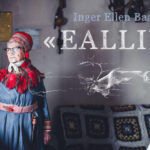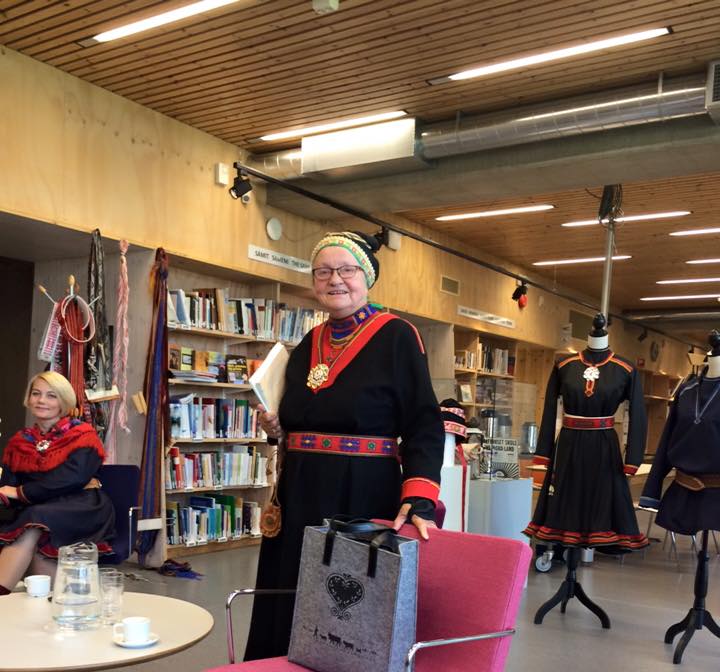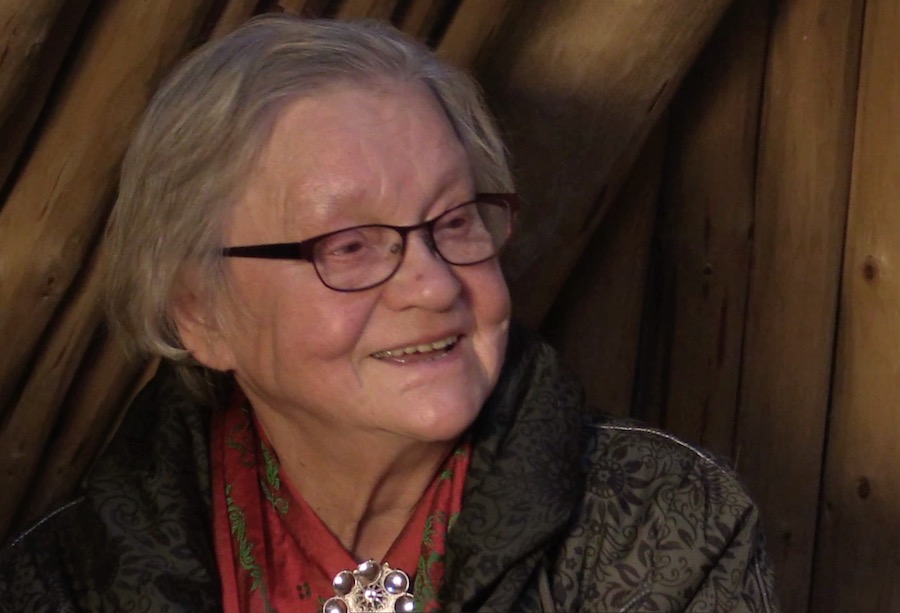
Mary Konstanse Mikalsen Trollvik (1935-2022) from Manndalen in Kåfjord was a strong and fearless pioneer in politics and duodji.
AN IMPORTANT POLITICIAN
Mary Mikalsen Trollvik was an important politician who left her mark on Sami politics for many years. She was active in local politics at an early stage, belonging to the Centre Party.
She was a member of Kåfjord municipal council for several terms. She was also deputy mayor of her home municipality from 1978-79 and a member of Troms County Council from 1980-1983. Between 1980 and 1989, she was a member of the government-appointed Norwegian Sami Council, the forerunner of the Sami Parliament.
When the Sami Parliament was established in 1989, she was elected for the Norwegian Sami National Association (NSR) for two terms until 1997. Mary was the Sami Parliament's first vice president from 1989-1993.
Mary had a big heart and commitment to Sami issues. Even after her time as vice president and Sami representative, she was an active member of NSR's local Gáivuona NSR - now Ivgu Sámesearvi NSR.
A RESOURCE PERSON IN DUODJI
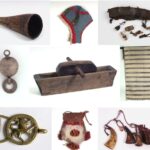
Mary's commitment to duodji was extensive. In 1966, she helped to start up Manndalen Husflidslag. It was first and foremost the desire to preserve the old branch weaving tradition that was the reason for starting a local handicraft organisation. They also recognised the importance of preserving traditions, culture and identity by passing on the area's duodji traditions through courses and training.
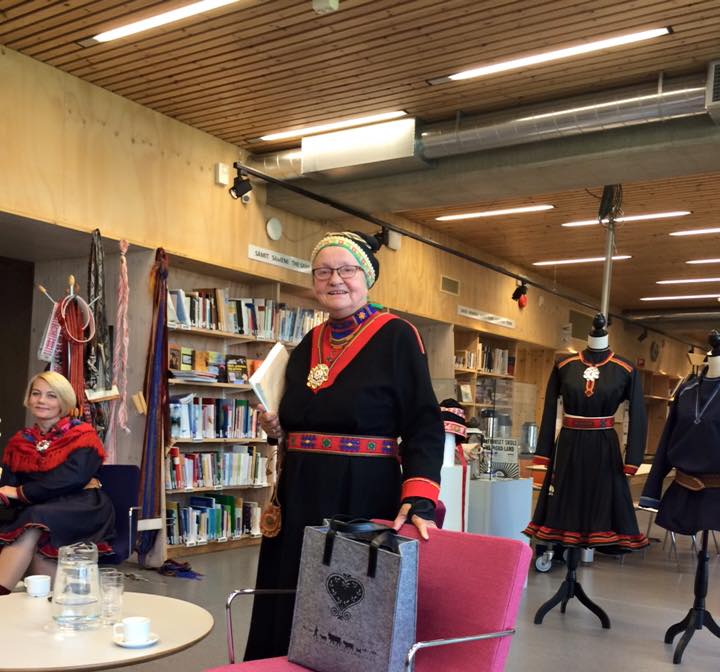
Mary was one of the initiators and driving forces behind bringing Lyngenkofta back into use. The first versions of Lyngenkofta were sewn for the opening of the first Sami Parliament in 1989. They were made for the two Sami representatives Mary Mikalsen Trollvik and Lars Nilsen Marakat from Kåfjord. For a long time, these were the only Lyngenkoftas in existence.
Read more here:
Mary has been an active member of both Troms Husflidslag and Troms Sámi duodjii, and in 2014 she received the Norwegian Husflidslag's gold medal of honour for her work with handicrafts and doudjii.
In 1997, Mary was awarded the King's Medal of Honour for her work.
ABOUT LIVING IN A RANGE
Mary was born in 1935, she was the oldest of her siblings. Even though she was a child, she remembers what it was like to grow up in a range.
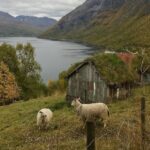
– I was born in my grandmother's house, but my father couldn't afford to build a house, so he made a range for us to live in. He made a house gambrel - a square gambrel. The material was birch wood that had been drilled and split, and added to the wall. We had a table on the floor and a stove where we cooked and kept warm, and other furnishings that you have in a small home, tables and chairs and stools and things like that. There were windows in the hut, so it was more like a house than a hut.
When we celebrated Christmas, we didn't have a lot of presents and stuff, but when we went shopping we had things wrapped in Christmas paper, and my mum stuck the Christmas paper on the walls, and it was so nice. So we lived like most people. I remember the farmhouse as a very cosy and good place to live. We were never cold, it was warm and cosy there. At my grandmother's and other people's houses, the simple windows froze, so there was ice. When the day came, it started to run off the windows. So they took woollen yarn and put it on the windowsill, then the yarn went into a bottle, so that when the ice melted, the water ran down after the yarn so that it didn't run onto the floor.
I remember Gammen as a very cosy and good place to live in. We were never cold, it was warm and cosy there.»
Then I remember that my mum had a lot of younger brothers, and in Manndalen we had the custom of making New Year's elf trains. I remember my uncles sitting with us and making masks, and the more imaginative and ugly they were, the better it was.
- There was only one room in the barn itself, but there was a large corridor on the other side, where we kept flour and other foodstuffs. And that's where we kept firewood and whatever else we might need in the fireplace that was fixed to the hut. We walked through that shaft when we went into the hut.
There was only one room, and there was mum and dad's bed, which was a pull-out bed that you could push together during the day so it didn't take up so much space, and pull out again at night. The two youngest children slept with them in that bed. The two of us who were a bit bigger had our own little bed, and there was room for it.
At that time, there were perhaps a couple of families who lived in a range. And there was one family that had animals in the same gable. The gamma was such that there was a corridor in between where the animals and people lived. Otherwise, people tried very hard to get a house, because it wasn't so good to live in a gite. We thought we had it good ourselves. We had a floor in the barn. My mum used to scrub the floor with sand a few times to make it look nice.
People tried too hard to get a house. Because it wasn't so good to live in a range.
- I can imagine that I was 6-7 years old when we got a house. His dad bought an old house from people up in the valley. He moved the house down and put it up, and then we got a loft. I can't believe we got a loft. We could go up the stairs and sit in the loft and look far out. We thought that was fun, as we'd only ever lived in flats. But it was also just a living room. We had stairs that went straight up to the loft. And we had simple household items, and the furniture there was the same as we'd had in the gamma. We also had a hallway on the outside, which was probably a bit more densely built than the one we'd had in the barn, but which served as storage for everything we needed.
Evacuation
– When we evacuated, there were six of us, and I was nine years old and my youngest sister was two months old. Then came the evacuation order, and people had no intention of travelling anywhere. So we had to hide ourselves away so they wouldn't find us, and people went to caves here and there and built themselves huts to stay in. My father and his brother and a couple of neighbours got together and built a hut up in the valley. The hut was probably a bit bigger, because there were a lot of us in that hut. Our escape up to the hut was very well prepared. There were four families up in that hut, and everyone had a cow each. It was important to have a cow that milked, because you had small children who needed milk. The cows were lined up at one end of the barn, and the people at the other end. We had the same doorway. There was no corridor between us and the cows, but they helped to keep the barn warm, even though there was one of those boat stoves that we fired up. And when we needed fresh bread, my mum and a few others would make these flapjacks, which we clapped between our hands and baked on top of the oven. You could even press them against the side of the oven and bake them there too, because it was so hot.
"When the evacuation order came in earnest, we realised that we had to escape. It was in November, but there was no snow in the fields. There was no snow at all that Christmas. The ground was bare and we crossed the Manndal river a little way opposite where we lived, because there was a place where it was easy to get across. Then we went up to Kjerringdalen, crossed the river and then continued on the other side of the river. The Germans had rounded up all the cows they found in the village and put them in a fence. It was a terrible scene. The cows were shouting and howling when we walked past them. It was scary, almost the worst part of the whole escape. We just walked past them and continued on up the valley until we got a little past where the dam stood up in the mountains. Then it started to get dark, so we had to go into a haystack and sleep while it was light, so the Germans wouldn't see us.
The Germans had rounded up all the cows they could find in the village and put them in a fence. It was a terrible scene. The cows screamed and howled when we walked past them. It was scary, almost the worst part of the whole escape.
– When we woke up again in the evening, we were rested and awake and went up to the pond. Then our lives continued there. We were there for a week. One of the neighbours, a single man, cycled down and brought us things we needed along the way. We were there for a week, but suddenly seven young German soldiers came up to the hamlet. We didn't realise how they had found us, but we assumed that they had seen people who had walked in the mountains, as did several people who lived with us. During the day, they took a walk up through the mountains. Anyway, they came and said we had to be at the quay in two hours. Then they lit the fire and took our four cows. The soldiers each rented a cow after the mountain. We stood outside and couldn't say anything. They just left.
I wasn't scared. I was most scared when we went past Kjerringdalen and heard that cow mooing. I thought it was very sad. We knew what was happening. The cows were locked up there. It was scary.
I don't remember being scared at all during the evacuation. I don't know why, but we had our parents with us. Whether it was that or something else. I don't know, but it went well.
Of course, the adults talked among themselves. There used to be a lot of discussion, on the farms and so on, about what we should do and so on. We knew we were going to have to run away, but we didn't think we'd have to travel. But otherwise, I don't remember much of what the adults talked about.
Mary Konstanse Mikalsen Trollvik died on 22 December 2022.
READ MORE ABOUT MARY MIKALSEN TROLLVIK HERE:
Sea Sami clothing in old Lyngen
Norges husflidslag: Medal of honour in gold to Mary Mikalsen Trollvik
Commemoration by the President of the Sami Parliament
Duodjegirji Ivgogáktái = : Workbook for Lyngenkofta
Ávvir: Mary Mikalsen Trollvik lea eretvádjolan