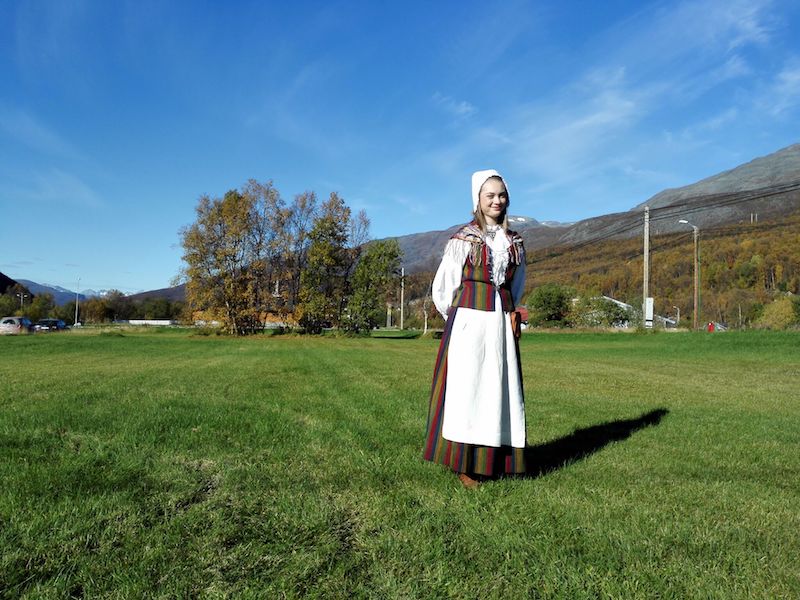
Work on developing a costume for the Kvens began in 1995, following an idea from artist Jens Stark. In 2001, the Kven costume was finalised, and today it is an important identity marker for the Kvens.
Artist Jens Stark from Kvænangen believed that the Kvens should have their own costume, just like everyone else. Thus began the work of creating a costume that would preserve Kven traditions while fitting into today's society. A separate Kven costume would strengthen the population's identity, both internally and in society at large.
The working group consisted of the Competence Centre for Handicrafts and Small Industries in Målselv and the Norwegian Kvens Association.
The Kvens did not have a universal costume that could be used as a model. The costume is therefore a reconstruction based on literary descriptions, photographs and other material finds from the period 1880-1920. The result is a costume based on Finnish costume traditions, but also inspired by Sami and Norwegian clothing traditions. In this way, the costume reflects the mix of traditions that make up Kven culture.
”The costume is characterised by being rooted in the Finnish costume tradition, has elements in common with the Sami and Kven costume tradition and has been adapted to the modern Norwegian costume tradition. In this respect, it is an example of how identity is created in interaction with other groups.”
Aarekol, Lena 2008. “Om å kle seg kvensk”, Ottar nr 1, Tromsø.
Women's suit with accessories
The costume consists of a coat, undercoat, waistcoat, shirt, apron, scarf, hat, bag, footwear and silver. The inspiration for the jacket and waistcoat comes from Northern Finnish clothing. The fabric is handwoven and has blue, yellow, red and green stripes.
The shirt, apron and hat are all white and sewn in half-linen with white embroidery. The inspiration comes from a hat from the Torne Valley.
The bag is made of reindeer skin and has a triangular shape that resembles the shape of a cow's stomach. Silk scarves are common for women and men. It's up to you to choose the colour and pattern of these. Women's scarves must have fringes.
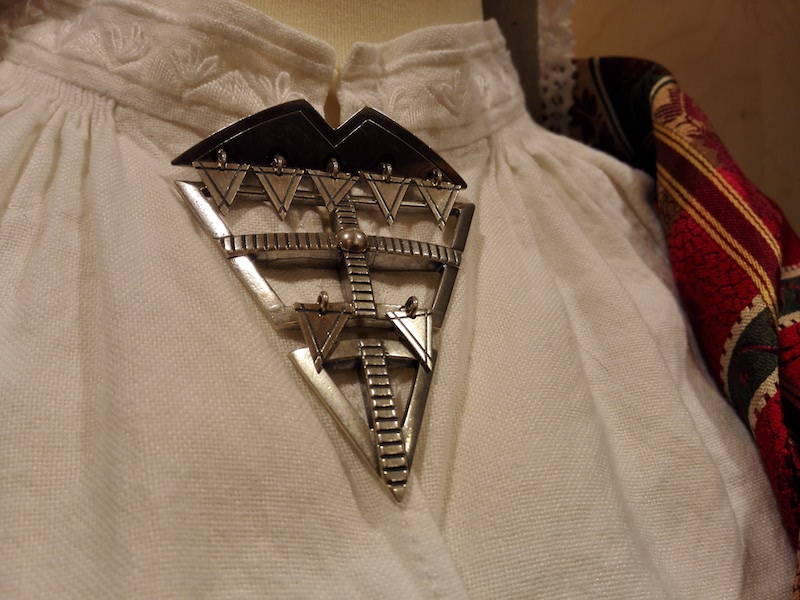
The jewellery is inspired by archaeological finds from Maursund in northern Troms. The cross shapes in the jewellery refer to the Kvens' close relationship with Christianity and Laestadianism.
The footwear for the costume is bunad shoes or komager,
Men's suit with accessories
It was difficult to find distinctive costume elements for men on which to base the suit, which is why the design is adapted to the women's suit.
The men's suit consists of a shirt, waistcoat, jacket, trousers, neckerchief, belt, footwear, silver and a sheath knife.
The jacket is sewn in white wool and has been given a cardigan-like shape. The trousers are made of black wool fabric. The belt is made of reindeer skin with a silver buckle. The headpiece is a white wool skullcap. This is based on a lithograph from the 19th century, which shows two men hunting squirrels with such a hat.
The men's suit is made with silver neck pins and cufflinks. The inspiration comes from a piece of neck jewellery found in northern Troms. The pendant on the piece of jewellery, which is dated to the late 11th century, is axe-shaped and is believed to have originated in Finland or Russia.
A thank you to you, Dad
«A thank you to you, Dad» is a picture game that deals with the Kven costume as an identity marker. We get to know Kristin Haslund Salo from Nordreisa, her father Steinar Salo, and their Kven roots from Manndalen in Kåfjord municipality.