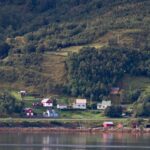
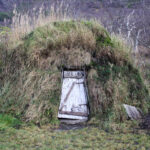
In Lyngen, the Germans realised that, geographically speaking, the area is the first natural defence barrier where it is possible to defend against a military attack from the east. The area has long fjords and high mountains.
Text: Tania Lopez
Between 1942 and 1943, around 100,000 Russian prisoners of war arrived in Norway. The majority of them ended up in Northern Norway. Many of the prisoners died due to malnutrition and miserable living conditions, while others were shot in the back after allegedly attempting to escape. In total, 13,700 of the Russian POWs died in Norway.
The prisoners who were sent to Lyngen were tasked with building a defence that would stretch from the Lyngenfjord to the Swedish border. This front line had to be completely continuous, blocked with barbed wire obstacles and covered by a mine belt. When the war ended in 1945, the construction had not been completed.
Roads, defence positions and trenches were built on Årøyholmen. Two of the prisoners of war who worked on these military positions died on the island. They were both in their early thirties and died after a year in captivity. Egor from malnutrition and Ivan from cardiac arrest.
Operation Asphalt
After the war, in 1951, it was decided that the crosses and memorials that had been erected at the Russian graves around Norway should be removed, and that the remains found in the graves should be dug up and transported to Kjøtta in Sandnesjøen. This work was called «Operation Asphalt».
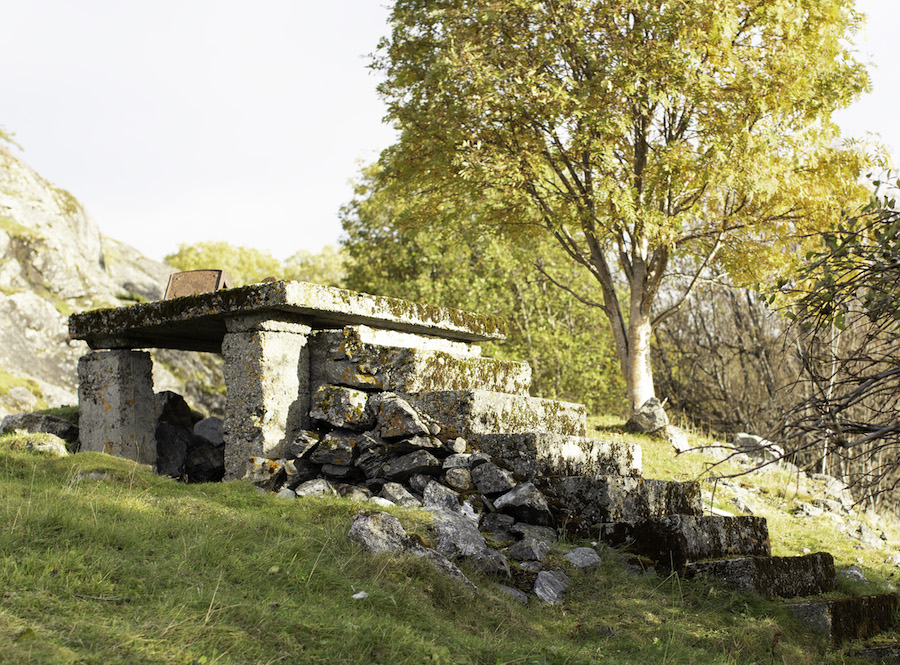
During Operation Asphalt, the two graves on Årøya were also dug up, but due to the condition of the remains, they were buried again. The graves still exist and are located beyond a summer barn on Vågen.
After the end of the war, Årøyholmen was taken over by the Norwegian Defence in 1976. Ice climbing for civilians was then prohibited until 2005, when Lyngen, Kåfjord and Storfjord municipalities bought the island as a recreational area.
On the north side of Årøya, the remnants of the war and its aftermath are largely visible. There are several bunkers, firing positions and trenches. During the Cold War, bomb shelters and corridors were built. These have now been sealed and secured so that hikers can travel safely on the island.
The civilians who lived on Årøya until the evacuation in autumn 1944 returned after the end of the war. When the Armed Forces took over in 1976, there were no longer any permanent residents on Årøya.
Current links
Lyngen: Årøyholmen, ishavskysten.no
Management plan for Årøyholmen 2017-2021, pdf
Årøyholmen is released by the defence, NRK 2004