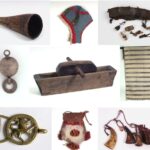
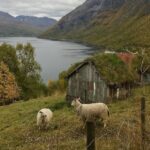
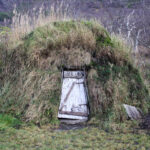
Descriptions from early times indicate that the region was rich in wild reindeer, bears, otters, foxes, squirrels, beavers and grouse, and place names such as Goddejávri / Wild Reindeer Lake and Čavkkus / The Otter provide information about hunting and trapping areas. Archaeological finds tell of a widespread hunting and trapping culture where the fur trade provided good financial returns.
Fur was sold at markets and through tax collectors. School teacher Ole Thomassen gives good descriptions of hunting tools and their use in the old days, in The conditions of the patches, 1999, s. 78-86.
The artefacts to be returned include hunting and trapping equipment that was important to traditional livelihoods, and was often made by local hunters and craftspeople.
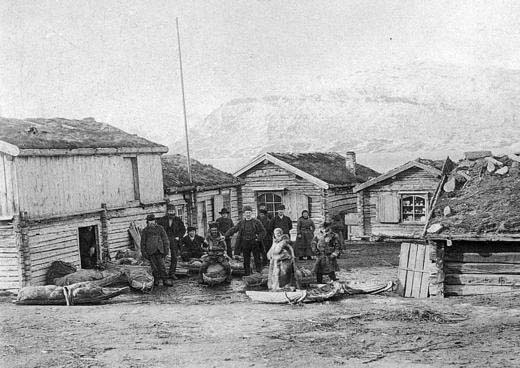
NFSA. 1728 Riššagohppu / Sulphur cup with lighter
This small riššagohppu / sulphur cup is carved out of wood and contains sulphur, lighters and is a fine example of a tool made according to need. The lighter was stored in its own bag, dollabursa, along with fire steel and a small piece of flint. The Riššagohppu / sulphur cup measures 3 cm in diameter and 1.2 cm in height. It was brought to the University's Ethnographic Museum from Oamasvuotna / Storfjord in 1931.

NFSA. 3130 Bivdoávvi osiiguin / hunting belt with equipment
The Bivdoávvi osiiguin/hunting belt with equipment consists of three horns, a small bone container and a leather pouch attached with leather straps to a woven band. One of the horns is ornamented and inscribed in the hunting equipment: a)IONACD c)ON.
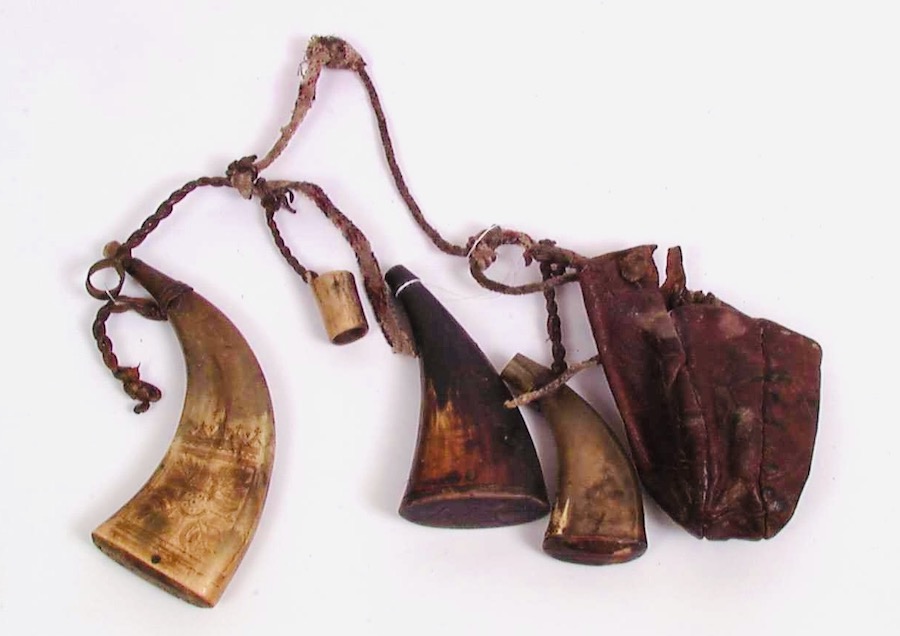
The hunting equipment is used in Moskavuotna / Ullsfjord (Sørfjorden), Ivgu / Lyngen. It was received by the Norwegian Folk Museum in 1952. According to linguist Konrad Nielsen's descriptions of hunting equipment in Lappish dictionary. Systematic part, such hunting equipment consisted of: «a powder horn, a blasting horn, a ball pouch which also contained a brush for polishing the rifle, two powder measures of reindeer horn (the small one for birds, the large one + the small one for bears), in the centre a powder measure for birds, with a pin to regulate the amount of powder» (Nielsen 1979: 392 (170).
NFSA. 2546 Buoiddaruovdi / weeding shears
Forged and riveted, the Buoiddaruovdi / weasel scissors consist of a spring steel construction with arches that collapse on contact with a base plate. Height 8 cm, width 10.2 cm and length 25.5 cm. Ole Thommasen (1999:80) describes that larger animals such as bears, wolves, wolverines, foxes and otters were also caught in similar scissors. Skins from large and small animals were of great importance in the fur trade. The buoiddaruovdi / weasel scissors were collected by Dr Asbjørn Nesheim in Biertávárri / Birtavarre, Gáivuotna / Kåfjord, in 1949. It was brought to the University Ethnographic Museum in 1949. Nesheim was hired as manager of the newly established Sami department at the Norwegian Folk Museum in 1951.

NFSA. 1416 Čeavrastohkka / otter stick, otter trap
Triangular čeavrastohkka/ otter stick, otter trap with separate part for bait attachment, made of wood with twisted rope and iron nails. Length 115 cm, height 75 cm and thickness 14 cm, and the length of the bait attachment is 36.5 cm. Čeavrastohkka / otter stick, the otter trap is from Bassevuovdi/ Helligskogen, Oamasvuotna/ Storfjord. It was purchased for the University Ethnographic Museum in 1912 by deacon Bertrand M. Nilsen.
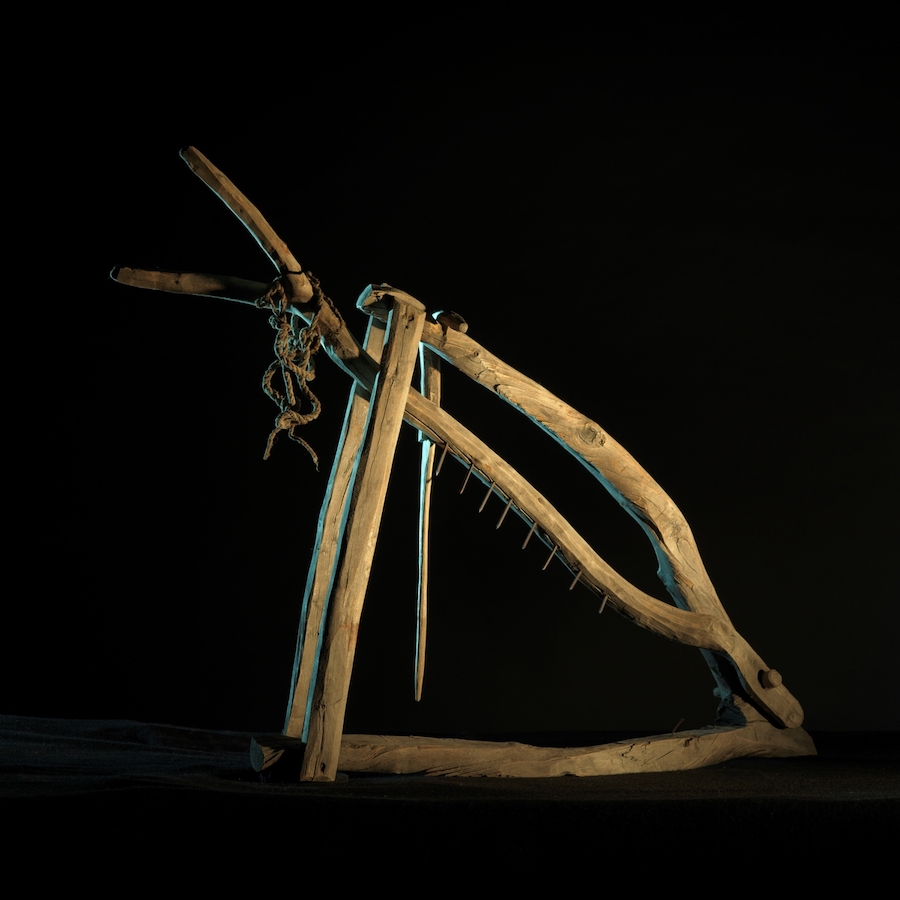
School teacher Ole Thomassen describes the use of čeavrastohkka / otter trap in Lyngen Herred in his records from 1896-98: «Otters are also caught with the so-called cane - čeavrastohkka - a kind of trap placed in the opening of the hole where the otter lives during the day, consisting of two birch logs about a metre long, fastened together at one end with a thread. The inner side of both logs is fitted with approximately 5 cm long iron spikes. One of these, the base log, is securely fastened with stones across the opening of the hole, while the other, the end of the top log, with its weight of stones, is balanced in such a way that when the otter begins to enter the hole, the log falls down and the otter is squeezed in between.» (Thommassen 1999). Ratio of patches s 80-81).