In the natural household, people made their own tools and utensils for everyday use, such as planes and knives for various purposes. It was also important to be able to produce important practical and functional objects, looms for branch weaving and handles for tools such as sickles, rakes and axes, as well as containers for storage and use in the household.
Such artefacts represent material culture and have a greater significance in themselves. The artefacts provide us with information about the person behind the object, its use and the entire society of which it was a part. We can distinguish different dialect areas and different cultural areas where there is a Sami population. Duodji artefacts show different local characters, which are also rooted in changing cultural impulses over the centuries manifested in decoration, design and ornamentation. Many of the artefacts that have been returned are richly ornamented and are today sources of new cultural knowledge.
NFSA. 0309 Niibi ja dohppa / knife with sheath
This is a traditional Sami knife with a horn sheath. The sheath is openwork and beautifully ornamented with openwork and incised geometric motifs, crosses and zigzags. The openwork sheath also has a practical significance: a damp knife blade stuffed into the sheath dries quickly with good ventilation. The length of the knife is 33.6 cm and width 5 cm.
Head of the University's Ethnographic Museum (1877-1916), Yngvar Nielsen, bought the knife in July 1891 from Sami people from Jukkasjärvi who were summering in Skoelvdalen (Várdnoljohka/Skoelva) in Bardu. «An addition to these Lapp collections was acquired in July 1891, on a short trip that Dr Nielsen made to Tromsø County at the time, when he visited Lapps from Jukkasjervi, who had their summer residence in Skoelvdalen, near Bardudalen.» (Nielsen Y. The University's Ethnographic Collections 1857-1907 s. 74).

NFSA. 0301 čoarvebaste / hornskje
Small traditional Sami čoarvebaste / horn spoon. The handle is ornamented with openwork round and triangle ornaments, and incised lines that follow the shape. The horn spoon is an example of an artefact that the Sami developed early on, Sami spoons are known to be short in the handle, and the spoon itself can be oblong, round, or pear-shaped. The horn spoon, NFSA. 0301, tells of a Sami aesthetic idiom that goes far back in history, the shape and ornamentation are preserved in the production of spoons even today.
This spoon was purchased for the University Ethnographic Museum in July 1891 by Yngvar Nielsen on a trip to Skoelvdalen (Várdnoljohka/Skoelva), in Bardu.
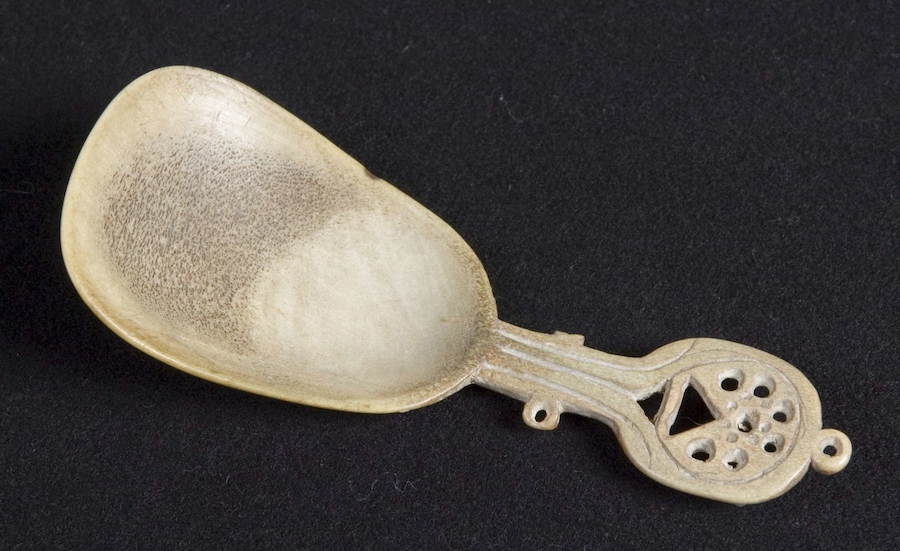
NFSA. 0309 Niibi ja dohppa/ knife with sheath and NFSA. 0301 čoarvebaste/ horn spoon is one of the cultural-historical artefacts that tell of the spread of reindeer husbandry and intercommunication between different groups of people who lived side by side on the coast for parts of the year.
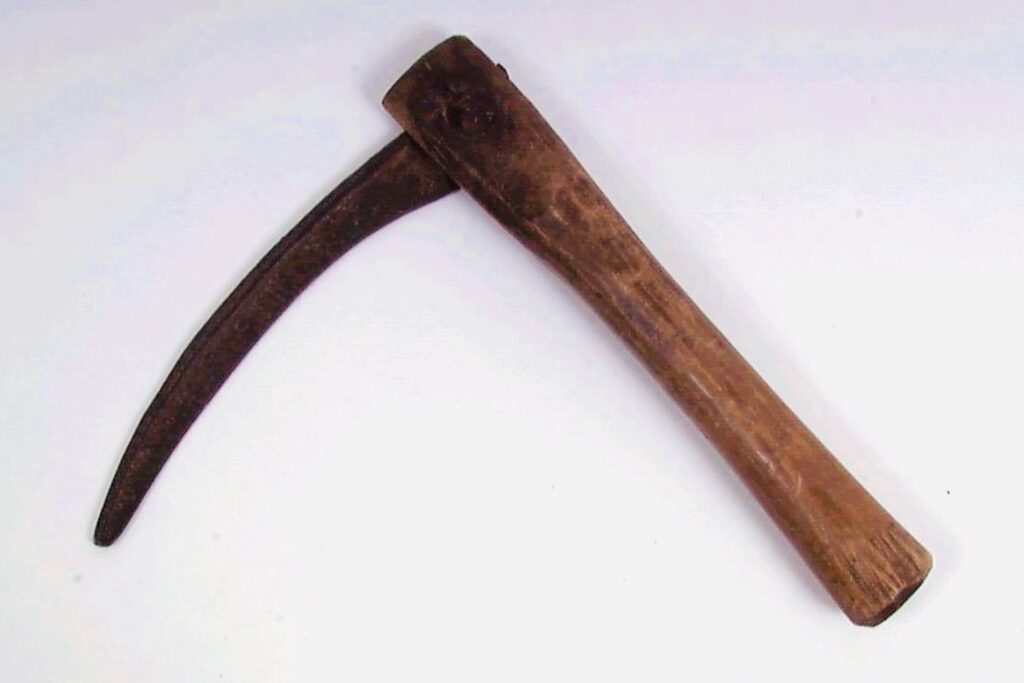
NFSA. 2544 Sirpe/ sigd
The sickle consists of an iron blade nailed to a wooden shaft. The blade is 21.5 cm long and 2.8 cm wide, and the shaft is 24.3 cm long and 3.6 cm wide. The artefact came to the Norwegian Folk Museum in 1949, collected by language and cultural researcher Asbjørn Nesheim. It has been used in Moskavuotna/ Ullsfjord (Sørfjorden), Ivgu/ Lyngen.
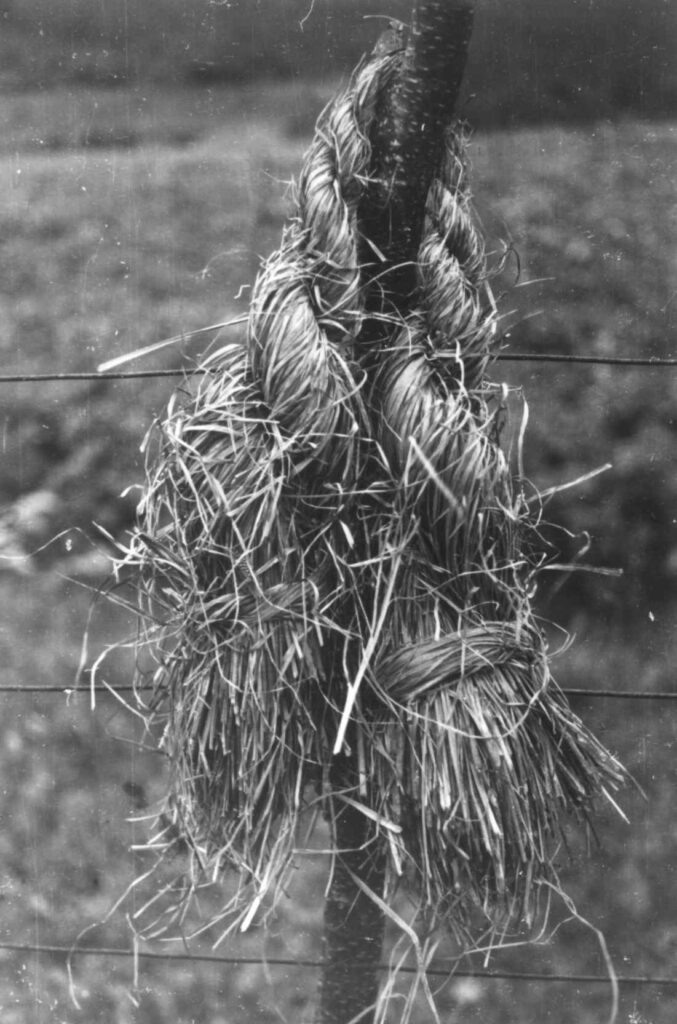
The cricket has also been referred to as a sennegrass spike. The artefact also relates to clothing traditions; it was widely used for cutting senna grass, which was a necessity in footwear, and which was changed regularly. From Ole Thomassen's descriptions: «In Lyngen, senna grass is only prepared in such a way that it is cut with a sickle and tied in the same shape as ribbons of grain, although not nearly as thick as the grain. Each ribbon is then divided into two parts from the upper binding towards the top. Both parts are twisted together like rope and are called bilgábealli. To such bilgábealli are then braided together with a small finger-length braid at the top to form the so-called suoidnebilgá. These are then dried and ready for use» (Thomassen 1999: 65-66).
NFSA. 3134 Skáhppu / box
NFSA. 3134 is a beautiful little skáhppu/box with a wooden lid. Both the box and the lid are wrapped and joined together with small rivets and brass wire. Length 26 cm, height 10.5 cm and width 12 cm. The box and lid are richly decorated with carvings. The ornamentation is of the Northern Sami type, with larger motifs such as circular ornaments and braided patterns in square shapes combined with smaller pattern elements, and parallel lines combined to form zigzag borders. «NINTSLIK 81» is inscribed on the box. This is a very old artefact and is registered in the Norwegian Folk Museum's archive as possibly dating from 1781. It is stated to be from Njoaski / Njosken, Moskavuotna / Ullsfjord.
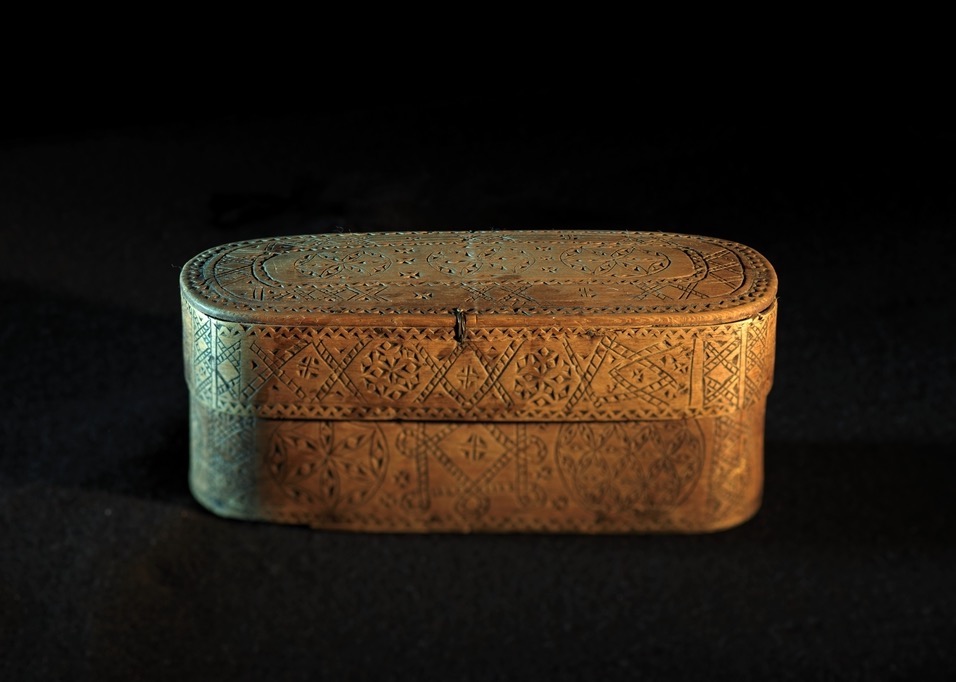
NFSA. 3134 Skáhppu/box is referred to as a butter box in older museum records.
Boxes, tins and caskets of various sizes were used in households to store food and artefacts.
NFSA. 1564 Gáfemillu / coffee grinder
Gáfemillu / coffee grinder is an oblong wooden grinder with container and roller with handle. The handle has simple carvings. Length of container: 26.4 cm and width 5.2 cm. The width of the roller including handle is 16.5 cm. The grinder was collected in the Báhccavuotna/Balsfjord area and sold to the University Ethnographic Museum in 1918, by emissary Lars Larsen.
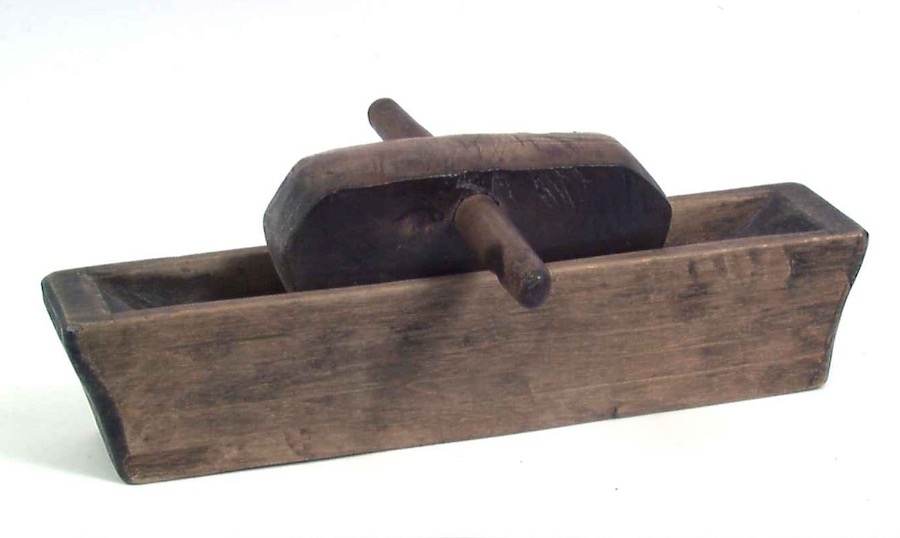
A similar type of grinder is described by Konrad Nielsen as a tool for crushing coffee beans (Nielsen 1979: 373). School teacher Ole Thomassen's records from 1896-98 describe how to use such a coffee mortar:
«The coffee beans are generally crushed in a grinder. Sometimes, though rarely, I have seen them crushed in my own black mortar. It consisted of a small cube of birch, internally shaped like a funnel so that the hole, which at its innermost end is greatly narrowed, was not through the entire cube. The so-called twister, also made of birch, was just like a rivet, about the same thickness at both ends and so long that it was easy to hold on to, and so thick that it almost filled the bottom end of the hole. The wringer was then inserted into the hole so that the end rested at the bottom of the hole, after which coffee beans were placed in the funnel hole. The top end of the turner was gripped firmly and moved round so that the circle was not cut any wider than was easily possible, and it was also constantly pressed against the bottom of the hole during the turning process. The coffee beans were thus crushed at the bottom of the hole. Grinding coffee beans with such a mortar was fairly quick and fairly easy.» (Ole Thomassen. The conditions of the patches. Sámi Giellaguovddáš/ Sami Language Centre, Gáivuona suohkan/ Kåfjord municipality 1999. S. 58).
NFSA. 2547 Heavval / planer
Heavval, the planer was collected by Asbjørn Nesheim in Biertávárri / Birtavarre, Gáivuotna / Kåfjord, 1949. This is a square birch plane with a narrow cutting blade of forged iron. Length 21.8 cm, width 7 cm. Planers were used for carpentry, making boats, sledges, necessary tools of various kinds and for repairs. Planes were made according to what they were to be used for, and this plane is referred to as a ski plane in older museum records. It is described as rik`ko-vault, (rihkkoheavval), a razor for making indentations in Konrad Nielsen, Systematic part 1979. 390 l, p. 257.