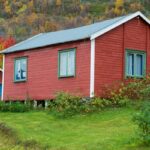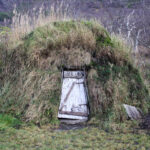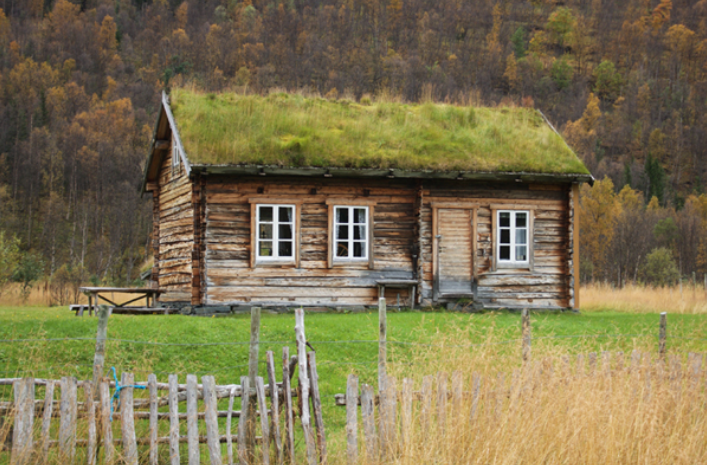
Holmene's Sea Sami farm dates from around 1850. Because it was not burnt down during the Second World War, it has been possible to restore or reconstruct the buildings. It now looks as it did in about 1930 and gives an impression of how Sea Sami families lived at that time.
Photo: Torun Olsen
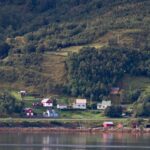
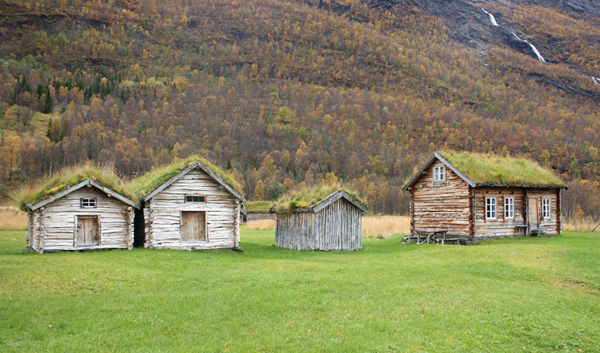
Holmenes is located in the Kåfjord valley, in a cultural landscape that is a mixture of hay meadows, pastures and a lush deciduous forest. The farm consists of many small houses, each with its own function: farmhouse, woodshed, arches, sheds, stables, hayloft, barn, summer barn and rocker well.
The buildings
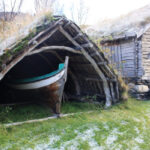
The farmhouse and arches are timber-framed. The house is built of pine from Skibotn and the arches of alder. The other houses are built using the stave technique. All the buildings have turf-covered roofs. The farmhouse has two rooms and was probably built around 1914. It was inhabited until 1964. At its peak, 14 people lived on the farm. The sheds and arches were used for overnight stays and to store firewood, food and clothes. The stable in laftet or, the hayloft, the barn aisle and the cowshed were probably built in the 1800s. The cow and sheep barns are built as barns with birch rafters clad with wood, reeds and peat. The hayloft is a combination of lath and post construction.


Combination use and nutritional customisation
In the farmhouse, there are both a loom and a warp beam, which were used in connection with branch weaving, which was an important sideline for many. Alongside their daily responsibilities for the farm and family, the women were often involved in various forms of handicrafts. The farm thus represents an example of how the Sea Sami adapted their livelihoods to the outdoors, inland and the sea, as well as how they utilised resources and harvested from nature. One of the shoreline arches in Birtavarre belonged to the Holmenes Sea Sami farm. This bears witness to ecological adaptation, combined industries and co-operation, which made self-sufficiency possible. Large and small had important tasks and all contributed to the best possible utilisation of resources.
SOURCES:
Architecture guide for Northern Norway and Svalbard, Holmenes
North Troms Museum, Holmenes Sea Sami farm
Nord-Troms Museum, The Sea Sami in Lyngen
Norges Naturvernforbund, Spor: et temanummer om kulturlandskap, no 5, 1988
Grepstad, O., K.M. Torheim & G. Dahl (2003) Holmenes gård og fjærebuer i Birtavarre i Fotefar mot nord: En kulturhistorisk reise i Nord-Norge og Namdalen, Forlaget Press: Os.
Current links
Studio Nord, A report from the ecomuseum in North Troms, NRK 1988
Here live my people - A picture story from old Lyngen
Interview with Sámi woman from Manndalen 1975, National Library of Norway