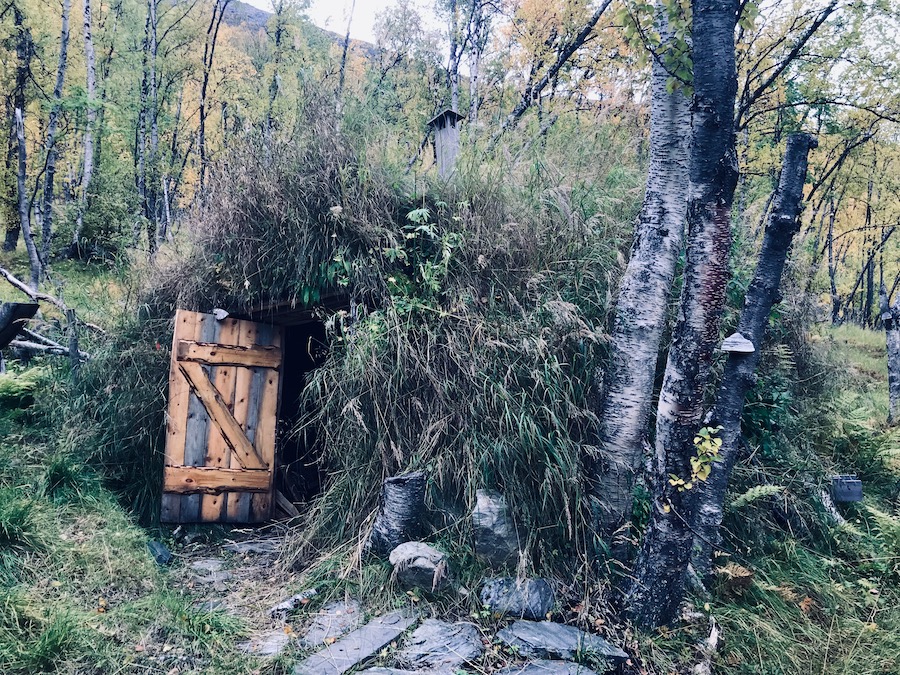
In 2014, 70 years after it was burnt down and evacuated, the hamlet that housed around 40 people and some animals was rebuilt in Gárdegohppi, Skardalen.
In the autumn of 1944, many believed that the war would soon be over. People in Skardalen chose to defy the Germans' evacuation orders and escaped to the mountains. Some fled to a disused mine up the valley, while others built huts in suitable locations. In Gardégohppi, a large hut was built that housed both people and animals. Up to 40 people, most of them from Skardalen, but also from other places in the municipality, lived in the gamma.
Narrated by Eliva Henriksen, written by Ruth Larsen:
There were rumours that the Russians would soon liberate Norway, and you could hear cannon fire in the direction of Skibotn. Something that confirmed the assumption that the war would soon be over. So when the evacuation order came, people here in Skardalen agreed to defy the Germans' orders and escaped to the mountains. Several people in the village began preparations straight away. Some went to a disused mine up in the valley, while others set about building gamma. Both here at Gárdeghoppi and also on the iceberg side, at Jalagadas and Láktan.
Gárdegohppi was a suitable location with access to water. The site was well hidden in the forest and the hut had to be large enough to accommodate both people and animals. The material for the hut was simply cut from the forest around the hut site, and the peat was taken from the nearby bog. The construction went quickly, there were many people working on it, and they knew a thing or two about building gams.
Many people moved in, from small children to older people. They kept the cows in the centre of the barn and the people in the outer part. They put in a stove for cooking, but eventually there were so many people there that they had to build a small hut next to it for cooking, and another hut called the youth hut.

People also came from Manndalen. Most were connected to Skardalen through marriage. Many people from the other side of the fjord fled to Skardalen at that time, and in Gárdegohppi there were also people from Djupvik. There were about forty people living here. Perhaps even more on some nights.
There was a nice vantage point a short distance from the pond, and there was always someone on the lookout, so they could tell immediately if the Germans were approaching. There was no road to Skardalen at the time, everyone had to use a boat, so it was easy to control who came to the village.
We cooked meat soup every day. There was plenty of meat, because many of the animals had been slaughtered, and we had potatoes. There were no vegetables, they didn't exist. Nor was there any fish, because no-one could go fishing because the Germans lived just across the fjord. They brought salt pans from Djupvik, so they weren't completely free of fish. They couldn't cook food during the day because the Germans would soon have seen smoke and found the hut. No, when it got dark someone would sneak down to the abandoned houses to bake bread. It was difficult to do that in the hut. But they baked flapjacks on the stove and that went well.
They chopped rice and twigs that they had on the dirt floors. On these they placed mattresses, or bolsters as they called them. They were filled with either senna grass or reindeer hair. When there was rice and twigs on the dirt floors, the mattresses didn't get wet and it didn't get cold. The cows also provided warmth, and at night everything was full. They lay close together all over the floor.
There was little opportunity to wash, so eventually there was a lot of lice, and it became a major nuisance for everyone. Those with young children therefore soon headed back down to the village.
The days were spent telling stories from the old days, fairy tales and ghost stories. The latter was probably the most exciting. Many songs were composed in Gárdegohppi, and the women spent their time doing needlework, mending cow's udders and clothes. They knitted, and they also had a coat with them up here. But they couldn't use candles, as they could no longer get carbide for the lamp, which was the only source of light. There was no longer any paraffin either. But when they had heat in the oven, they could just open the oven door a little and it would light up.
Some of the boys tried their hand at snaring grouse, but the catch wasn't very big, but it was a pastime when the days got long and boring. Then there was chopping wood. This had to be done in such a way that it didn't make a lot of noise, and you had to use completely dry wood that didn't produce much smoke.
That's how the days went up here in Gárdegohppi, waiting for peace and freedom. But just before Christmas, everyone decided to follow the evacuation order, and the hamlet was abandoned. It could have told us a lot about that time if it could. About love and happiness, and about sorrow and hardship. It probably contained many untold stories and fates that only it knew about.
Watch the film Elivas reise, NRK 2015

CURRENT LINKS
Skárfvággi/Skardalen selected cultural landscape
The village was growing again. Then the inhabitants took action, Nordlys, 2014