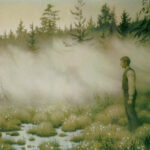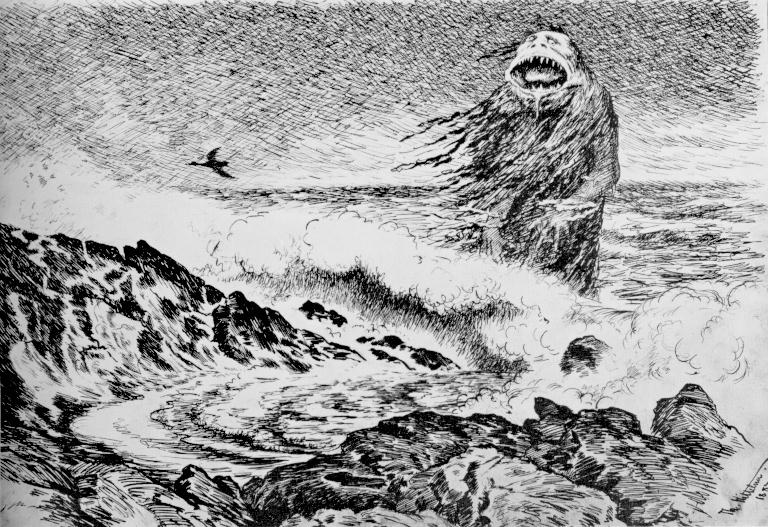
The draug is an evil ghost or spirit of someone who has drowned at sea. If you see or hear the dragon, it's a warning that something bad is about to happen.
There are many legends about the dragon along the coast of Northern Norway. Draugen was originally a dead person who haunted the living both on land and water, but in later folklore Draugen was a dead fisherman who had died at sea and was not buried in Christian soil.
Warning of storms and death
You can either hear or see the kite, and in both cases it is a sign of misfortune and death. The kite is always evil and dangerous, and can both warn of and cause the death of a fisherman. The presence of the kite is also a sign of storms and stormy weather, and as is often the case, it will happen the next day. The warnings can come in the form of screams from the kite. The extent of the accident depends on how many times and how loud or ”gurgling” the cry is heard.
Draugen appears as a human, dressed as a fisherman with sea boots and leather clothes, and he may have a seaweed vase for a head. In some legends, he has transformed himself into another form, often into objects or beings associated with the sea.
By boat or on land
The kite often comes rowing, often in half a boat. Hearing the kite at the seashore may be a sign that bones, clothes or planks from the boat of someone who has drowned have come ashore there. The kite can also come ashore and follow you, and in some legends there is a wrestling match between humans and the kite. In such cases, the dragon will drag you out to sea. If the dragon succeeds in taking a possession, such as a mitten or some other garment from a human, the human will sooner or later perish at sea.
Fear of death
The legends of the dragon arose at a time when it was common for fishermen to die at sea. The fear of storms and death was an everyday occurrence, and explanations were sought. Those who died at sea weren't buried in Christian soil, so they weren't at peace either. Seeing or hearing the kite was often a sign that the trip should be postponed.
Get rid of the dragon
I ”The patchwork relationship” Ole Thommasen describes what, according to superstition, must be done if you come into contact with a draug:
If the dragon calls out ”Welcome.” or call out the name of a particular person, you shall not respond. You should stand up, turn your back to the sound, and shout the same word.
If you find bones, clothes, planks or similar from a wrecked boat near where you hear the draughts, make sure you get it in front of the flood gauge and bury it. When it is buried where the seawater cannot reach it, it will lose its effect.
If you are in possession of fire when you hit the dragon, throw a firebrand at it and shout: ”De buolat!”, ”Now you're on fire!” Then it heads out to sea, and only Morilden appears after it.
If you are being followed by a draug and you are carrying a knife or a loaded rifle, you must throw the knife under your left arm with the point in front, without looking back. When you think the knife's point is impaling the draug, get rid of it. When you go to look for the knife, you will find it with an object stuck in the headland. If you're using a rifle, you'll find an object pierced by the bullet.
In a wrestling match with draug, it's important to get the draug over the flood target. If you wrestle to the day, the draug will disappear.
Current links
Radio:
Finnmarkshistorier, NRK 1982, National Library of Norway
Coastal culture - strange creatures in the sea, NRK 1986, National Library of Norway
Supernatural creatures of the sea by Odd Smith Robertsen, NRK 1969, National Library of Norway
Gamal Lofofisker fortel, NRK 1970, National Library of Norway
Digital books: stories about draugen
Lappish fairy tales and legends from Lyngen, National Library of Norway
Sami stories, National Library of Norway
Draugen: The Avenger of the Sea, National Library of Norway
Draugen screamed; National Library of Norway
Headless men and frozen hitchhikers, Living legendary tradition from Northern Norway
Stories in the north, Ottar 1, 1997
Between legends and reality in northern Norwegian tradition, National Library of Norway