By Øyvind Rundberg, Kåfjord
The bus drivers we had in the 1950s exuded great respect. They were firm, but also extremely helpful and humorous. We had to sit properly in the bus - with our faces in the direction of travel. ”There might be sudden braking,” was the driver's important reasoning. The school bag had to be held in the lap. The biggest girls in Year 7 and secondary school were allowed to deviate slightly from these rules when they sang songs and had to make eye contact to be in tune.
The drivers” uniforms had their own ”image". This was tough stuff, and several of us wanted to become drivers when we grew up. By the way, three of us trained as car mechanics.
Not all of the drivers wore full uniforms on a daily basis. But a uniform cap with a large, round badge was standard. The badge bore the abbreviation NAF (Norges Automobil Forbund) In the ”gossip mirror” above the driver's head, the abbreviation was written backwards, much to our secret amusement.
"Once my dad and I were playing with words," he said:
”If you take a coat and twist it round, it becomes the colour!” This was a bit cheeky, but not exactly dirty talk.
”And if you look in the rear-view mirror of a driver wearing a NAF hat, it's FAN!” I replied. Dad became serious: ”Do you know what that word means?”
I didn't know what to say, and of course I couldn't tell my older mates.
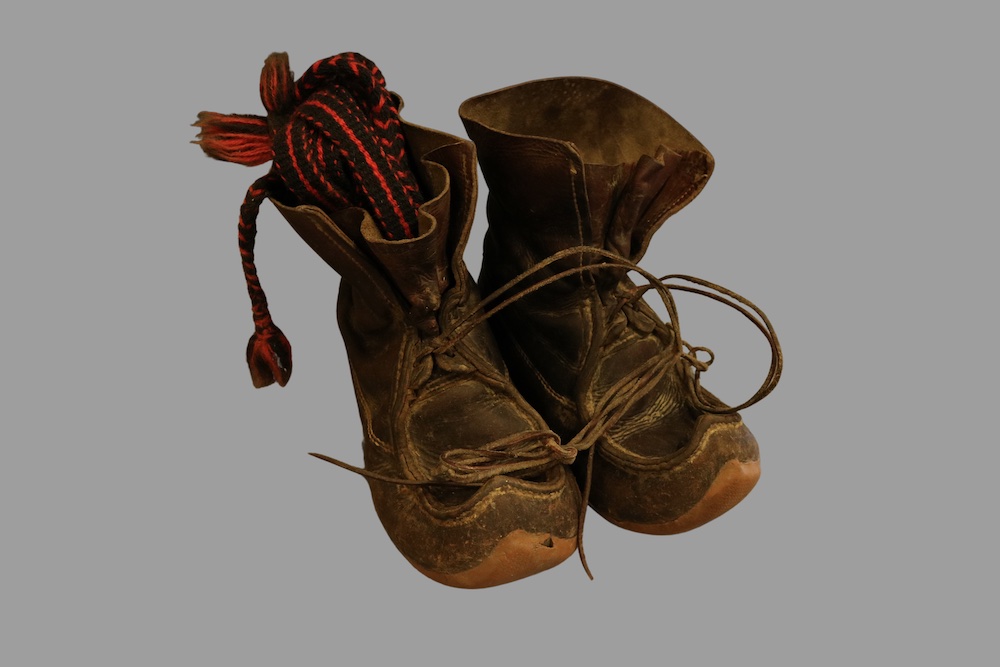
One early late summer day when we were travelling to school in Trollvik, the unbelievable thing happened: the driver was wearing komager. Komager - the very symbol of poverty, need and degradation. Komager - we all knew what it was, but it wasn't supposed to be worn by the fjord people, only the floating Sami (badjeolmmoš).
When we spotted the sensational, a driver in a station wagon, there were low but intense comments from the kids sitting in the middle of the bus and those at the back. The front ones just stared in horror, but some of the biggest girls in secondary school probably had a certain admiration in their eyes: How dare he!
The comments centred on what lousy footwear komager was:
- They draw in water.
- They smell bad, a mixture of leather, tar, cod liver oil, willow bark and toe fart!
- They are dangerous: The coma bands come loose so you trip on them and hurt yourself.
- The senna grass that is in the komagan is irremovable.
And then the crowning argument:
- Using them will make you flat-footed!
It was clear that many showed great insight in their description of misery.
No, that old stuff wasn't usable. We had to make do with rubber boots in the autumn, even though they were both heavy and clammy, especially when we were playing football, handball, dodgeball or batting. Buying things gave status, and was of course superior to everything else because it was produced in the south and genuinely Norwegian.
Askim rubber goods factory with its Viking brand was best of all, we thought. That's just the way it was.
It would be almost 50 years before I got my hands on a homemade, hand-sewn cowhide coma bag. I've learnt a great deal about the benefits of cowhide over the years.
- With the right treatment, they were virtually waterproof in damp weather.
- They were warm and cosy with senna grass or thick wool.
- The coma bands held the coma tightly at the top, but had to be fastened correctly to avoid loosening.
- The tendons and ligaments that hold the arch of the foot in place are exercised correctly when using coma bags.
- The shoe is moulded to your feet when worn, not like many types of shoe: The foot has to adapt to the shape of the shoe, which can lead to permanent damage.
This footwear is now produced in factories, but there are still people who sew cowhides the old-fashioned way. The skins are softened in water with boiled willow bark and a little salt. Later they are smeared with a mixture of tar and cod liver oil.
Comager is a footwear that can be worn for all occasions and has therefore enjoyed a renaissance.
But this driver in a cab may not have realised that he was ushering in a new fashion, and in that respect was decades ahead of his time.