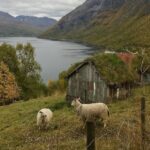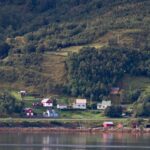
Árdni, Arnøy as the place is called in Norwegian, is an island in Skjervøy municipality, Arnøy is Norway's 15th largest island. On Arnøy we find traces of settlement dating back to the Stone Age.
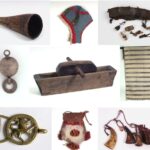
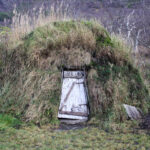
Arnøy has an unusually high density of cultural heritage sites, with more than 450 Stone Age artefacts, 400 pits, 20 boathouses and around 10-20 graves.
As an island surrounded by fjords rich in fish, Arnøy has always had a strong maritime focus with fishing and hunting of marine mammals such as seals and whales.
Halibut pits are found along large parts of the coast of northern Troms and Finnmark. Archaeological surveys show that halibut pits were used to extract oil from seal and whale blubber.
Helle pits can be seen in the terrain as elongated depressions that lie parallel to the sea. In well-preserved hellebores, you can see angular slopes protruding from the vegetation.
Most of the pits are 2 to 4 metres long, 1 to 2 metres wide and between 0.3 and 1 metre deep.
Reconstructed use
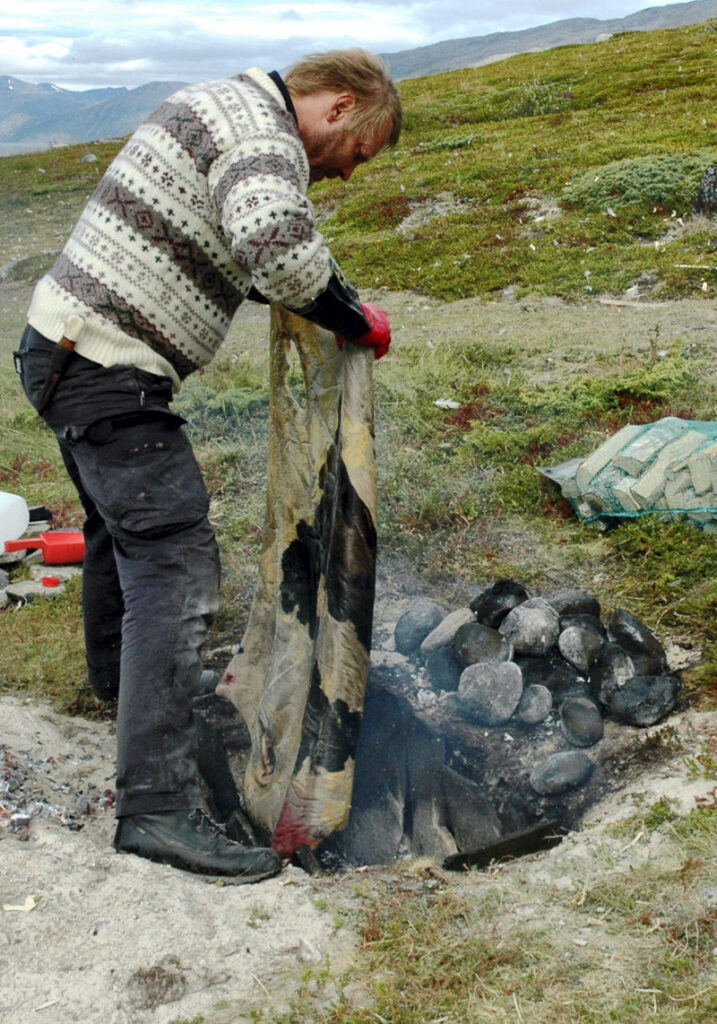
In 2008 and 2009, Gørill Nilsen, Associate Professor at the Department of Archaeology and Social Anthropology at the University of Tromsø, attempted to reconstruct the traditional use of salt pits. In the most successful experiment with seal blubber, she managed to produce 20 litres of oil from 30 kilos of seal blubber. Whale blubber turned out to require more blubber per litre of oil.
Current links:
Hellegropene - Ancient artefacts from a silent period, National Library of Norway