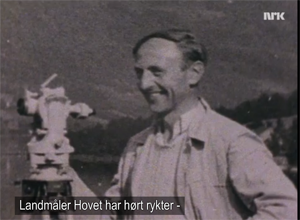
Surveyor Tor Hovet tells the story of his frightening encounter with the rebellious Manndalers, as he remembers it in a radio interview from 1982.
Listen to the interview with surveyor Tor Hovet, National Library of Norway
Surveyor Tor Hovet was a recent graduate of the Norwegian School of Agriculture. As part of the post-war reconstruction of Finnmark and North Troms, the county had planned a major project involving the re-cultivation of good arable land up the valley. Maps and plans were needed.
At Lyngseidet, he got a taste of what was to come in Manndalen. At the local shop, he had to fork out 14 kroner for a map that normally cost two kroner. Hovet protested, but to no avail. On the boat that was to take him to Manndalen, he was threatened by an angry man who thought he shouldn't complain about the price. He acted threateningly and prepared to attack, but during his studies Hovet had learnt The Noble Art of Selfdefence, which his teacher thought they could use in the field. He took a fighting stance and, at 98kg and 1.94 metres tall, he scared the man away. Afterwards, he learnt that the man he had frightened away was the King of the Nose himself, who was a feared and powerful man in the area.
Two helpers
In Manndalen, everything went smoothly at first. He bought food in the local shop and was placed in a German barracks. He got hold of two helpers. He particularly remembers the guy called Johan Olsen Jauri or Vatni. He was clever, friendly and human, and he knew various arts. Hovet often got nosebleeds at the time, and the man muttered some incomprehensible words, put his finger on Hovet's nose, and the blood stopped instantly. He did this several times. Before he did this, he wanted to know Hovet's name and the year he was born. When Hovet wanted to learn the art, the man told him that he couldn't teach it, because then he would lose the ability himself. He could only teach it to a younger man, but he would keep the skill for as long as he lived.
Army call from the Viking Age
Hovet brought many instruments with him to use in his work, and was allowed to carry on for a few days. But one sunny day at midday, around 100 people came screaming and shouting up the road where they were working. Jauri, the relief worker, said, "We'd better watch out, because they probably don't like what we're doing here.
At the front of the group were four or five men and a few women, and the sound resembled an army call from the Viking Age. It sounded terrible, and they were carrying sticks, knives and even dung ropes.
Although Hovet was fairly unprepared for this episode, he had heard what kind of treatment Sheriff Rivertz had received in the village, and for a moment he considered leaving for the forest. He chose to stay until they arrived. The procession also included a divan on a sleigh pulled by a horse, and he was terrified when it stopped close to the court. The large crowd around him made it difficult to find an escape route. Hovet was told by a man to pack up his things, go down to the sea and leave the village; they didn't want any mapping there. This was accompanied by shouting, screaming and threats with long Sami knives. The crowd demanded that blood be shed.
Chased out of the village
In an attempt to calm the crowd, Hovet jumped up on a rock to address the people. He explained what consequences this could have for them. This was of little help. He therefore decided it was best to pack up, and he also realised that his assistants were getting quite a rough ride. The binoculars and instruments were placed on the divan, which had been brought along for this purpose. It was down to the sea, and all the way the surveyor had the screaming and threatening gang after him, and he realised that there was no way to escape. He was graciously allowed to stop by the barracks to pick up his suitcase and lock it up again.
Down on the quay, a skate had been arranged, which he was almost dragged aboard. He was taken to Lyngseidet and received a hefty bill from the skipper. He had to pay for the trip himself.
When Hovet came ashore, he called the county governor to tell him what had happened, and suggested that the county governor should send a troop of armed soldiers or policemen to show respect over there and get the job done.
Wild vests
After three or four days at the hotel, Hovet received a call from his boss telling him that the two of them, together with a group of armed police, were to start work again. The work was carried out, but now only those who were interested in having their property measured were allowed to do so. There were only a few who were interested. The intention was probably that, even though the county governor had thought it would be nice to say that only those who wanted to measure would be allowed to do so, they would still be tricked into measuring the other properties. That they would probably get it all. But then he didn't know the Mandalites well enough. They stood guard over their properties, and there was no question of them being allowed to measure.
When it comes to mapping, you're allowed to enter private land if you don't cause any damage, but not in Manndalen.
Hovet says that the policemen were armed with pistols in their belts, just like in the Wild West, and the sheriff's officer from Lyngseidet carried his pistol in his jacket pocket.
After being housed in the same German barracks as before, they were told not to go out in the evening unless they were all together, at least two or three of them. Every night they lay with their pistols under their pillows. This reminded Hovet of lying out in the field in front of a front.
Some armed policemen followed the surveyor as he carried out his work, while others travelled around the village to take statements. Some were taken into custody and sent to Lyngseidet.
Not language problems
Hovet believes that the reason for all the fuss is different from what the county governor and the higher-ups had in mind. "A little later, he learnt that the reason was that since so many people were moving up the valley, the shopkeeper down at the quay would lose a lot of customers, and he probably had a bit of a chip on his shoulder. He realised that he would lose profits and set up these men, over whom he had great power. That's probably where it all came from, as the villagers later told me.
Hovet doesn't think the problems were due to language issues, at least not on his part. He himself speaks the Setesdal dialect. One of Hovet's assistants explained to him that the Manndalers were more enlightened than he was, because they spoke Sami, Finnish and Norwegian, and Hove only knew Norwegian. Hovet didn't understand anything when the Manndalers talked among themselves, but they answered him in straightforward Norwegian.
According to Hovet, the case has nothing to do with a culture clash, but rather a way of reacting to society. "They'd probably had some unfortunate experiences with pawning and other things.
Hovet believes that the fact that he didn't get to do his job was unfortunate for the Manndalers. "Since it wasn't properly mapped, a proper plan wasn't drawn up either. The county governor and the other politicians at the county level became angry, and when they stopped, the Manndalers lost support from the burnt sites regulation, and did not get to rebuild their houses, as the others in the area did.
After Hovet had left, he was followed by a delegation who wanted him to return to measure in order to get things moving again. He was reluctant to do this because he was afraid of revenge.