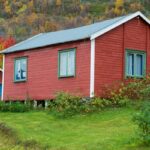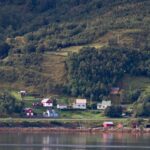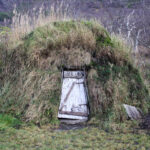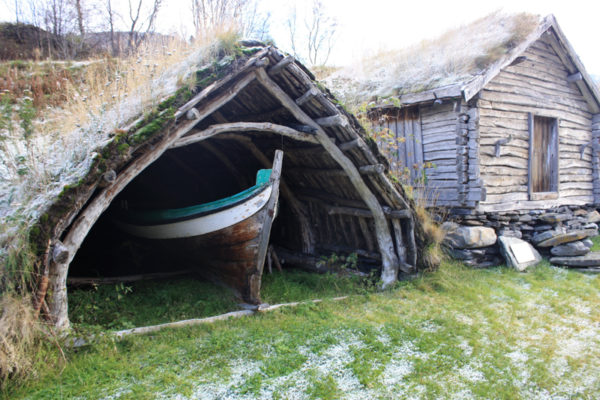
North of Birtavarre there are several shoreline arches lined up along the seashore. Eight of these are examples of Sea Sami building techniques from the 19th century. The huts were used to store seafaring tools and fishing equipment, but were too small to house the boats.
Photo: Torun Olsen
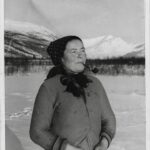
Due to the burning down during the Second World War, there are few examples of Sea Sami building practices older than the 1940s. Fjærabuene are some of the few physical cultural relics of the old Sea Sami way of life. The Sea Sami harvested the versatile resources found in the sea, forest, inland and outlying areas. Fjærabuene became a place to store carving tools and fishing equipment.
The Sea Sami mostly fished on the Lyngenfjord, but many also went seasonal fishing. During the Finnmark fishing season, they traded for flour, coffee and other products from the Pomors. What they bartered could be stored in the fjord sheds until the weather made it possible to take it home with them.
Most of the shoreline arches are constructed with cross-ties, one of them is a stick construction and two of them are a combination of these two types of construction. They are built of alder/older. The roof trusses are usually made of split and axed alder. All the roofs have been covered with turf. The size of the shore arches varies from 8 to 12 square metres, and all the older arches are located with the gable end and entrance facing the sea.
Boat frame
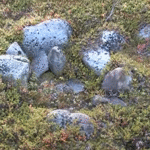
The reason why the shore arches were not used as boathouses for the boats may be that the material you get from alder rarely has a straight length of more than 3-4 metres. This may also help to explain why the Sea Sami houses were also small. There is only one boathouse left, which is actually a boat frame. It consists of curved birch rafters, which are partly dug into the ground.
Fjærabuene tells the story of the old Sea Sami way of earning a living, with fishing, cattle farming and utilisation of outlying land. For the most part, the Sea Sami fished on the Lyngenfjord, but many also went seasonal fishing. During the Finnmark fishing season, they traded for flour, coffee and other products from the Pomors. What they bartered could be stored in the shoreline huts until the weather made it possible to take it home with them.
SOURCES:
Studio Nord, A report from the ecomuseum in North Troms, NRK 1988
Holmenes sjøsamiske gård, Nord-Troms museum
Architecture guide for Northern Norway and Svalbard
Grepstad, O., K.M. Torheim & G. Dahl (2003) Holmenes gård og fjære
Norges Naturvernforbund, Spor: et temanummer om kulturlandskap, no 5, 1988