Åarjel-saemieh - South Sami were Northern People of the Year in 2021.
Åarjel-saemieh - South Sámi or Southern Sámi is a group among the Sámi in the south of Saepmie. What distinguishes the South Sami from other Sami groups is first and foremost the language, but also the costume, ornamentation, building practices and other cultural expressions. Traditionally, fishing, hunting, trapping, gathering, craftsmanship and reindeer husbandry are central to South Sami society.
Text: Aajege language and culture centre
Year red - to live, to be
Today's settlement area extends in the north from Saltfjellet and Västerbotten to northern Inland and Jämtland County and parts of Dalarna in the south. From the Gulf of Bothnia to the Norwegian Sea. The South Sami live spread over a large area and their connection to the landscape, their ancestors and their family history is important, as is their connection to their family, extended family and reindeer.
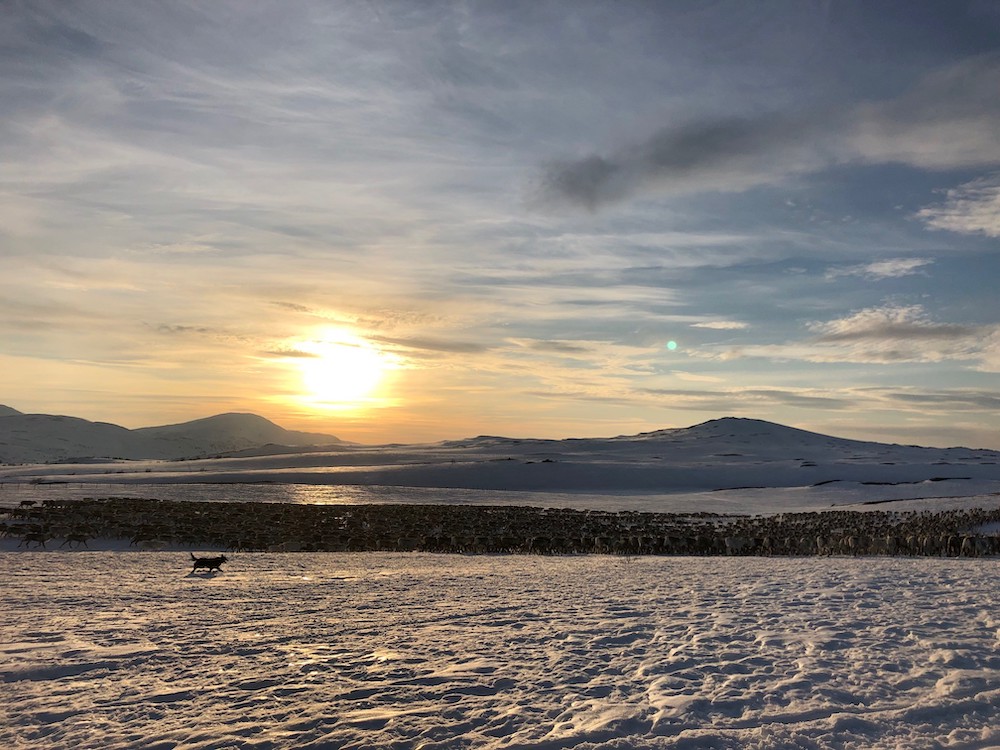
Saemiestidh - to speak Sami
The Sami language area extends across all the countries that have shared Saepmie between them, across parts of Norway, Sweden, Finland and Russia. The boundaries of the languages do not follow national borders. The Sami language belongs to the Finno-Ugric language group. There are 10 different Sami languages, with South Sami being the southernmost. There is a marked difference between South Sami and the other Sami languages.
On UNESCO's list of endangered languages, South Sami is classified as a seriously endangered language. Few users and long distances make it demanding to conduct South Sami language work. Society has a great need for people with expertise in South Sami. This applies in particular to the teaching profession, the development of teaching materials and in public administration and service provision.
The stress in Sami words is always on the first syllable. Sami is a verbal language in the sense that, as a means of communication, it is concerned with the verb, the action. Because the stem of the word can be used to derive several meaning-changing and clarifying endings, the language allows for almost endless variations in, for example, the description of movements.
Vytnesjidh - to do needlework, carpentry
Skills and the connection to cow dung is important to the Southern Sami. Vætna includes utilitarian objects, performing arts and a symbolic language that represents the Sami way of life and worldview. A Sami way of life in which you don't take more than you need for the moment and in a way that does not impair access. Southern Sami ornamentation has a predominantly geometric character. The patterns are made up of geometrically straight lines, with braid patterns, star patterns and borders. Ornamentation, i.e. drawing, engraving or the use of pewter and beads, is practical, aesthetic and communicative. It is particularly associated with crafts, skis, sledges, harnesses and vehicles, tools, clothing or handicraft products. The materials are traditionally wood, horn, bone and leather. Fibre, roots, wood and marbles are used for the wood. From the reindeer, leather, horns, bones, tendons for cow dung and the rest is eaten.
Byöpmedidh - to eat
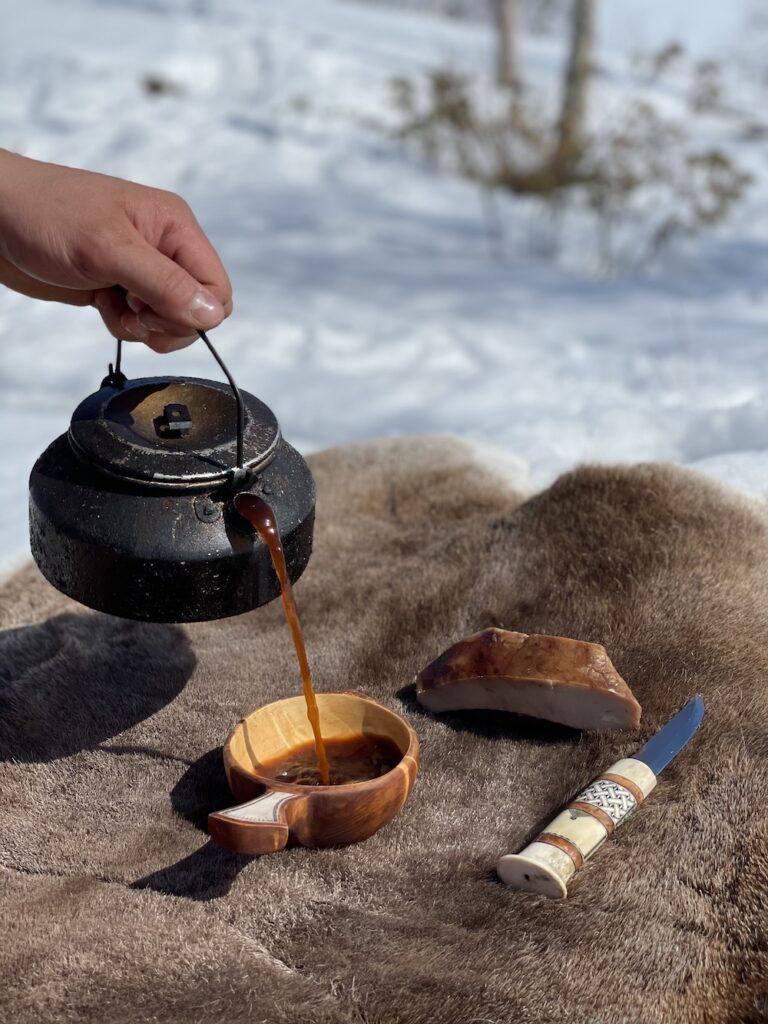
Besides eating what the reindeer provide, fish and berries are everyday food. Moose and reindeer meat can be boiled and roasted or salted, smoked and dried for preservation. Plants in the local environment are used for food, medicine, craft materials and insulation.
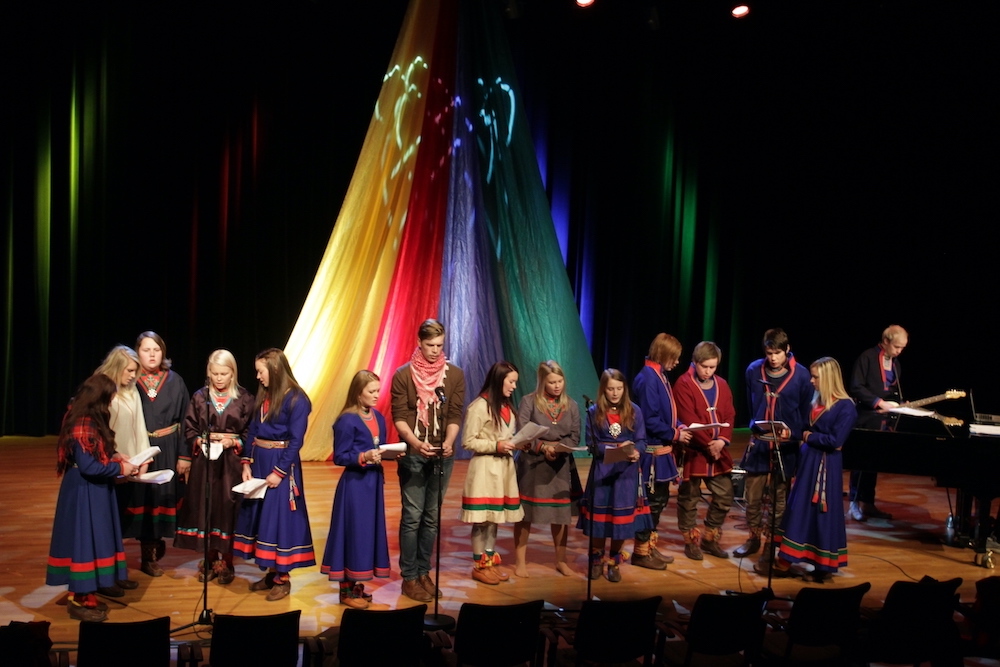
Pedestrianised - Getting dressed
The South Sami costume traditionally consists of a hip- or knee-length kirtle, yawn. Traditionally, it is blue and has coloured bands around the wrists and neck opening. Gapta is largely the same throughout the South Sami area, with some variations between districts and families. The most obvious variation is that the costumes from the Røros and Härjedal area have a chequered pattern on the breastplate, while the costumes from Vefsn, Namdalen, Västerbotten and Jämtland have a semi-circular breastplate.
Dovletje aejkiej - in the old days
The history of the Southern Sami can be broadly divided into three periods: hunting communities, intensive reindeer herding nomadism and extensive reindeer herding. The period of reindeer herding nomadism is thought to have begun late in the Middle Ages, around 1200-1400. The end of reindeer herding nomadism is usually associated with the cessation of reindeer milking, which in Norway occurred between 1902 and 1964.
Traditionally, the Sámi reindeer grazing areas, including in the South Sámi area, have been independent of national borders. When the border between Norway and Sweden was drawn in 1751, the conditions for reindeer herding were clarified in the Lapp Codicil, which was an addition to the border treaty between the two countries. The Lapp Codisil provided the basis for reindeer herding to continue with seasonal migrations between the two countries.

Norwegianisation policy is a term used to describe the public policy pursued by the Norwegian authorities to assimilate the Sami into Norwegian society. For about 100 years, from around 1850, the official Norwegian policy was that the Sami should be assimilated into Norwegian society.
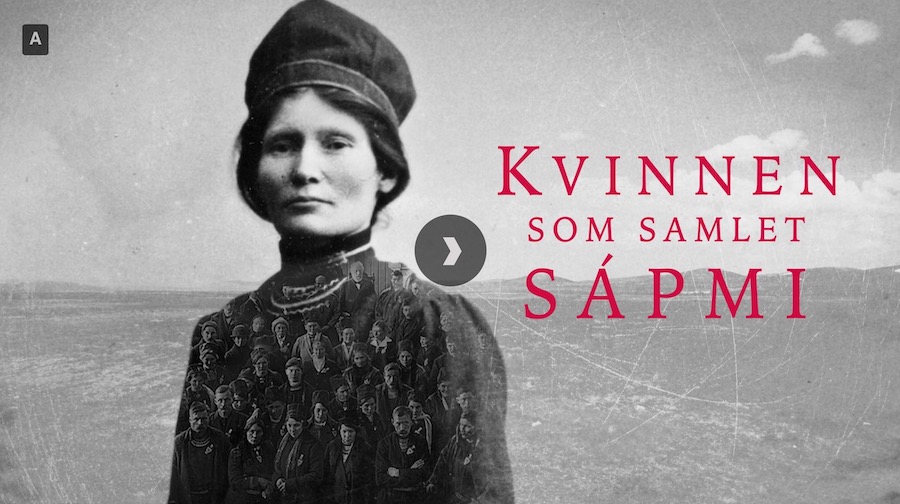
The first Sami civil society organisation in Norway was Brurskanken Sami Women's Association in Vefsn, founded in 1910 on the initiative of organisational pioneer Elsa Laula Renberg. In the early part of the 20th century, there was a great deal of Sami political activity, which resulted in the first international Sami meeting in Trondheim in 1917.
Daan bejjien - today
Today, the official position is that the state of Norway is founded on the territory of two peoples - the Sami and the Norwegians. Both peoples have the same right to develop their culture and social life.
Today, Sami parliaments have been established in both Norway and Sweden, as well as South Sami institutions such as schools, museums, theatres and language centres. They are located throughout the South Sami area.
Baakoeh - word
Tjoejkedh - go skiing
Tjoekedidh - keep on skiing
Tjoejkehtalledh - keep on skiing after
Tjoejkehtehtedh - run up
Tjoekehtidh - go skiing after
Tjoejkehtæjja - someone who skis after reindeer
Tjoejkelidh - set off on skis
Tjoejkestidh - hurry up and run; take a little ski trip
Tjoejkijidh - setting off on skis
Watch the film: Elsa Laula Renberg - The woman who united Sápmi, NRK