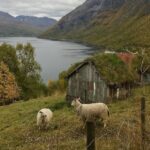
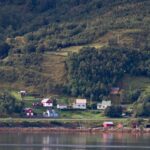
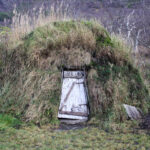
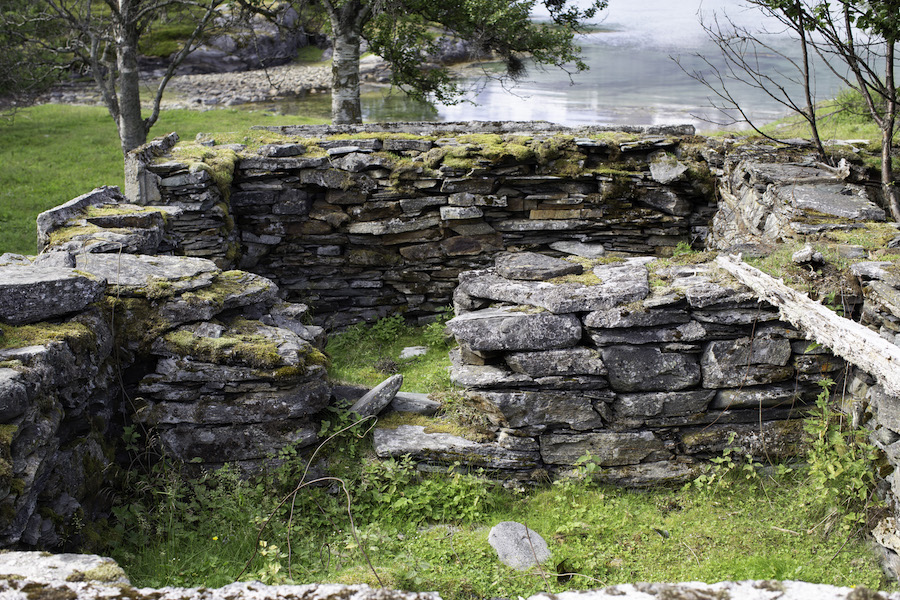
Årøya lies in the Lyngenfjord. The island has probably been inhabited or visited since the Iron Age. On the island there are several foundation walls and remains of earlier settlements. These bear witness to several centuries of farming, trade and defence activities. In the 1950s, the island was acquired by the defence forces. Until 1 July 2006, there was a traffic ban for civilians on the whole of Årøya.
Text: Tania Lopez
We know that Iron Age people landed on Bunkholmen in connection with the ceremonial burial of bears, and it is therefore assumed that Årøya must have been inhabited or visited already in the Iron Age.
Settlement on Årøya is recorded from the beginning of the 17th century, when the lieutenant of the time collected taxes for the Swedish king. The goods handed in were eiderdown, cod liver oil, fur and stockfish. Later in the 17th century, it was the parish priest of Karlsøy who had the rights to use the island, and the island then had several users.
Stopping point for bartering
In the 18th century, during the Russian Pomor trade, Årøya became a stopping point for barter between people in the northern regions. The Russian traders brought grain products with them, which they exchanged for fish. Vågen had become a trading centre and inn. A family with a large household (including maids and servants) now lived here, running the trading centre and farming for their own use.

Plenty of natural resources
Just like today, there were plenty of natural resources on Årøya. In 1805, the owner of the island was fed up with others going ashore and exploiting the natural resources. He had the area gazetted and protected for his own use. It was forbidden for others to collect firewood, leaves, grass, cloudberries, eggs, down, feathers and to hunt birds, and otherwise to collect «anything else that can be mentioned».
In 1867, scheduled traffic to Årøyholmen was established and the island got a post office. Gradually, more households were added, with families living from fishing and animal husbandry. Sommersetet on the north-west side was registered as a settlement in 1877, and Storbukta and Holmenden in 1880. In the censuses carried out at this time, the people living on Årøya are registered as Norwegian, Sami and Kven. Some people are registered with mixed ethnicity.
Due to a shortage of fuel (coal) during the First World War, demand for peat increased. Labourers were then hired to stack peat, dry it and transport it to Birtavarre Gruber in Ankerlia.
The two people who owned Årøya farmed and fished. In 1931, more families arrived on Årøya. The west side of Årøya is known for having good fishing spots, and in the 1940s children aged 8-9 could row from Manndalen to fish for small saithe at Årøya.
Foundations and defences
During the war in 1942, the Germans built a new foundation wall outside the original foundation wall at Vågen, and erected a youth centre they had transported from the mainland on top of it. This became the Germans' command centre. They also built a birch timber quay on Vågen. There were a total of 750 Russian prisoners of war on Årøya and Rottenvik, and the prisoners started work on building a defence facility on the north side of the island. During the war, five families lived on Årøya. They were evacuated in the autumn of 1944, but the families returned after the end of the war. After the war and until the 1960s, a total of 25 people lived on Årøya.

Defence takes over the island
During the rearmament of the Cold War, the Norwegian Armed Forces expropriated the island in 1976 and closed it to all civilian traffic. The Norwegian Armed Forces continued to build on the defences constructed by the Germans during the war with bunkers and new weapon positions. Årøya was reopened to the public when the municipalities of Lyngen, Storfjord and Kåfjord bought it in 2005. Today, traces of settlement can still be seen in Vågen, Sommarsetet, Storbukta and Holmenden.
Current links
Lyngen: Årøyholmen, ishavskysten.no
Management plan for Årøyholmen 2017-2021, pdf
Årøyholmen is released by the defence, NRK 2004