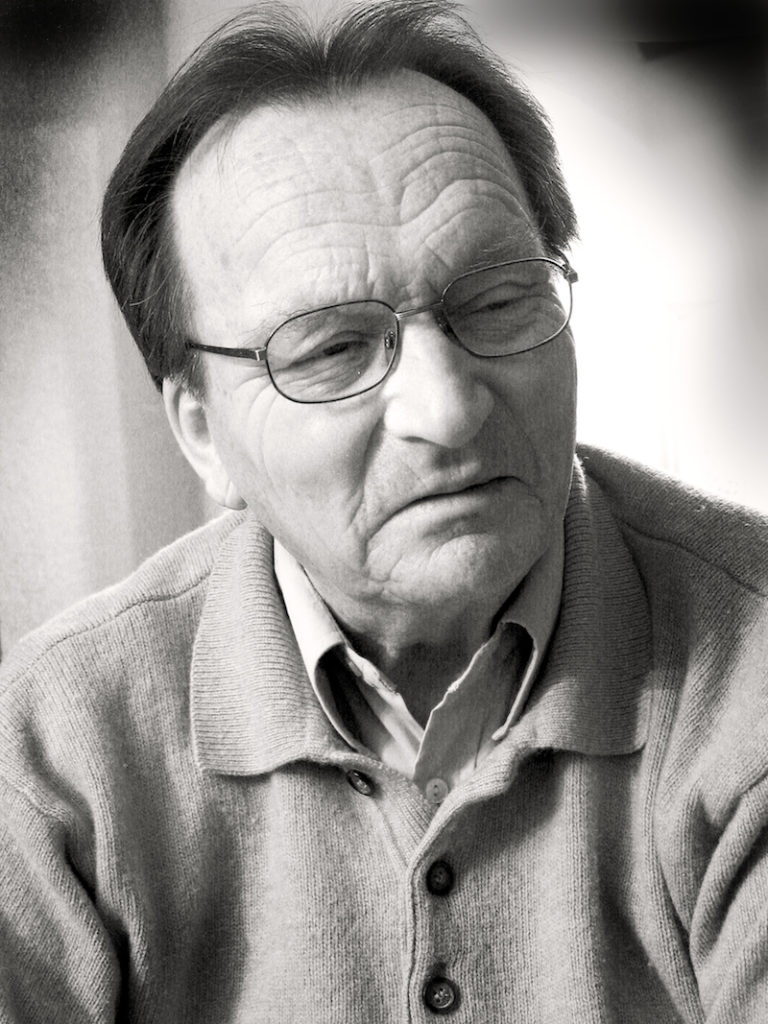
Alf Nilsen-Børskog was the first novelist to write in Kven. His books are said to be a tribute to the Kvens and their culture.
Text: Kaisa Maliniemi
In 2004, Alf Nilsen-Børsskog's Kuosuvaaran takana, the first instalment of his novel series Elämän jatko [Continuation of life]. The novel was published a year before Kven was recognised as a separate language in Norway. Since then, Nilsen-Børsskog's novel has played an important role in the standardisation of the Kven language. The Kven grammar was finally published in 2014. Alf Nilsen-Børsskog was the first novelist to write in Kven.
Nilsen-Børsskog was born in the Kven-speaking village of Børselv in Kistrand municipality (Porsanger today) in 1928. Nilsen-Børsskog had to interrupt his schooling when the war began, which affected most of his generation in Kistrand. However, he was still interested in acquiring knowledge and enrolled as a private student at the primary school in Alta. He later took his A-levels in Bodø. In 1969, he graduated as a teacher from the seminary in Tromsø. He also studied Finnish, Sami, English and history at the University of Oslo. After graduating, Nilsen-Børsskog worked as a teacher in Kirkenes, Nordreisa, Nesseby, Kautokeino and Karasjok. When he retired, he moved to his home village of Børselv and began writing books.
Nilsen-Børsskog was bilingual. However, he chose Kven as his writing language despite the fact that he would have had more readers if he had written in Norwegian. He said that «Mie en valinnut kieltä, kieli valitsi minut» / I didn't choose the language, the language chose me. Kven was his heart language, he believed. However, Nilsen-Børsskog had to struggle for several years to get funding for his novels before he finally succeeded in 2004.
Merete Eidstø has conducted a major study of Nilsen-Børskog's writing. She believes that his books can be said to be a tribute to the Kvens and their way of life. The author himself says that the environment in which he grew up, together with his parents and the spiritual heritage of the village, has had a major impact on his later life. He has learnt to respect justice and independent thinking, which is reflected in his production. In addition, his home was characterised by Laestadianism. These traits emerge in his novels. However, Nilsen-Børsskog did not choose his parents' religious views, but became interested in philosophy and humanistic ideas.
Äitin sanat - Mother's words
When 72-year-old Alf Nilsen Børsskog sat down to write his first novel, he encountered a very special problem. In order to fulfil his lifelong dream of writing a series of novels in his mother tongue, he had to create a written language himself. A film by anstein Mikkelsen.
In 2010, Alf Nilsen-Børsskog was awarded Porsanger municipality's cultural prize. The reason for the award was that he has helped to strengthen the Kven language in the three cultures of Porsanger, and that he has helped to preserve the special character that makes up the soul of Porsanger. Alf Nilsen-Børsskog died in 2014.
Novel series Elämän jatko
Kuosuvaaran takana is a story of survival during a historically difficult period in the history of Northern Norway. The events take place in the autumn of 1944 and the winter of 1945. The people of Børselv must survive both materially and spiritually. They have to flee from the German enemy to Kuosuvaara, which is a mountain in the Børselv area. They have little food with them, so they have to resort to nature. The story reveals that the more difficult the conditions, the stronger the sense of community among the Kvens becomes.
The second novel Aittiruto Come 2008. Here, the refugees have come to Aittiruto. There the refugees meet two Sami people: Elli and Piera. They stay in Aittiruto over the winter. Most of the novel describes the time as bleak and dark. It seems that the war will never end. The winter is long and dark. But when spring arrives and nature begins to awaken, optimism among the refugees also rises. Nature plays a major role in Nilsen-Børsskog's novels. It can be harsh and merciless, but it can also provide food and security for refugees. Such descriptions can also be found in other Kven novels.
In autumn 2011, the third part of the Elämän jatko-series: Rauha [Fred]. As the title suggests, the story centres on the post-war period. The last novel in the series was published in 2015, one year after Børsskog's death.
Poetry collections
Nilsen-Børsskog has also published poetry collections. The first, Muistoin maila was published in 2008. Two years later in 2010, three poetry collections were published: Poiminttoi (2010), Korrui tien varrela (2010), Älä unheeta minnuu (2010) and Merimies muistelee (2013). Common themes for all these collections are war, nature, memories of youth and, not least, love.
Current links
Contributes to the richness of the Kven language even after his death, NRK 2019