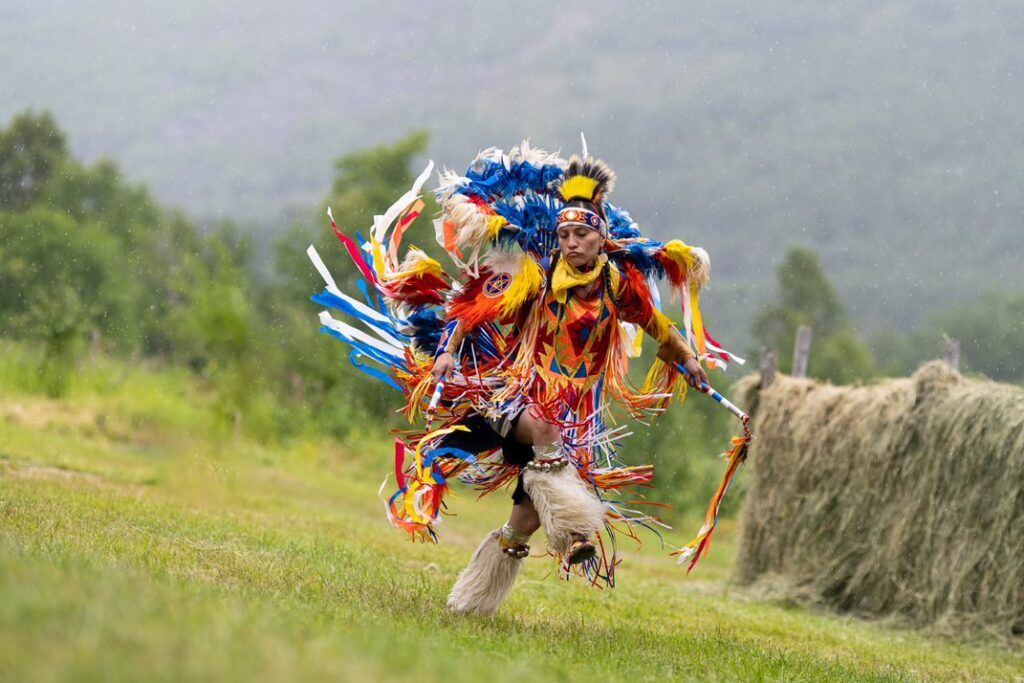
The Lakota people were Northern People of the Year in 2023.
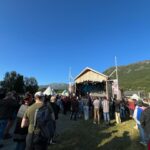
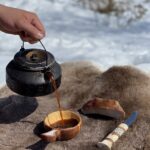
Every year, Riddu Riđđu invites an indigenous people to the festival by virtue of being the Northern People of the Year. In 2023, they were able to showcase the Lakota people, who are part of the Oceti Sakowin («seven hearths») confederation. In this year's Riddu Riđđu, the focus was especially on the cultural expressions of the Lakota people. Things like dancing, singing and drumming were an important part of Riddu Riđđu this year. They were also able to tell their own stories and share their knowledge with festival participants. They were also able to tell and teach about the historical and cultural significance of traditional Lakota food.
Language: The Lakota people have their own language, which is used by many today and is extremely important in religious and other rituals. It is considered wakan, meaning «very powerful».
The Lakota people in the past: The Oceti Sakowin («seven hearths»), of which the Lakota are one of the seven nations, migrated from the southeastern part of North America to the Minnesota region around 1000 A.D. In the 1700s, the Lakota moved west to the Great Plains, where they lived in teepees and hunted buffalo.
During the 18th century, the Lakota were divided into seven groups: Oglala, Sicangu, Hunkpapa, Mnikowoju, Itazipco, Oohenunpa and Shisapa. The Lakota had alliances with the Cheyenne and Arapaho, but were also in conflict with other groups in the region. From 1778, the mountain range located in Wyoming and South Dakota, the Black Hills, also became the centre of the Lakota region. But during the 1870s, gold was found in the Black Hills and people invaded the area to mine gold, but ended up in war with the Lakota people. This was a violation of the treaty between the US government and the Lakota people. In 1876, during the Battle of Little Big Horn in Montana, Lieutenant Colonel George Armstrong Custer and the Seventh Cavalry were wiped out by the Cheyenne and Lakota, led by Crazy Horse and Sitting Bull, just to name a few.
After the Red Cloud Wars of the 1860s, in which indigenous nations in North America militarily defeated the United States for the first time, the Lakota were awarded the Great Sioux Reservation (Fort Laramie Treaty of 1868). An area equivalent to about half of South Dakota, some of Nebraska and Wyoming.
The situation of the Lakota people today: Despite many attempts to suppress the Lakota people, both language and culture have survived to this day. Despite various problems on the reservations, the traditional Lakota culture and language are alive and well. The Lakota are known as organisers of powwows, and are very active in politics and various AIP (American Indian Programs) on and off the reservations.
Video from Riddu Riđđu 2023
Written by Isak Kvitfjell